
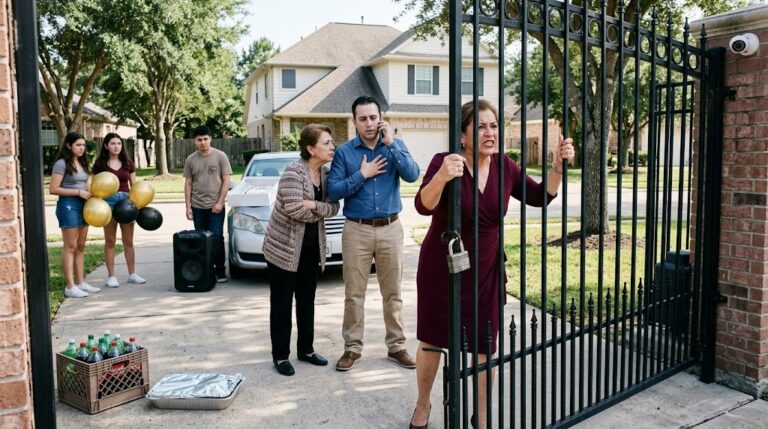
I was sitting in a diner across the street with a coffee going cold in front of me, watching my mother-in-law lose her mind at my locked gate.
“Why is the gate locked?!” Ofelia screamed, loud enough to carry through the camera feed and probably through the diner window too.
My husband called me thirty seconds later.
“Mariana, where are you?” Sergio snapped. “We’re all here. We have the cake, the food, my aunts drove an hour. What is going on?”
I looked down at the live feed on my phone. All of them were there — Ofelia in a wine-colored dress clutching her oversized purse like she already owned the place. Sergio sweating through his shirt. Two nieces blowing up gold balloons. A cousin hauling a speaker like this was going to be the celebration of the year.
Like they had already decided the house was theirs.
“Put me on speaker,” I said.
Pause.
Silence.
I could feel every head turn.
“I want everybody to hear this,” I said. “Because no one is stepping foot inside my house today. And your whole family is finally going to find out what you and your mother have been trying to do.”
The line went so quiet I could hear wind moving through the trees near my driveway.
I leaned back in the diner booth, looked out the window at that locked gate, and began.
Part 2: What Was Mine, and How She Decided It Wasn’t
The house was never the “family home,” no matter how many times Ofelia called it that at Sunday dinners and neighborhood get-togethers and loud conversations on the front porch designed for the neighbors to overhear.
My father built that house in 1987 on a corner lot in a quiet part of town. He worked construction for thirty-one years, saved every dollar he could spare, and poured all of it into a two-story colonial with a wraparound garden and a wrought-iron gate he installed himself in his late fifties because he said it made the place look like it had standing.
He left me half the property when he died eight years ago.
The other half I paid off over four years, on my own, while working as an accounts manager for a logistics company and picking up freelance bookkeeping on weekends. I closed on the final payment fourteen months before I met Sergio at a mutual friend’s birthday dinner.
I want to be precise about that timeline. Before any ring. Before any shared address. Before any last name hyphenated on any document.
That house was mine.
Sergio knew this when we got together. We talked about it plainly early on. He said he respected it. He said it was one of the things he admired about me — that I had built something real and protected it.
Ofelia found out the deed was in my name alone about three months into our marriage.
The temperature changed immediately.
It started with comments. Small ones, positioned carefully in front of an audience so I couldn’t challenge them without looking difficult.
“My son’s family has rights too,” she’d say at the table, to her sisters, to the neighbor asking about the new back fence. “A wife and husband share everything. That’s what marriage means. That house belongs to all of us now.”
I corrected her twice, directly and calmly.
Sergio asked me afterward to let it go.
“She’s old-fashioned,” he said. “She doesn’t mean anything by it.”
But Ofelia was not old-fashioned. She was strategic. There is a difference, and it took me longer than it should have to stop confusing the two.
She let herself into my house without warning on two separate occasions that I know of. The first time, I came home from work to find that she had rearranged my kitchen cabinets, swapped out the throw pillows on the living room sofa, and ordered new curtains — without a single word to me — because she had decided mine were not “elegant enough for such a nice room.”
The second time, I came home to find labeled food containers in my pantry in her handwriting. Stacked neatly. Like planted flags. Like she was marking the territory one shelf at a time.
When I confronted Sergio about the key situation — because she clearly had one — he was quiet for a long time before saying she had asked him for it “just in case.”
Just in case of what, Sergio never said.
I did not get the key back.
I changed the locks.
He was annoyed with me for a week.
Part 3: The Night I Found Him at My Desk
One week before Ofelia’s sixty-fifth birthday, I came home from work forty minutes earlier than expected.
The house was quiet. The lights in the hallway were low. I set my bag down at the front door, walked through the kitchen, and pushed open the door to my home office.
Sergio was at my desk.
My desk. The one that sits in the corner of the room I had converted from a spare bedroom, where I kept my freelance client files, my father’s estate documents, and a locked fire-safe box containing the original property deed and the paid-off mortgage paperwork.
The fire-safe box was open.
A manila folder was in his hands.
His face went the color of old concrete when he saw me.
He closed the folder. Slowly. Like a man who understood the specific weight of being caught but was still deciding which version of the truth to try.
“What are you doing?” I asked.
“Nothing,” he said. “Just looking at some papers.”
“What papers?”
He waited too long to answer. That pause — that specific, calculating pause — told me everything his words were going to try to undo.
“My mom thinks,” he said finally, “that it would be better if the house was in both our names. For security. The way it usually is when people are married.”
I stood in the doorway of my own office and looked at my husband sitting at my desk with my documents in his hands.
I did not feel the anger I expected.
I felt something colder.
Something focused.
Clarity is the only word for it — the specific, almost physical sensation of a fog lifting at the worst possible time and leaving everything lit up and sharp underneath.
I said nothing.
I walked to the kitchen. Made tea. Ate dinner. Watched television.
And that same night, after Sergio fell asleep, I texted my attorney, Ricardo Saldaña.
The next morning, while Sergio was at work, Ricardo walked me through my options in a forty-minute phone call. I took notes in a new notebook I had bought specifically for this conversation.
Then I called a locksmith. New locks on every door, including the office. Deactivated every gate remote I had not personally programmed. Had a second camera installed inside the office doorway — discreet, angled at the desk.
I did not mention any of it to Sergio.
I did not mention any of it to anyone.
I simply moved through the following week in my own house as if nothing had changed, and I waited to see what they would do next.
What they did next was show up to a birthday party.
Part 4: The Gate. The Speaker. The Conversation Nobody Saw Coming.
Ofelia had announced three months earlier — not asked, announced — that she wanted her sixty-fifth birthday celebration at my house.
“There’s more room,” she said. “The garden looks beautiful in photos. It’ll be perfect.”
I said no.
Sergio said: It’s one day, babe. Do it for me.
I said no again.
I did not explain myself further than that. I did not owe an explanation. It was my house.
What I didn’t know then — what Ricardo confirmed for me in the days after I found Sergio at my desk — was that the party had never been only a party.
Ofelia had a plan.
Ricardo, who has twenty-two years of family law experience and a particular talent for reading patterns, explained it to me carefully.
The party was to establish precedent. Photographs of the family celebrating in the space. Witnesses who could later say the house had always functioned as a shared family property. A paper trail — however thin — that she could use to support a future claim, particularly if Sergio filed for any kind of property co-ownership petition.
It was not paranoid speculation.
Ricardo had seen the same approach used in two prior cases.
Ofelia was not old-fashioned.
She was methodical.
So when I saw them all arriving on the camera feed that morning — the cake, the balloons, the aunts, the speaker, the confidence of people who had been told the gate would be open — I finished my coffee, picked up my bag, and walked across the street to the diner.
I ordered a coffee I didn’t need.
And I watched the feed and waited.
When Sergio put me on speaker, the driveway went quiet enough that I could hear the balloon strings rustling.
I spoke slowly. Clearly. The way Ricardo had coached me to speak when the moment came.
“Three weeks ago,” I said, “I found Sergio going through my property documents at my desk. When I asked him what he was doing, he told me his mother thought the house should be in both our names.”
The silence from the speaker had a specific texture.
“That house,” I continued, “belonged to my father. He built it. He left half of it to me. I paid off the other half before I ever met your son. There is not a single dollar of Sergio’s money in that property, and there never has been.”
I heard one of the aunts say something low and sharp in Spanish.
“Ofelia has a key she was never given permission to have. She has entered my home without notice at least twice that I know of. She has moved my belongings, ordered renovations she didn’t pay for, and told this neighborhood and her own family that my house belongs to all of you.”
I paused.
“It doesn’t.”
Ofelia’s voice came through high and strangled. “You are embarrassing this family in front of everyone — “
“You tried to take my home,” I said. “In front of everyone.”
Sergio said my name once. Low. Careful.
“Ricardo Saldaña filed the injunction this morning,” I said. “Any attempt to access, claim, or legally contest the property will be met with the documentation he has already prepared. The locks were changed three weeks ago. The gate remotes were deactivated three weeks ago. Today was not a surprise to me.”
I could hear one of the nieces asking someone what an injunction was.
I could hear the aunts piecing it together.
I looked at the feed. Sergio had stepped away from the group. He was standing at the far edge of the driveway with his back to the gate, one hand pressed flat against the back of his neck. The posture of a man dismantling something in real time.
“The party isn’t happening today,” I said. “And until Ricardo and I have had a conversation with Sergio and his attorney, nothing about this situation changes. You’re welcome to take the cake somewhere else.”
I ended the call.
I finished my coffee.
I left a $6 tip for the waitress who had very kindly pretended not to hear any of it.
The Aftermath: What Came After the Gate
Sergio called me eleven times that afternoon. I let every call go to voicemail and forwarded the messages to Ricardo.
He came to the house the following morning. He sat in the kitchen — the kitchen his mother had rearranged without permission — and he cried.
He said he hadn’t understood how far his mother had taken it. He said he thought putting the house in both names was just a practical suggestion, not the first step in something larger.
I listened to all of it.
I believed parts of it.
But believing someone didn’t understand the depth of what they did is not the same as deciding it doesn’t have consequences.
Ricardo and I met with Sergio and his attorney two weeks later. We established, in writing, the full legal status of the property. No shared claim. No co-ownership filing. No precedent of any kind.
Sergio signed it.
His attorney told him it was the correct decision.
Ofelia did not come to that meeting. She has not spoken to me since the morning of the gate.
Sergio and I are in counseling. We are not done, but we are not fixed either. Some things, once you see them clearly, you cannot unsee. That is not a metaphor. That is the actual mechanical problem with clarity — it is permanent.
The gate remote in Sergio’s possession now opens nothing.
He accepted that without argument.
Last Saturday I spent the afternoon in the garden my father built — pruning the hedges, pulling weeds from the corner bed, sitting on the back steps with a glass of iced tea while the light came through the trees the way it always has on quiet late-afternoon days out there.
My father’s wrought-iron gate stood at the end of the driveway, locked, the way he always kept it.
The way I intend to keep it.

Evan Cole Editor-in-Chief | Breaking News & Public Policy
“From Washington to Wall Street, and Main Street to Hollywood—Evan Cole connects the dots.”
As the Editor-in-Chief at Newskilo, Evan leads a dynamic team of journalists dedicated to uncovering the truth behind the headlines. With over 15 years in digital media, Evan has a reputation for cutting through the noise.
While he is widely recognized for his deep analysis of U.S. fiscal policy (IRS & Stimulus), Evan’s expertise extends to global current events, corporate accountability, and cultural trends. Whether he is breaking down a complex government bill, exposing a tech giant’s failure, or analyzing the societal impact of a viral celebrity moment, Evan’s goal is simple: To tell the stories that shape our world with clarity, accuracy, and integrity.
Leave a Reply