
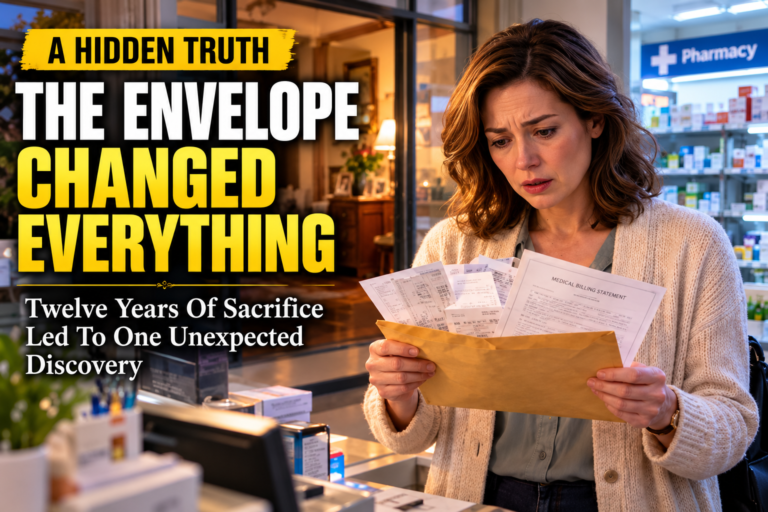
For twelve years, I helped take care of my husband’s mother because I believed that was simply what family did.
I paid bills, picked up prescriptions, drove her to appointments, and handled countless small things that nobody thought to keep track of. I never expected praise or repayment.
Then, a few days after she passed away, a pharmacy called and told me they had an envelope with my name on it.
Inside were years of receipts, a notarized document, and a message from my mother-in-law that forced me to question not only my in-laws, but also the marriage I thought I understood.
The envelope looked completely ordinary.
It was pale and slightly wrinkled, the kind of envelope a pharmacy might use for paperwork that didn’t fit inside a regular bag.
My name was written across the front.
Not my husband’s.
Mine.
I stood at the kitchen counter staring at it before I finally opened it.
Three days earlier, I had been standing in that same kitchen trying to make coffee while thinking about my mother-in-law’s house.
Her name was Evelyn.
She had passed away after a long period of declining health, at home and surrounded by familiar things. She had wanted to remain there, and we had done everything we could to make that possible.
For twelve years, I had been deeply involved in her day-to-day care.
I knew which pharmacy had her prescriptions ready.
I knew which bottles were nearly empty.
I knew which purchases could wait and which ones needed to be handled immediately.
And for most of those years, I had paid for a large share of it.
It hadn’t started that way.
At first, it was a small expense here and there.
A prescription.
A medical supply.
A ride across town.
Something Daniel and I could easily absorb into our monthly budget.
Then the costs gradually increased.
Daniel would tell me his brothers couldn’t contribute much.
I would cover the difference.
Eventually, it became normal.
I never created a spreadsheet.
I never sent anyone a bill.
I never sat Evelyn down and explained exactly how much I had spent.
She was family.
That was all the explanation I thought I needed.
At least, that’s what I believed.
The day after Evelyn passed, Daniel and I went to her house to help with practical matters.
I expected sadness.
I expected awkward conversations.
I expected everyone to be tired and emotional.
What I didn’t expect was the way her sons immediately began dividing up her belongings.
Mark was opening drawers.
Scott was looking through cabinets.
Pieces of tape had appeared on furniture as people quietly decided what they wanted.
I stood in the hallway holding a laundry basket and watched it happen.
At one point, I asked about one of Evelyn’s pieces of jewelry.
Mark answered immediately.
“That stays with the family.”
I stared at him.
“I’m family too.”
He gave me a polite smile.
“You know what I mean.”
I did.
That was what hurt.
I understood exactly what he meant.
I had spent twelve years showing up for their mother, yet somehow, when there was something valuable to divide, I suddenly felt like an outsider.
I didn’t argue.
I went home.
Then the pharmacy called.
The woman on the phone explained that some of Evelyn’s belongings had been returned after the family collected what was left at the pharmacy.
There had been an envelope inside.
My name was on it.
They weren’t comfortable throwing it away.
So I drove over and picked it up.
Now I was standing in my kitchen, surrounded by receipts.
There were dozens.
Some were faded.
Some were folded.
Some had handwritten notes on the back.
The dates went back years.
I recognized the pharmacies.
I recognized the amounts.
I remembered the circumstances behind many of the purchases.
Then I found the notarized document.
It was only a couple of pages.
I read the first paragraph.
Then I read it again.
My full name appeared near the beginning.
At the bottom was Evelyn’s signature.
Beside it was a notary stamp.
And there was a section that made my stomach tighten.
I called Daniel.
He answered after several rings.
“Hey. What’s wrong?”
“I found something at the pharmacy.”
There was silence.
Not the kind of silence that comes from confusion.
Something else.
I immediately knew he understood more than he was saying.
“Daniel?”
“I’m here.”
“You knew about this?”
Another pause.
“What did you find?”
I almost laughed.
“That isn’t an answer.”
“I just want to know what the paper says.”
“You already know.”
“I haven’t seen it.”
“Then why did you go quiet?”
He exhaled.
“Can we talk about it when I get home?”
“No.”
The word came out before I had time to reconsider it.
For twelve years, I had made things easier for him.
I had paid without asking too many questions.
I had accepted explanations.
I had avoided difficult conversations at his mother’s house because I didn’t want to add stress to an already complicated situation.
But something inside me had finally reached its limit.
“I want you to tell me now.”
“Claire, please.”
I looked down at the receipts scattered across the table.
“You told me your brothers couldn’t afford much.”
“They couldn’t.”
“You told me your mother needed help.”
“She did.”
“You told me nobody expected me to keep paying.”
Daniel hesitated.
“I never expected—”
“You asked me to.”
He stopped.
Neither of us spoke.
We had been married for fourteen years.
Our life had never been extravagant.
We had a modest house, two dependable cars, ordinary routines, grocery lists, weekend breakfasts, arguments about money, and all the little things that make up a normal marriage.
I had always believed those ordinary things meant we knew each other.
Now I wasn’t so sure.
“What did my mother write?” Daniel finally asked.
“I’m not reading it to you.”
“Claire.”
“You can read it yourself when you get home.”
“I’ll be there.”
He arrived less than an hour later.
He walked into the kitchen without taking off his coat.
His eyes went straight to the papers.
He pulled out a chair.
“Show me.”
I slid the notarized document across the table.
He read the first paragraph.
His expression changed.
Not dramatically.
He didn’t gasp.
He didn’t ask what it meant.
His shoulders simply dropped.
“You knew,” I said.
He rubbed his forehead.
“I knew there was a document.”
“How long?”
“A few years.”
I stared at him.
“Why didn’t you tell me?”
“It wasn’t supposed to happen like this.”
“What wasn’t?”
He looked toward the window.
“My mother wanted to make sure you were protected.”
I almost smiled.
“Protected from what?”
“My brothers.”
That answer only created more questions.
Daniel explained that Evelyn knew Mark and Scott had very different ideas about her finances and her property.
She had also known that I had been covering far more of her expenses than either brother realized.
“What exactly did she want to protect me from?” I asked.
Daniel looked at the receipts.
“From carrying something that should have belonged to the whole family.”
That was when I finally understood what the document said.
Evelyn had kept records of the money I had spent on her prescriptions, supplies, transportation, and other necessary expenses.
She had instructed that those documented costs be reimbursed from her estate before the remaining property was distributed.
But the financial arrangement wasn’t the part that affected me most.
It was the letter attached to it.
Evelyn had written that she never wanted me to believe her gratitude could be measured in dollars.
She knew I had helped because I loved her.
But she also believed love should never become an excuse for allowing one person to quietly carry an entire family.
Then came the sentence that stopped me.
She wrote that someone who had spent years carrying a family should not be treated like an outsider when the responsibility was finally over.
I looked at Daniel.
“Did your brothers know?”
“No.”
“Did you?”
“Yes.”
“How long?”
He didn’t answer.
He didn’t need to.
The next morning, Daniel asked me to return to Evelyn’s house with him.
I almost said no.
Then I remembered Evelyn’s words.
I decided to go.
But I made one thing clear.
“I am not going there to fight with your brothers.”
Daniel nodded.
“I don’t want you to.”
“I’m going because I want to understand what your mother intended.”
We arrived late in the morning.
Mark’s truck was already outside.
Scott’s car was beside it.
We sat in the driveway for a moment before going inside.
The house looked exactly as it had for years.
White curtains.
The old bench by the front door.
The flowerpot Evelyn always cared for.
I had brought groceries there during bad weather.
I had driven her to appointments.
I had sat beside her while she sorted mail and clipped coupons.
I had spent countless hours in that house.
Yet now I felt like a visitor.
Daniel opened the door.
Mark appeared from the living room.
“What are you doing here?”
“We need to talk,” Daniel said.
Mark looked at me.
“About what?”
Daniel took out the notarized document.
Mark’s expression changed immediately.
“Where did you get that?”
“The pharmacy.”
Scott came into the room.
“What is it?”
Daniel placed the document on the dining table.
“Mom left instructions.”
Scott picked it up.
He read silently.
Then he looked at Mark.
“What is this?”
Mark shook his head.
“This doesn’t mean anything.”
I finally spoke.
“Why not?”
“Mom wasn’t thinking clearly.”
Daniel’s expression hardened.
“She signed it in front of a notary.”
“That doesn’t prove anything.”
I looked at Mark.
“Did you know I paid for her prescriptions?”
He shrugged.
“Everybody helped.”
“No,” I said. “Not everybody did.”
Scott looked uncomfortable.
Mark crossed his arms.
“How much are we talking about?”
Daniel answered.
“Twelve years.”
Mark stared at me.
“Why didn’t you keep records?”
I almost laughed.
“I did.”
I placed the receipts on the table.
His expression changed.
There were pharmacy receipts, supply purchases, transportation expenses, and other records.
Evelyn had kept many of them.
For years.
Scott sat down.
“She planned this?”
“She planned to reimburse Claire,” Daniel said.
Mark turned toward him.
“And you knew?”
“Yes.”
“You knew and said nothing?”
Daniel looked down.
“I didn’t want another family argument.”
Mark stared at him.
“You let us think—”
“I let you assume,” Daniel said quietly.
The room went silent.
Daniel finally explained that Evelyn had known for years how much I was contributing.
She had even asked him to make sure I understood that she appreciated it and didn’t expect me to continue carrying the responsibility forever.
He had promised to talk to me.
He never did.
When I asked why, he finally admitted the truth.
“I was ashamed.”
That answer surprised me.
He explained that he kept telling himself he would solve the problem.
He thought his brothers would eventually contribute more.
Then months became years.
Every time Evelyn needed something, I handled it.
He had become dependent on my willingness to help.
“You knew enough to let me keep doing it,” I said.
He closed his eyes.
“Yes.”
For the first time, there was nothing left for him to hide behind.
Then the doorbell rang.
An older woman stood outside carrying a leather folder.
She introduced herself as Margaret Ellis, Evelyn’s attorney.
She had known Evelyn for nearly twenty years.
She sat down with us and explained that Evelyn had given very specific instructions.
She wanted me to receive the receipts before the family began discussing the rest of the estate.
“Why?” Mark asked.
Margaret looked at him.
“Because your mother wanted Claire to understand that she had seen what she had done.”
She opened the folder.
There were account statements, property records, copies of legal documents, and another handwritten letter.
Evelyn had written about ordinary moments she remembered.
The first time I drove her to the pharmacy.
A rainy afternoon when I waited in the car while she picked up a prescription.
The cup of tea I brought her afterward.
Things I had completely forgotten.
Evelyn hadn’t.
Margaret explained that the estate included the house, several investment accounts, and other property.
The documented expenses would be reimbursed first.
The rest would then be distributed according to Evelyn’s estate plan.
Mark asked how much was involved.
Margaret gave him the approximate figure.
Nobody spoke.
It was considerably more than the brothers had expected.
I wasn’t excited.
I wasn’t relieved.
I was overwhelmed.
For twelve years, I had thought of those expenses as small acts of responsibility.
Now they were being turned into numbers.
That wasn’t what I wanted.
Margaret seemed to understand.
She looked at me.
“Your mother-in-law wanted you to know one thing.”
“What?”
“She knew.”
I looked down.
“She knew what?”
“She knew you were giving more than anyone understood.”
Then Margaret read a sentence from Evelyn’s letter.
She had accepted my help with gratitude, never entitlement.
I closed my eyes.
Suddenly I remembered all those years.
The pharmacy runs.
The rushed evenings.
The calls.
The purchases.
The times I had quietly rearranged our budget because Evelyn needed something.
I had never thought anyone was keeping track.
Apparently, Evelyn had been.
But she hadn’t kept the records to create a debt.
She kept them because she wanted me to know my effort mattered.
Then Margaret brought out one final document.
It concerned the house.
Evelyn had not wanted it immediately sold.
Instead, it would remain available for one year.
I would have the option to purchase it at a reduced value.
I stared at the page.
“Why would she give me that choice?”
Margaret smiled.
“Because she knew you never asked for the house.”
That was true.
I didn’t want someone else’s home simply because I had helped care for its owner.
I wanted fairness.
The house was different, though.
It held twelve years of memories.
Evelyn had taught me recipes there.
We had talked in that kitchen.
We had laughed.
We had disagreed.
We had built a relationship that had become real long before either of us officially called each other family.
After everyone left that afternoon, Daniel and I remained in the kitchen.
“I’m sorry,” he said.
“For what?”
“For letting you believe you were just helping.”
“You were helping too?”
“I thought I was.”
He admitted that he had allowed my generosity to become part of the family’s routine.
I looked at him.
“You depended on me.”
“Yes.”
“And you never seriously asked your brothers to contribute.”
“No.”
“Why?”
“Because I knew what they would say.”
That answer hurt more than I expected.
Not because it was new.
Because it explained years of our marriage.
Daniel avoided difficult conversations.
I often stepped in to keep things moving.
Eventually, my willingness to solve problems had become the reason he didn’t have to face them.
“Did your mother ever ask you to tell me about the document?” I asked.
“Yes.”
“When?”
“Three years ago.”
I stared at him.
“She knew?”
“She said if you kept carrying everything, you deserved to know that she saw it.”
“And you promised?”
“Yes.”
“But you didn’t.”
“No.”
I walked toward the window.
Outside, Mark stood near Evelyn’s old garden.
Daniel lowered his head.
“You protected the wrong thing,” I said.
“I know.”
That was when Mark came inside carrying a small wooden box.
“I found this in Mom’s bedroom.”
He put it on the table.
My name was written on top.
For Claire.
I opened it.
Inside was a photograph, a small key, and a note.
The note directed me to the blue drawer in Evelyn’s writing desk.
I went upstairs.
The drawer contained photographs, cards, letters, old bank envelopes, and a small velvet pouch.
The key opened it.
Inside was a simple gold pendant Evelyn had worn for years.
Beneath it was another letter.
She explained that the pendant had belonged to her mother.
She had once considered giving it to one of her sons.
Instead, she chose me.
Not because she loved her sons less.
Because she believed they had always known they belonged.
She wanted me to have something that reminded me family was not always defined by a last name.
Sometimes it was defined by the people who chose to stay.
I sat on the edge of the bed.
Daniel appeared in the doorway.
“I didn’t know about that.”
“I believe you.”
He sat beside me.
We looked through the photographs together.
Then I found one of myself and Evelyn at the kitchen table.
We were laughing.
On the back, she had written:
“She thinks she is helping me. She does not realize how much she has helped all of us.”
My eyes filled.
Daniel looked at the photograph.
“She loved you.”
“I know.”
“She knew you chose us.”
I looked at him.
He continued.
“Her sons were family because they were born into it. You became family because you stayed.”
That sentence made me uncomfortable.
Because I suddenly wondered how often I had mistaken endurance for love.
How many times had I stayed quiet because speaking up seemed selfish?
How many times had Daniel benefited from my willingness to keep things peaceful?
“I don’t know if staying was always the right thing,” I said.
Daniel nodded.
“I don’t either.”
It was perhaps the most honest answer he had ever given me.
When we returned downstairs, Mark and Scott had found another letter.
This one was addressed to all three brothers.
Evelyn wrote that she didn’t want them fighting over her belongings.
The house was never the inheritance she cared about.
What mattered was how they treated one another when there was nothing left to divide.
Then she explained something else.
She had intentionally kept parts of her finances private because she wanted to see whether her sons would communicate, contribute, and ask questions—or simply assume someone else would take care of everything.
Mark sat down.
Scott looked away.
Then came the part none of us expected.
Evelyn wrote that I had never been part of that test.
I had simply been the person who kept showing up.
Mark looked at me.
“I feel ashamed.”
I didn’t tell him he shouldn’t.
He needed to sit with the truth.
Later, when we began handling the estate properly, I spent evenings organizing twelve years of receipts.
Each one represented a moment.
A pharmacy stop before dinner.
A prescription picked up on the way home.
A supply bought after work.
A bill paid without a second thought.
Together, the receipts became a timeline of our lives.
One evening, Daniel sat across from me.
“Are you thinking about leaving me?”
I stopped sorting.
“I don’t know.”
He nodded.
“I deserve that answer.”
“You keep saying that.”
“Because it’s true.”
“No,” I told him. “Sometimes saying you deserve whatever happens is easier than actually changing.”
He was quiet.
“What do you want me to do?”
“I want you to stop asking me what I want and start asking yourself why you allowed this.”
He looked at the table.
“I was afraid.”
“Of your brothers?”
“Of disappointing my mother.”
“That doesn’t explain me.”
He looked at me.
“I was afraid of becoming the bad son.”
“So you made me the invisible wife.”
His expression changed.
“I never meant to.”
“I know.”
That was the hardest part.
People don’t always intend to create the situations they create.
Sometimes they make small choices for years and only realize later what those choices have built.
I told Daniel that if he wanted our marriage to continue, things had to change.
Not with promises.
With behavior.
He called his brothers.
The conversation was difficult.
There were disagreements.
Old resentment surfaced.
People raised their voices.
But Daniel stayed on the phone.
He didn’t tell everyone to calm down.
He didn’t end the conversation.
He admitted what he had done.
When Mark said, “Claire never should have carried all of that,” Daniel simply answered:
“I know.”
It didn’t erase twelve years.
But it was a beginning.
Eventually, I decided to purchase Evelyn’s house.
Not because of its financial value.
Because I wanted one place connected to that family that I had chosen freely.
The garden came with it.
Margaret gave me one final note from Evelyn.
It said:
“Plant something new where you remember something old.”
I kept that sentence.
The house became mine.
But I didn’t want it to become another symbol of conflict.
I wanted it to become a place where the family could start again.
The brothers slowly began contributing to the remaining expenses.
Mark apologized for the way he had treated me after Evelyn passed.
He admitted that when he told me I wasn’t really family, he had been wrong.
I accepted his apology.
But I didn’t pretend the words had never happened.
Forgiveness, I learned, doesn’t require pretending.
It requires deciding what you want to do with what happened next.
One afternoon, Mark brought me Evelyn’s old gardening tools.
A small shovel.
Worn gloves.
A faded wooden garden marker.
“I thought you might want these,” he said.
I smiled.
“Thank you.”
He looked around the garden.
“Mom would have liked this.”
“I hope so.”
“She would have complained about the weeds.”
I laughed.
“Yes, she would have.”
It was the first time we had laughed together since Evelyn’s passing.
Later, Daniel found another envelope in his mother’s desk.
My name was on it.
Again.
This time, it wasn’t a legal document.
It was Evelyn’s cinnamon bread recipe.
At the bottom, she had written:
“Claire makes this better than I ever did.”
I laughed through my tears.
“She was lying.”
Daniel smiled.
“She loved you.”
I folded the recipe card and put it away.
Then Daniel sat beside me.
“I need to tell you something.”
I waited.
“I used to think keeping peace meant avoiding difficult conversations.”
“And now?”
“Now I think peace means being honest enough that people don’t have to guess where they stand.”
I looked at him.
“That sounds like something you should have learned ten years ago.”
“I know.”
We laughed.
Then he became serious.
“I don’t want you spending the rest of our marriage proving that you love me by carrying things for me.”
“I don’t want that either.”
“Then don’t.”
It was simple.
But for me, it was important.
For the first time, I understood that saying no did not automatically mean saying I didn’t care.
I could love people without constantly rescuing them.
I could help without becoming responsible for everything.
I could be generous and still have boundaries.
A year after Evelyn passed away, the garden was full.
Not perfect.
Some plants struggled.
Some grew too quickly.
Daniel complained that the mint was taking over.
I told him Evelyn would have considered that a success.
One Saturday afternoon, Mark and Scott came over.
There was no paperwork.
No discussion about property.
No argument about money.
They brought food.
We ate outside.
Eventually, Mark reached into his bag.
He had brought a framed photograph.
It was the picture of Evelyn and me laughing at the kitchen table.
“I thought you should have this,” he said.
I thanked him.
Then I turned it over.
Evelyn’s handwriting was on the back.
“She thinks she is helping me. She does not realize how much she has helped all of us.”
I ran my fingers across the glass.
“She knew,” I whispered.
Daniel nodded.
“She always knew.”
I thought about how different everything might have been if we’d talked sooner.
If Daniel had been honest.
If his brothers had asked questions.
If I had spoken up the first time I felt like an outsider.
But regret can’t rewrite the past.
It can only teach you what to do differently next.
That evening, Daniel and I sat on the front steps.
The house was quiet.
The garden moved gently in the breeze.
“You happy?” he asked.
I thought about it.
“Yes.”
“Really?”
“Really.”
He smiled.
“I still feel guilty sometimes.”
“I know.”
“I wish I had done things differently.”
“You should have.”
He laughed.
“I walked into that one.”
I rested my head against his shoulder.
“I don’t need you to erase the past.”
“What do you need?”
“Honesty.”
“You have it.”
“Partnership.”
“You have that too.”
“And I need to be able to say no.”
He nodded.
“Then say no.”
I laughed.
“You make it sound easy.”
“It probably won’t be.”
“No.”
“But we can practice.”
The next morning, I put Evelyn’s recipe card in the kitchen drawer.
Beside it, I kept a small stack of the old receipts.
I no longer saw them as proof of what I had lost.
They reminded me of who I had been.
A woman who gave freely.
A woman who stayed quiet too often.
A woman who eventually learned that kindness and boundaries can exist together.
The notarized document went into a folder with the house papers.
The pendant stayed around my neck.
And the garden became the place where our family gathered.
Not because Evelyn had instructed us to.
Because we chose to.
The family wasn’t suddenly perfect.
We still disagreed.
We still misunderstood each other.
There were old habits to unlearn.
But nobody assumed anymore.
Nobody quietly disappeared behind someone else’s generosity.
Nobody treated love like an unlimited account.
One evening, I stood beside the garden and remembered the phone call from the pharmacy.
At first, I thought that ordinary envelope had arrived to tell me what I had lost.
Instead, it gave me something I hadn’t realized I needed.
My voice.
My boundaries.
My understanding of family.
And the freedom to recognize that being generous did not mean being invisible.
For twelve years, I thought I was simply helping my husband’s mother.
In the end, she left me a lesson that was worth far more than anything written in an estate document:
You can love people without carrying everything for them.
You can forgive without forgetting.
And you can remain part of a family without surrendering your place in it.
If you were in my position, would you have accepted Evelyn’s decision and kept the house, or would you have walked away and started completely fresh?

Evan Cole Editor-in-Chief | Breaking News & Public Policy
“From Washington to Wall Street, and Main Street to Hollywood—Evan Cole connects the dots.”
As the Editor-in-Chief at Newskilo, Evan leads a dynamic team of journalists dedicated to uncovering the truth behind the headlines. With over 15 years in digital media, Evan has a reputation for cutting through the noise.
While he is widely recognized for his deep analysis of U.S. fiscal policy (IRS & Stimulus), Evan’s expertise extends to global current events, corporate accountability, and cultural trends. Whether he is breaking down a complex government bill, exposing a tech giant’s failure, or analyzing the societal impact of a viral celebrity moment, Evan’s goal is simple: To tell the stories that shape our world with clarity, accuracy, and integrity.
Leave a Reply