
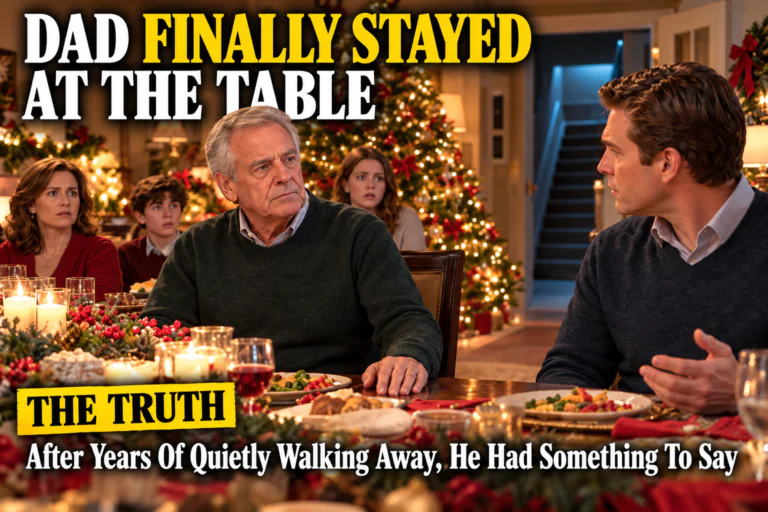
For most of my life, I thought my father simply hated arguments.
Every Christmas, whenever my brother-in-law made another comment about Dad’s career, Dad would quietly excuse himself and disappear downstairs to “check the furnace.” I never questioned it. I thought he was choosing peace.
I was wrong.
That Christmas, Dad finally stayed in his chair.
And what he told us about the life behind his silence made me realize how little I had understood about the man who had spent thirty-three years quietly providing for our family.
My father was sixty-eight and had been retired from the paper mill for several years.
He still woke before sunrise, drank coffee from the same chipped blue mug, read the newspaper slowly, and kept his shoes beside the back door.
He also had a habit of fixing things nobody else noticed.
A loose cabinet hinge.
A squeaky stair.
A lamp that flickered.
A shelf that leaned slightly to one side.
Dad never announced that he had repaired something. He simply noticed a problem and took care of it.
That was how he lived.
Quietly.
When I was young, I assumed he was just a quiet man. When I got older, I began to understand that his silence had layers I had never bothered to examine.
He had spent thirty-three years working rotating shifts at the paper mill in Chillicothe.
There were nights when the rest of us were asleep and Dad was getting ready for work. There were holidays when other families were opening presents while he was finishing a shift.
He rarely complained.
If we asked whether the work was difficult, he would shrug and say, “Part of the job.”
He never seemed interested in sympathy.
What he wanted was simple: he wanted his children to have choices he had never had.
He wanted my sister to have braces.
He wanted me to go to college.
He wanted our family to have a stable home.
I knew money had sometimes been tight. I knew Dad worked extra hours.
What I didn’t know was how many personal opportunities he had quietly put aside so his children could move forward.
That became painfully clear years later.
My sister married my brother-in-law about a decade ago.
He wasn’t an awful man.
That was what made things complicated.
He was intelligent, confident, successful, and comfortable talking about careers, investments, leadership, and ambition.
But he had developed a habit of measuring people’s lives by visible achievements.
And Dad became one of his favorite examples.
The comments started small.
“You really stayed at that mill your whole career?”
Dad would smile.
“Thirty-three years.”
My brother-in-law would laugh.
“That’s a long time to punch a clock.”
Dad never argued.
Then came other comments.
“Didn’t they have management opportunities?”
“You never wanted to move up?”
“Did you ever think about doing something bigger?”
Eventually came the one I hated most.
“I don’t know how you don’t feel like you wasted your potential.”
Dad never responded.
He would reach for his glass.
Change the subject.
Or, most often, glance toward the hallway and say the sentence we had all heard hundreds of times.
“I ought to check the furnace.”
Then he would disappear downstairs.
The furnace wasn’t always the reason.
Sometimes it wasn’t even close.
Our furnace was old, but Dad knew every sound it made. If something actually needed attention, he usually knew before anyone else.
The basement had simply become his escape.
A place where nobody followed him.
A place where he could be alone for ten minutes.
I had always called it avoiding conflict.
I didn’t understand that there was a difference between avoiding an argument and quietly protecting yourself from being diminished.
Then came the Christmas when Dad stopped doing it.
We were halfway through dinner when my brother-in-law began talking about his latest promotion.
He was explaining how difficult it was to manage people who, in his words, “didn’t understand ambition.”
Dad listened.
My sister listened.
I listened.
Then my brother-in-law looked across the table.
“You know what I’ve realized?” he said.
Dad looked up.
“What?”
“Some people get comfortable working their whole lives and never ask whether they could have done more.”
My sister immediately said, “Can we not?”
Her husband smiled.
“I’m just talking.”
Dad’s fork stopped.
For a moment, I expected him to stand.
I expected the familiar excuse.
I expected him to disappear.
Instead, Dad placed both hands flat on the table.
He stayed.
My father wasn’t angry.
That somehow made the moment more serious.
Anger would have been easier to understand.
Dad simply looked tired.
He nodded once.
“You’re right.”
My brother-in-law smiled as though he’d won something.
Then Dad continued.
“But you don’t know my choices.”
The smile disappeared.
“What does that mean?”
Dad rubbed his thumb along the edge of his napkin.
“It means you know what I did. You don’t know why.”
Nobody spoke.
My brother-in-law shifted in his chair.
“I wasn’t insulting you.”
Dad looked directly at him.
“You’ve been insulting me for years.”
The room became completely still.
My sister looked down at her plate.
I couldn’t believe what I was hearing.
Dad had spent decades letting those comments pass.
Now he wasn’t yelling.
He wasn’t trying to embarrass anyone.
He was simply refusing to disappear.
My brother-in-law folded his arms.
“If I’ve offended you, I’m sorry.”
Dad nodded.
“Thank you.”
For a moment, I thought the conversation was over.
Then my brother-in-law tried again.
“I just don’t want you to think I don’t respect what you did.”
Dad looked at him.
“Do you?”
“Yes.”
“Then why do you keep explaining my pension to me?”
I almost laughed.
Dad wasn’t joking.
The previous summer, my brother-in-law had spent nearly forty minutes explaining retirement accounts to him, apparently assuming Dad didn’t understand his own finances.
Dad knew exactly what came into the house.
He knew exactly what went out.
He knew what his pension paid.
He knew what he had saved.
His quietness had been mistaken for ignorance.
Dad finally said it out loud.
“You think because I don’t answer quickly, I don’t understand.”
My brother-in-law shifted again.
“I never said that.”
“You don’t have to.”
Dad’s voice remained calm.
“That look does it for you.”
My sister finally spoke.
“Dad, you don’t have to explain yourself.”
“I know,” he said.
Then he looked around the table.
“But maybe I should have years ago.”
Outside, snow was falling lightly.
Dad stared through the window for several seconds.
Then he said something none of us had heard before.
“I didn’t stay at the mill because I couldn’t do anything else.”
My brother-in-law opened his mouth.
Dad gently raised a hand.
“I stayed because you kids needed me.”
He looked at my sister.
“Your sister needed braces.”
Then he looked at me.
“You needed college.”
He paused.
“And there were years when your mother couldn’t work as much as she wanted.”
Dad leaned back.
“So I worked.”
My brother-in-law nodded.
“I understand that.”
Dad looked at him.
“No. You understand the sentence. That’s different.”
I felt something tighten in my chest.
Because suddenly I remembered a conversation from when I was seventeen.
I had been sitting at the kitchen table with college applications spread in front of me.
I was terrified about the cost.
I asked Dad how we were going to afford it.
He had been making toast.
“We’ll figure it out.”
“How?”
He smiled.
“That’s my job.”
At seventeen, I thought that was simply what fathers said.
At that table years later, I finally understood what those words had meant.
My brother-in-law asked, “So what do you want me to say?”
Dad thought for a moment.
“Nothing.”
That surprised everyone.
“I don’t need you to praise me,” Dad continued. “I just need you to stop treating me like my life is something you have to feel sorry for.”
Nobody answered.
Then Dad looked down at his plate.
“There is one thing you don’t know.”
I looked at him.
So did everyone else.
For once, Dad didn’t walk away.
He just sat there with the secret he had carried for years.
The next morning, I found him downstairs beside the furnace.
It was running perfectly.
Three cardboard boxes sat near his workbench.
I had seen them before but never asked what was inside.
This time, I did.
Dad opened the first.
Inside were old work gloves, a lunch thermos, his company badge, photographs, pay stubs, and other pieces of a life I suddenly realized I knew very little about.
There was a photograph of Dad standing outside the mill when he was young.
Dark hair.
Straight shoulders.
A face without the lines I knew.
I picked it up.
“Who took this?”
“My sister,” Dad said.
He smiled.
“She used to tell everybody her daddy made paper.”
I laughed.
“She did.”
“I know.”
He opened another box.
This one contained college bills, bank records, receipts, and an old letter from the university I attended.
I recognized the date immediately.
I also recognized the amount.
“What is this?”
“Your tuition.”
“I knew you helped pay for college.”
Dad shrugged.
“There wasn’t much to it.”
I looked at the documents.
There were overtime records.
Withdrawal slips.
Notes in his handwriting.
One page said:
College — don’t touch emergency fund.
I looked up.
“What emergency fund?”
“Never needed it.”
I stared at him.
“You worked all those extra shifts?”
“Some.”
“How many?”
“Enough.”
That word again.
Enough.
He had reduced years of sacrifice to one ordinary word.
I remembered all the times he had said he was fine.
The old truck he kept repairing instead of replacing.
The coat he wore for years.
The vacations he didn’t take.
The things he quietly postponed.
I had thought those were simply his choices.
I had never asked what those choices had purchased for us.
Dad looked toward the furnace.
“You know why I came down here all those years?”
I waited.
“This was the only room in the house where nobody followed me.”
He said it without bitterness.
“Sometimes you need ten minutes where nobody needs anything from you.”
I thought about every Christmas.
Every Thanksgiving.
Every family gathering.
Every time he had disappeared downstairs.
Thirty years of ten-minute escapes.
Then Dad opened the third box.
Inside was a folder.
He stared at it for a long time.
“This,” he said, “is why I didn’t tell your brother-in-law what I really thought.”
The folder contained an old letter from the paper mill.
Dad had been recommended for a significant management position.
Better pay.
A different schedule.
Less physical work.
A real opportunity to move forward.
But the position required moving several hours away.
Dad had turned it down.
I stared at him.
“Why?”
He answered simply.
“Your life was here.”
I reminded him that he could have taken the position.
He shook his head.
“Your sister had just started college. You were finishing high school. Your mother didn’t want to leave.”
“You could have gone alone.”
He looked at me.
“And come home when?”
I had no answer.
Then Dad said something I’ll never forget.
“People think sacrifice always feels noble.”
He gave a small laugh.
“Usually it just feels inconvenient.”
That changed how I saw him.
I had imagined sacrifice as one dramatic decision.
For Dad, it had been ordinary.
An extra shift.
A missed dinner.
A postponed vacation.
A promotion he never mentioned.
One decision after another.
None of them announced.
None of them performed for anyone.
He had simply chosen us.
There was another letter in the folder.
This one was from Mom.
I recognized her handwriting immediately.
It was written around the time I went to college.
She described Dad coming home exhausted after another overnight shift, sitting at the kitchen table, and quietly counting money to make sure my tuition would be covered.
Then she wrote a sentence that stayed with me:
Love can be quiet enough to look like ordinary work.
I had to put the letter down.
Dad looked away.
“Why didn’t you show us this?”
“Because it was hers.”
That answer was enough.
Then I asked him why he had finally stayed at the Christmas table.
Dad was quiet.
“I realized something.”
“What?”
“I was teaching your brother-in-law that silence meant agreement.”
He looked toward the basement.
“Every time I went downstairs, I thought I was keeping the peace.”
He paused.
“But maybe I was only teaching everyone else that my feelings didn’t matter.”
That was the real turning point.
Dad hadn’t suddenly become a different man.
He had simply decided he deserved to remain present.
A few days later, my brother-in-law came to the house alone.
He looked uncomfortable.
That was unusual.
He normally walked into a room as if he already knew how every conversation would go.
This time, he waited at the door.
Dad invited him inside.
They sat across from each other.
After a long silence, my brother-in-law said, “I owe you an apology.”
Dad nodded.
“Yes.”
“I’ve been disrespectful.”
“Yes.”
“I made jokes about your pension.”
“Yes.”
“I talked to you like you didn’t understand things.”
Dad nodded again.
Then my brother-in-law said something I didn’t expect.
“I think I did it because I was trying to convince myself that the choices I’d made were the right ones.”
Dad studied him.
“That sounds honest.”
“It is.”
My brother-in-law explained that he had spent years believing success meant always moving forward, always earning more, always achieving something visible.
Then he admitted that he had been jealous of Dad.
“Of how little you seemed to need other people to approve of you.”
Dad smiled.
“I needed them.”
“You didn’t act like it.”
“I just learned not to ask.”
My brother-in-law looked down.
“I don’t know how to do what you did.”
Dad shook his head.
“Don’t.”
“What?”
“Don’t try to become me.”
Dad leaned forward.
“You have your own life. Your own family. Your own choices.”
Then he said something that my brother-in-law would repeat for years.
“Just don’t make yourself feel taller by standing on somebody else’s life.”
My brother-in-law’s eyes filled.
He looked away.
Dad didn’t rush to comfort him.
He didn’t need to.
After a while, my brother-in-law asked if he could come back the next day.
Dad smiled.
“Bring the good coffee.”
He came back.
And he listened.
Dad began telling stories about the mill.
Not impressive stories.
Real ones.
People who worked nights.
People who covered each other’s shifts.
Someone who brought cookies every Friday.
Someone who kept a photograph of his children in his wallet.
People who had family emergencies.
People who became grandparents.
People who left.
People who returned.
Dad remembered them all.
My brother-in-law stopped taking notes and simply listened.
Eventually, my sister joined us.
She told a story about forgetting her lunch at school when she was ten.
Dad had been working nights, but he drove back to the school anyway to bring it to her.
She remembered him standing outside the classroom window with her lunch bag.
Dad laughed.
“You cried.”
“I was ten.”
“You cried over a sandwich.”
“It was a peanut butter sandwich.”
Everyone laughed.
Then my sister reached for his hand.
“I’m sorry.”
Dad looked confused.
“For what?”
“For not seeing you.”
He squeezed her hand.
“You were a kid.”
“I mean now.”
Dad nodded.
“Now you see me.”
That was all he needed.
Months passed.
Dad and my brother-in-law began having lunch together once a month.
Sometimes they talked about work.
Sometimes retirement.
Sometimes baseball.
Sometimes they argued about tools.
Dad usually won.
The biggest change, though, happened at Christmas.
Dad stopped saying, “I ought to check the furnace.”
He still checked it when the furnace actually needed attention.
But he stopped using it as an escape.
One evening, I asked him whether he missed having the basement to himself.
“Sometimes,” he said.
“Really?”
“It’s peaceful.”
Then he smiled.
“You know, there was nothing wrong with needing a quiet place.”
“No.”
“The mistake was thinking I had to disappear to deserve one.”
I never forgot that.
Dad had spent years believing peace required absence.
Now he understood that peace could exist in the middle of a family.
The following Christmas, my brother-in-law arrived early with Dad’s favorite coffee.
My sister brought a pie.
I made the potatoes.
Nobody announced that our family had changed.
We didn’t need to.
Change had become visible in small things.
A question instead of a joke.
A person listening instead of interrupting.
A chair pulled closer to the table.
Dad sat in his usual place.
My brother-in-law sat across from him.
At one point, he asked, “Dad, what was the worst shift you ever worked?”
Dad laughed.
“There were plenty.”
“Tell me one.”
And Dad did.
For the first time, we weren’t looking at him as a retired man who had spent his whole career at one company.
We were listening to a person with a history.
A man who had made choices.
A man who had given things up.
A man who had regrets without regretting his children.
That distinction mattered.
Because for years, I had looked backward and felt guilty.
I should have noticed.
I should have asked.
I should have understood.
But Dad never wanted his sacrifices to become a debt we carried.
He wanted us to carry the lesson instead.
There is a difference.
A debt weighs you down.
A lesson changes how you live.
That night, my brother-in-law looked across the table.
“I think I finally understand what you were trying to teach me.”
Dad raised an eyebrow.
“What was that?”
“That a life doesn’t have to look impressive from the outside to be meaningful.”
Dad smiled.
“Pretty close.”
“What am I missing?”
Dad looked around the table.
“The people.”
He pointed toward us.
“You can have the biggest job in the world. But if nobody’s sitting here with you, what good is it?”
Nobody answered.
My brother-in-law reached across the table and squeezed Dad’s shoulder.
Dad let him.
Years earlier, Dad would have stood up at that moment.
He would have smiled.
He would have said he needed to check the furnace.
Instead, he asked for another roll.
He complained that the coffee was cold.
He told another story.
And when everyone laughed, Dad laughed with us.
I thought about Mom’s old letter.
Love can be quiet enough to look like ordinary work.
I finally understood what she meant.
My father never needed a medal.
He never needed us to call him extraordinary.
He never wanted repayment.
He only needed the people he had spent his life showing up for to eventually learn how to show up for him.
The next morning, I went downstairs alone.
The furnace was humming.
Dad’s old photograph hung beside his company badge.
His blue coffee mug sat on the workbench.
I stood there for a moment.
Then I heard footsteps behind me.
Dad came down the stairs.
“You checking the furnace?”
I smiled.
“No.”
He nodded.
“Good.”
We stood together in the quiet basement.
After a moment, Dad looked toward the stairs.
“Ready?”
I nodded.
He turned off the light.
We walked upstairs together.
And for the first time in thirty years, the basement wasn’t where my father went to disappear.
It was simply another room in his house.
Because the place he truly belonged was upstairs.
At the table.
With us.

Evan Cole Editor-in-Chief | Breaking News & Public Policy
“From Washington to Wall Street, and Main Street to Hollywood—Evan Cole connects the dots.”
As the Editor-in-Chief at Newskilo, Evan leads a dynamic team of journalists dedicated to uncovering the truth behind the headlines. With over 15 years in digital media, Evan has a reputation for cutting through the noise.
While he is widely recognized for his deep analysis of U.S. fiscal policy (IRS & Stimulus), Evan’s expertise extends to global current events, corporate accountability, and cultural trends. Whether he is breaking down a complex government bill, exposing a tech giant’s failure, or analyzing the societal impact of a viral celebrity moment, Evan’s goal is simple: To tell the stories that shape our world with clarity, accuracy, and integrity.
Leave a Reply