
For three years, I had learned how to become invisible at family gatherings.
I worked quietly, raised my daughter, paid our bills, and avoided explaining myself to people who had already decided that my life was somehow less important than the one their family had expected.
Then came Easter.
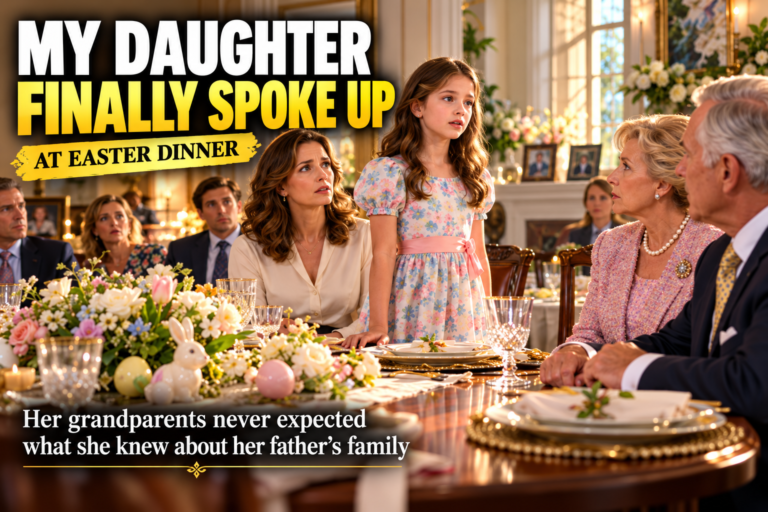
My eleven-year-old daughter pushed her chair away from the table, looked directly at her grandparents, and said something that made the entire room fall silent.
She wasn’t angry.
She wasn’t trying to embarrass anyone.
She simply knew a part of her father’s story that I had never known.
And once she started talking, I realized that the life I thought I had been left to rebuild alone had never been as empty as I believed.
Three years earlier, I had sat beside my husband’s hospital bed and held his hand.
Daniel was the kind of person who could make two completely different worlds feel as though they belonged together.
His parents were wealthy and well-established. They owned several businesses and lived in a large house where every room seemed designed for a purpose I didn’t understand.
I came from a much simpler background.
My parents had always lived carefully. My mother kept coupons in a kitchen jar. My father had driven the same old truck for years because he preferred repairing things to replacing them.
Daniel never looked down on that.
In fact, he loved it.
The first time he visited my mother’s house, he noticed that none of our coffee mugs matched.
“You have six different mugs,” he joked.
“And?”
“Nothing. I think I like it here.”
He stayed.
We married.
Then we had our daughter, Audrey.
For a while, I believed that was the entire story.
Daniel had found a way to build a family that didn’t look exactly like the one his parents had imagined for him.
Then he was gone.
And after his funeral, something changed.
His parents didn’t openly tell me that I no longer belonged.
They didn’t have to.
The invitations became less frequent.
The calls stopped.
The financial assistance they had occasionally offered for family expenses disappeared.
Suddenly, I was a widow with a child, a mortgage, household bills, school expenses, and no clear idea how I was going to make everything work.
So I worked.
I took early shifts.
Then evening shifts.
Then weekend jobs.
Eventually, I found steady work at a private school.
My title wasn’t impressive.
I cleaned classrooms and maintained the building.
But the job was honest.
It kept the lights on.
It helped pay for Audrey’s school supplies.
It put food on our table.
And most importantly, it allowed me to keep showing up for my daughter.
Some nights, I came home after everyone else had gone to bed.
Even after washing my hands several times, I could still smell cleaning products.
I would quietly check on Audrey before going to sleep.
Then I would wake up and do it all again.
I never told her how exhausted I was.
She was a child.
She didn’t need to carry that weight.
My in-laws saw things differently.
Evelyn, my mother-in-law, rarely hid her opinion about my job.
Richard, my father-in-law, was more careful.
He didn’t usually make direct comments.
Instead, he spoke about Daniel’s potential and the future he believed his son should have had.
It often felt as though my life was being compared with an imaginary version of Daniel’s life.
And I always felt as though I had lost that comparison before it even began.
I learned to stay quiet.
I told myself that protecting Audrey mattered more than answering every insult.
Then came Easter.
We were sitting around the large dining table at my in-laws’ house.
The conversation had been pleasant enough until Evelyn looked at me and smiled.
“Still cleaning?”
A few relatives laughed.
I forced a polite smile.
I had heard worse.
I could handle one more comment.
Then Richard added, “Daniel had such a promising future. It’s difficult seeing what was left behind.”
That sentence hurt more than I expected.
I lowered my eyes.
I decided not to respond.
But Audrey had heard him.
She slowly pushed her chair backward.
The legs made a soft sound against the floor.
Everyone stopped talking.
Audrey stood.
She was only eleven, but there was something unusually calm about her expression.
She looked directly at her grandparents.
“Grandma. Grandpa. You need to listen.”
Evelyn lowered her glass.
Richard leaned back.
I whispered my daughter’s name.
“Mom,” Audrey said without looking away from them, “you don’t have to stop me.”
Then she said the words that changed everything.
“You keep talking about what Mom was left with.”
She paused.
“But you never talk about what she built.”
Nobody answered.
Audrey reached into the small bag beside her chair.
She pulled out an old envelope.
Then she placed it in the center of the table.
I recognized the handwriting immediately.
Daniel.
My heart began pounding.
Audrey told us she had found the envelope in Richard’s study.
She had been looking through old photographs because she wanted pictures of her father for a school project.
Richard immediately asked why she had been in his study.
She explained.
Then Evelyn asked her to hand over the envelope.
Audrey refused.
“No.”
The room became even quieter.
I asked her what was inside.
“Something Dad wrote.”
I knew Daniel had written one short note for me during his final days.
I had kept it beside my bed for years.
But I had never heard about this letter.
The envelope was dated several years earlier.
I opened it with shaking hands.
The first line was addressed to his mother.
I read slowly.
Daniel wrote that he knew his parents believed I had married him because of his family’s money.
Then came the sentence that stopped me.
He told them they were wrong.
He wrote that I had never asked him for anything.
He said I had never cared about his family’s name or what their money could provide.
He wrote that he loved me because I loved him for who he was.
Then came something even harder to read.
Daniel had apparently worried that if something happened to him, his parents might blame me.
He specifically asked them not to.
He wrote that I wasn’t what remained of his life after he was gone.
I was the life he had chosen.
I couldn’t finish reading.
I pressed the letter against my chest.
Evelyn was crying.
I had never seen her cry like that.
Not at the funeral.
Not afterward.
Not when Audrey was born.
Audrey then reached into her bag again.
She had found something else.
A small notebook.
“Dad wrote in this too.”
Richard stood up.
“Audrey.”
She didn’t move.
“I wanted to understand why everyone treated Mom like she didn’t belong.”
That sentence silenced him.
I asked what she had found.
She opened the notebook to a page.
There was a number written beneath Daniel’s handwriting.
Beside it were a few words:
For my wife, when she is ready to know what I left behind.
I stared at the page.
For three years, I had believed Daniel had left me with love, memories, and a mountain of responsibilities.
Now I wondered whether there was something else.
Something he had deliberately kept hidden.
That night, after we returned home, Audrey went upstairs.
I stayed in the kitchen.
The same kitchen where Daniel and I had once argued about paint colors.
The same kitchen where Audrey had taken her first steps.
The same kitchen where I had spent countless nights calculating whether we could afford groceries and the next utility bill at the same time.
I opened Daniel’s notebook.
Most of it was ordinary.
Appointments.
Bills.
Notes about repairs.
Reminders about Audrey’s school.
Then the entries changed.
Daniel wrote about his parents.
He wrote about their expectations.
His father wanted him to continue the family business.
His mother believed marriage should strengthen the family’s position.
Daniel had felt pressure to become the person they wanted.
Then he wrote about me.
One entry was dated several months before his passing.
He wrote that he wanted to make sure I never believed I had been a burden.
Another entry said that if his parents made me feel small after he was gone, I needed to remember that he knew exactly who I was.
Not what I earned.
Not what I could contribute.
Not what I could provide for his family.
Who I was.
I sat at the table for a long time.
Then I noticed the number Audrey had found.
It was connected to a financial account.
The following morning, I called.
After several security questions, the person on the other end told me something I had never heard before.
Daniel had established a protected trust.
I couldn’t believe it.
He had arranged for a portion of his assets to be placed there years earlier.
But there was a condition.
I would not receive access until I had been independent for three years.
Three years.
Exactly the amount of time I had spent struggling to keep our lives together.
I asked why he had done that.
The trustee explained that Daniel was concerned his parents might use financial support to keep me dependent on them.
He wanted me to build my own life first.
He wanted the money to provide freedom, not control.
Then the trustee told me the amount.
It was enough to transform our situation.
Not enough to make us extravagant.
Enough to pay off the house.
Enough to create an education fund for Audrey.
Enough to give us a real emergency reserve.
Enough to make one unexpected expense feel like a problem instead of a crisis.
I sat there thinking about all the nights I had counted every dollar.
The school shoes Audrey had worn longer than they fit.
The groceries I had put back because the total was too high.
The secondhand computer.
The evenings when I had come home exhausted and still helped with homework.
Daniel had known.
He had planned.
But he had intentionally kept the decision in my hands.
Then the trustee gave me another envelope.
Daniel had written it for me.
He said he knew I might be angry that he hadn’t told me about the trust.
But he didn’t want my first three years without him to be controlled by fear of losing financial security.
He wanted those years to belong to me.
Not his parents.
Not their expectations.
Me.
Then I read something that changed how I understood the entire marriage.
Daniel wrote that his father had given him a choice between the family business and the life he wanted with me.
Daniel had chosen me.
He simply hadn’t known how to make his parents accept that choice.
I cried.
Not because of the money.
Because for three years, I had wondered whether Daniel had failed to prepare us.
Now I realized he had been preparing us in a completely different way.
When I came home, Audrey was waiting.
She had made two sandwiches.
One for herself.
One for me.
“How did it go?” she asked.
I told her that her father had left us something.
“I know,” she said.
I stared at her.
She admitted she didn’t know everything, but she knew her father had never wanted her grandparents deciding our future.
Then she told me something else.
She had overheard Evelyn talking about me.
Evelyn had said I should be grateful that they still invited us.
She had apparently suggested that Daniel would be disappointed if he could see what had happened to his family.
Audrey had remembered every word.
I thanked her for defending me.
She looked confused.
“I wasn’t defending you.”
“No?”
“I was telling the truth.”
That answer stayed with me.
Children sometimes say the sentence adults spend years avoiding.
The next day, I asked Evelyn and Richard to meet with me.
I didn’t want to argue.
I wanted answers.
Evelyn looked tired when she opened the door.
Richard was sitting in the study.
The same room where Audrey had found the notebook.
He already knew I had spoken with the trustee.
“So Daniel finally gave you access,” he said.
I asked whether they had known about the trust.
Silence.
Then Evelyn admitted they had.
They had known Daniel had arranged something.
They had known about his assets.
But they hadn’t told me.
I asked why.
Richard finally answered.
They had been angry.
Not at me.
At Daniel.
He had refused to return to the family business.
They believed he was making the wrong choice.
They believed I was part of the reason.
I asked them why they had treated me as though I were responsible.
Richard couldn’t answer.
Evelyn began crying.
She admitted they had assumed I would eventually leave.
They believed that without Daniel’s financial support, I wouldn’t stay.
I reminded them that they had watched me work for three years.
They had watched me raise Audrey.
They had watched me struggle.
And they had still believed I would leave.
Evelyn finally said the words I had waited years to hear.
“We were wrong.”
Richard then opened a cabinet.
Inside was a box of Daniel’s belongings.
Photographs.
His old watch.
A few childhood items.
Letters.
Then he placed another envelope on the table.
It had my name on it.
Underneath were four words:
For the woman who stayed.
I took it home.
I couldn’t read it in front of them.
That night, Audrey sat beside me.
“Are you scared?”
“Yes.”
“Why?”
“Because every time your father leaves me something, I learn something I didn’t know.”
She thought about that.
“Maybe that’s why he left it.”
I smiled.
“You’re eleven.”
“I know.”
Then she grinned.
“I hear you talking to yourself.”
I laughed.
It was the first real laugh I had shared with her in days.
Then I opened the letter.
Daniel wrote that I might have spent years believing he had left me with nothing.
He said he knew the years after his passing would be difficult.
He knew his health was unpredictable.
He knew his parents would resist his decisions.
So he made arrangements.
But the most important thing he left couldn’t be placed in a bank.
He wanted Audrey to grow up knowing that her mother never stopped showing up.
He wanted her to understand that I didn’t work because my life had failed.
I worked because my daughter needed someone who would keep going.
That distinction changed something inside me.
I had spent three years thinking of myself as someone who had been left behind.
Daniel saw me as someone who stayed.
The trust gave me options.
For the first time in years, I could reduce my hours.
I could pay off the house.
I could plan for Audrey’s education.
But there was another dream I wanted to pursue.
Before Daniel died, I had been taking evening classes in bookkeeping.
I had stopped because tuition had become impossible.
Now I enrolled again.
A few months later, the school where I worked offered me an administrative position.
My supervisor had noticed something I hadn’t.
While cleaning the building, I had also been managing schedules, supplies, invoices, and other daily tasks.
“You’ve been running half this place without realizing it,” she told me.
I accepted the job.
For the first time, I began to understand that the woman who had survived those difficult years was capable of becoming something more.
Not because Daniel had left money.
Not because his parents finally changed their minds.
Because I had kept going long enough to discover what I could do.
The following Easter, Audrey wanted to visit her grandparents again.
So we went.
The house looked almost exactly the same.
The long dining table.
The polished silverware.
The flowers.
But I felt different.
I wasn’t sitting there waiting for permission to belong.
I knew I belonged.
Evelyn greeted us warmly.
Richard nodded.
Dinner was quieter than the previous year.
Nobody mentioned my job.
Nobody mentioned money.
Nobody criticized Daniel’s choices.
After dessert, Richard asked Audrey to come with him.
He returned carrying Daniel’s old watch.
“This belonged to your father.”
Audrey looked at him.
“Why are you giving it to me?”
“Because he wanted you to have it.”
Richard then admitted something.
Daniel had spoken with him shortly before his final hospital stay.
Daniel had asked his father to stop punishing the people he loved simply because Richard disagreed with his choices.
Richard had admitted he didn’t know how.
Daniel told him to learn.
Richard said that was exactly what he had been trying to do ever since.
Audrey looked at him.
“Then don’t do it anymore.”
Richard nodded.
“I won’t.”
As we prepared to leave, Evelyn stopped me.
She told me that during Daniel’s illness, she had once asked him whether he regretted marrying me.
Daniel had laughed.
Then he told her that I wasn’t the part of his life he regretted.
I was the part he wished he had more time for.
Evelyn finally admitted something else.
She had spent years telling herself I had taken Daniel away from his family.
Now she understood that wasn’t true.
They had lost their closeness with him because they couldn’t accept the life he had chosen.
“You were never what was left behind,” she told me.
“You were the person he chose.”
For the first time, I believed she meant it.
Then another secret surfaced.
Richard gave me a note Daniel had written shortly before his passing.
It explained something I had never known.
Daniel had once been offered a major position that could have made him considerably wealthier.
It would also have required him to spend much of the year away from me and Audrey.
He refused.
His father had considered that another wasted opportunity.
Daniel saw it differently.
He had told Richard that his future was sitting at our kitchen table waiting for him.
Richard admitted that he had spent years believing Daniel had thrown away his potential.
Now he understood that Daniel had simply chosen a different definition of success.
I thought about that for a long time.
Maybe that had always been the real disagreement.
Daniel’s family measured success through money, status, and business.
Daniel measured it through people.
A home.
A child.
A marriage.
Ordinary evenings.
Time together.
And I realized that I had spent years worrying that my own life looked small from the outside.
Daniel had never thought it was small.
One afternoon, Audrey had a school assignment about family history.
While looking through old papers, she discovered another document.
This time, it involved my parents.
Daniel had quietly helped them financially before we were even married.
Small amounts.
Help with household repairs.
Groceries.
Other expenses.
He had specifically asked them not to tell me.
My mother confirmed it when I called.
She told me Daniel had said I was too proud to accept help.
I laughed through my tears.
That sounded exactly like me.
Then my mother repeated something else Daniel had told her.
He said I believed I had to carry everything alone.
He didn’t want that for me.
For years, I had believed I had done everything alone.
Maybe I hadn’t.
Maybe love had been surrounding me quietly while I was too busy surviving to notice.
Eventually, Audrey asked the question I had been avoiding.
“Why did Grandma think you weren’t good enough for Dad?”
I told her to ask Evelyn herself.
So she did.
We went to my in-laws’ house.
Audrey sat across from her grandparents.
“Grandma?”
“Yes?”
“Why did you think Mom wasn’t enough?”
Evelyn looked at me.
Then she looked at Audrey.
For once, she didn’t defend herself.
“Because I was wrong.”
Audrey waited.
Evelyn explained that she had believed Daniel needed a certain kind of future.
More money.
More status.
More family involvement.
Audrey asked what Daniel wanted.
Evelyn looked at me.
“Your mother.”
Then Audrey asked the question that finally broke through everything.
“Why did you make Mom prove she deserved him?”
Nobody spoke for several seconds.
Richard finally reached for Evelyn’s hand.
“We shouldn’t have.”
Audrey looked at them.
“Then don’t do it anymore.”
That was all.
No speech.
No argument.
No dramatic confrontation.
Just eleven words from a child who had watched adults complicate something that should never have been complicated.
Love did not need to prove its worth.
A year after that Easter, our lives looked very different.
Not perfect.
Better.
I completed my bookkeeping certification.
The school promoted me to office manager.
I still walked through the same hallways I had once cleaned.
But I didn’t feel embarrassed.
I felt grateful.
That job had carried our family when we needed it most.
It taught me discipline.
It taught Audrey that honest work deserves respect.
And it showed me that a person’s worth has nothing to do with whether other people think their job sounds impressive.
The money Daniel left was carefully managed.
I paid off the house.
I created an education account for Audrey.
I kept emergency savings.
And I made one promise to myself.
The money would never become the center of our lives.
Because Daniel had been right.
The important gift wasn’t the money.
It was freedom.
The ability to make decisions without fear.
The ability to say no.
The ability to build a future without depending on people who believed financial help gave them authority over us.
Evelyn and Richard slowly became part of our lives again.
There were awkward conversations.
There were apologies.
There were family dinners where everyone seemed unsure what to say.
But things changed.
They stopped asking about my finances.
They stopped comparing me with Daniel’s imagined future.
They asked about Audrey’s school.
They asked about my work.
They asked what we wanted.
They began learning how to be grandparents without trying to control the family.
One afternoon, Evelyn brought me another photograph of Daniel.
He was young, standing beside Richard.
On the back was a simple phrase:
Our future.
Evelyn looked at it.
“I used to think that meant the business.”
Then she smiled sadly.
“Now I think it meant him.”
She gave me another letter.
Daniel had written it before Audrey was born.
He hoped their daughter would grow up knowing she could become anything.
He hoped she would never confuse wealth with worth.
He hoped she would understand that kindness wasn’t weakness.
And he hoped she would learn from her mother that dignity could survive difficult seasons.
I couldn’t finish reading it.
I handed it to Audrey.
She read the final words and looked at me.
“He knew you’d be a good mom.”
“I tried.”
“You did more than try.”
I pulled her close.
For a moment, I wished Daniel could see us.
Then I realized something.
Maybe he already had.
Not literally.
But through everything he had prepared.
The letters.
The memories.
The trust.
The choices.
The lessons.
The life he had built with us.
One evening, Audrey and I sat outside our house.
She rested her head against my shoulder.
“Mom?”
“Yes?”
“Do you think Dad would be proud?”
I looked toward the photograph inside.
“I think he’d be proud of you.”
“What about you?”
I smiled.
“I think he’d be proud that I kept going.”
Audrey shook her head.
“You didn’t just keep going.”
I looked at her.
“You built something.”
She was right.
For three years, I had thought my greatest achievement was surviving.
But survival was only part of the story.
I had raised a child.
Kept our home.
Built a career.
Finished the education I had once abandoned.
Learned to accept help without feeling ashamed.
Forgiven people without pretending their choices hadn’t hurt.
And most importantly, I had stopped measuring myself through someone else’s expectations.
Daniel’s family had once looked at my work and seen something embarrassing.
I eventually realized they had been looking at the wrong thing.
They saw a job.
Daniel saw dedication.
They saw a woman who hadn’t inherited their world.
Daniel saw the woman he wanted beside him.
They saw what I lacked.
He saw what I gave.
They saw the years after his passing as evidence that his life had been wasted.
I saw those years differently.
Every early morning.
Every late shift.
Every packed lunch.
Every school project.
Every bill.
Every tired evening.
Every time Audrey needed me and I showed up.
Those things were not evidence of failure.
They were the foundation of the life I built.
And then there was that Easter dinner.
The moment my daughter stood up.
She hadn’t planned to become the voice of the room.
She hadn’t intended to embarrass her grandparents.
She simply couldn’t understand why adults who claimed to love her father were willing to disrespect the woman he had chosen.
Her words didn’t destroy our family.
They forced us to stop pretending.
After that, secrets came into the light.
Old assumptions were questioned.
Apologies were made.
Boundaries were established.
And slowly, people began choosing each other for the right reasons.
I still miss Daniel.
I always will.
There are mornings when I see something he would have laughed at and instinctively turn to tell him.
There are moments when Audrey does something that reminds me of him so strongly that I have to pause.
Loss doesn’t disappear.
But neither does love.
Sometimes it changes shape.
For us, it became a daughter who wasn’t afraid to speak.
It became a mother who discovered she was stronger than she realized.
It became grandparents who finally learned that love isn’t ownership.
It became a family that had to rebuild its understanding of success.
And it became a reminder that a person’s value cannot be measured by a surname, a bank balance, or a job title.
My in-laws once laughed at the work that kept our family going.
My daughter eventually reminded them that there was nothing embarrassing about it.
She reminded me too.
Because the woman they thought had been left behind had actually been building something the entire time.
A home.
A future.
A life.
And most importantly, a daughter who knew exactly what her father had believed all along:
Love is not something a family gets to purchase. It is something people choose, protect, and prove through the way they treat one another.
And sometimes, the person brave enough to remind everyone of that truth is the youngest person sitting at the table.
What do you think matters more when judging someone’s success: the life they appear to have from the outside, or the people and values they quietly build behind closed doors?

Evan Cole Editor-in-Chief | Breaking News & Public Policy
“From Washington to Wall Street, and Main Street to Hollywood—Evan Cole connects the dots.”
As the Editor-in-Chief at Newskilo, Evan leads a dynamic team of journalists dedicated to uncovering the truth behind the headlines. With over 15 years in digital media, Evan has a reputation for cutting through the noise.
While he is widely recognized for his deep analysis of U.S. fiscal policy (IRS & Stimulus), Evan’s expertise extends to global current events, corporate accountability, and cultural trends. Whether he is breaking down a complex government bill, exposing a tech giant’s failure, or analyzing the societal impact of a viral celebrity moment, Evan’s goal is simple: To tell the stories that shape our world with clarity, accuracy, and integrity.
Leave a Reply