
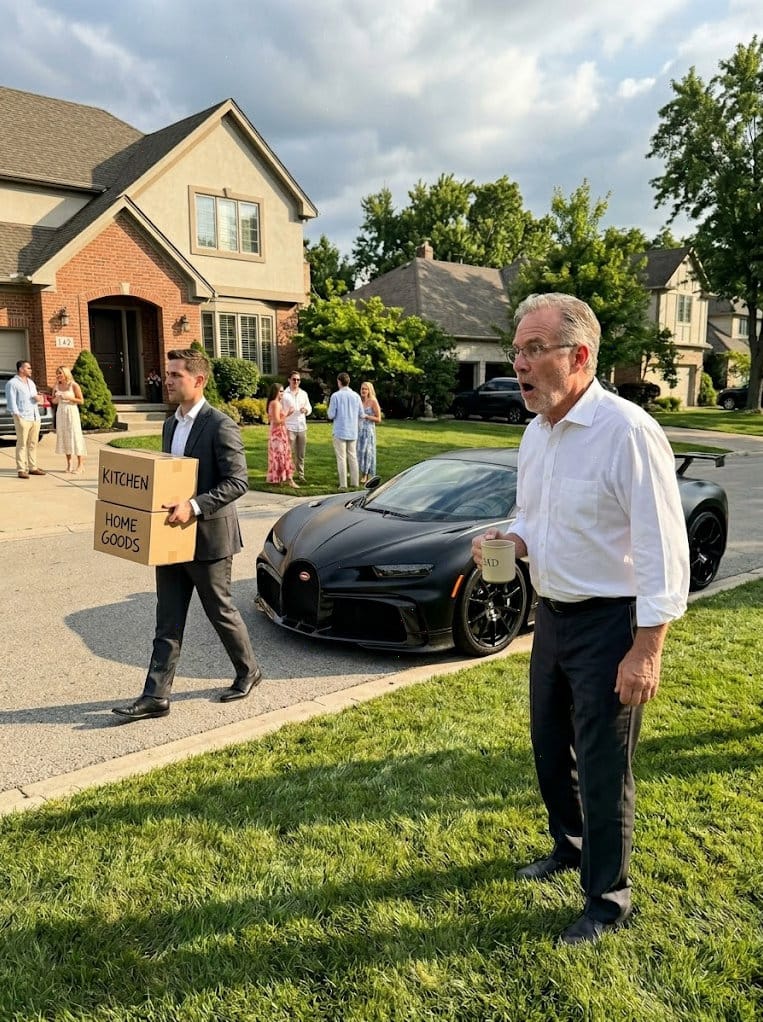
My father’s face went white the moment the door opened.
Not pale. White. Like something inside him just stopped.
He had clients on the lawn. Expensive suits. A catered brunch. The kind of performance he’d spent thirty years perfecting — the illusion of a man who mattered.
And then the Bugatti pulled up.
Midnight black. Doors that open like wings. A car that doesn’t ask for attention. It simply takes it.
I stepped out in a charcoal suit that cost more than his mortgage. The driver handed me two boxes from the trunk without a word. I walked toward the house like I’d done it a thousand times.
My father didn’t move. He just stood there, coffee cup in hand, mouth slightly open, staring at me like he was seeing a stranger wearing his son’s face.
Because yesterday — just yesterday — he told me to leave.
“Pack your things,” he had said, cold and final, at my parents’ 30th anniversary party. “I’m done pretending that car outside belongs to my son.”
That car was a 2005 Corolla with a cracked bumper.
I had just come from work. Still in my uniform. Still carrying the homemade cake I made at 6 a.m. before my shift.
My mother didn’t even let me set it down. She grabbed it from my hands and dropped it into the trash without blinking. “You ruin everything, Kairen.”
My brother Jace was leaning against the doorframe, smirking. “Some people are meant to stay invisible,” he said. “So others can shine.”
The guests laughed. My father straightened his collar. My mother turned back to her party.
And I left. Quietly. Without a scene.
Because I’ve always known something they don’t.
Three years ago, on an ordinary Tuesday, a set of numbers — 4, 12, 28, 35, 42, Mega Ball 11 — changed everything. $450 million. After taxes, $280 million, sitting in a blind trust managed by a lawyer who has never once met my family.
I stayed a janitor at Intrepid Tech on purpose. The same building where my father worked. I needed the truth. I needed to know whether any of them loved me when I had absolutely nothing to offer.
They answered that question clearly.
And yesterday, they set everything that was about to happen next in motion.
Part 2: The Family That Never Looked Down Long Enough to See Who Was Holding Them Up
Jace came out three minutes after my father froze on the lawn.
He was still chewing something. Holding a mimosa. Wearing the kind of casual confidence that only exists when you believe you’re untouchable.
He saw the Bugatti first. Then he saw me.
His jaw stopped moving.
“Whose car is that?” he asked one of the nearby guests.
No one answered. They were all watching me.
My father finally found his voice. It came out wrong. Smaller. Cracked at the edges, like a man realizing mid-sentence that the ground beneath him isn’t solid.
“Kairen… what is this?”
“You told me to come at 10,” I said. “You said I’d learn what success looks like. I didn’t want to disappoint you.”
Jace laughed — that sharp, dismissive snap I’d grown up hearing. “Nice rental. What’d you do, find a coupon?”
He winked at one of my father’s clients. Still performing. Still convinced he could talk his way out of any room.
My father grabbed my arm, low voice, urgent. “Stop this. Whatever point you’re trying to make—”
“I’m just here for Grandpa’s memory box, Dad.”
Flat. Calm. The tone of someone who no longer needs anything from the person in front of them.
What my family never understood was the math underneath our daily life.
For three years, I had quietly paid off the $47,000 in credit card debt my mother had buried from my father. I paid it in installments, through anonymous third-party transfers, because I knew my father’s ego would collapse if he knew how deep she’d gone.
For three years, I had funneled money through a shell consulting account to prop up my father’s flagging performance metrics at work — so that Intrepid Tech wouldn’t quietly push him out at 58, the way companies quietly push out men who’ve stopped growing.
And Jace — golden, brilliant, “rising star” Jace — was three months from having two civil lawsuits filed against him for unpaid vendor contracts on his collapsed startup. I had settled both cases out of court, anonymously, for $190,000 combined.
They thought it was luck. They thought debts just resolved. They thought the company kept their father on out of loyalty.
They never once looked at the janitor mopping the floor in the lobby.
My mother appeared at the front door. She looked at the Bugatti. Then at me. Then at my father.
And for the first time in my adult life, I watched her go completely, utterly silent.
Part 3: The Turning Point
The night they threw me out, I didn’t sleep in my Corolla.
I called a car and went straight to the Harborpoint Grand Hotel. The penthouse suite — the one that faces the harbor, the one you can see from the highway, the one my mother had once pointed to from our old car when I was nine and said, “People like us don’t stay there, Kairen. Know your place.”
I ordered room service at midnight. I drank a bottle of wine that cost more than the rent on their basement. I sat on the balcony in the dark, watching the lights on the water, and I felt something shift.
Not anger. Not triumph. Something quieter than both.
Relief.
Because for three years, I had been running an experiment. The hypothesis: Does my family love me, or do they love the idea of having someone beneath them?
The data was in.
I called my lawyer, David Ren, at 7 a.m. the following morning. He’s a quiet, meticulous man who speaks in short sentences and charges $900 an hour and is worth every cent of it.
“They don’t know anything?” he asked.
“Nothing,” I said.
“Then today is your choice, Kairen. You can walk away clean. Disappear. They never have to know.”
I looked at the harbor.
“I’m going back for Grandpa’s box,” I said. “At 10.”
There was a pause. “I’ll arrange the car.”
My grandfather, Ray Soryn, was the only person in that family who ever looked at me like I was enough. He died four years ago, two months before the lottery numbers came up. Sometimes I think about that timing and I don’t know what to do with it.
His memory box was a small wooden thing — photos, a folded letter, his army dog tags. My father had put it in my basement room, out of sight. He’d never had much use for sentiment.
I wasn’t going back to prove a point.
I was going back to get the only real thing in that house.
But I knew what it would look like. And I decided I was done shrinking to protect people who had never once shrunk for me.
I got dressed. The driver was waiting downstairs at 9:40.
Part 4: The Final Confrontation
My father pulled me inside before his clients could hear.
The study. Dark wood. His old golf trophies on the shelf. The room he used when he wanted to feel important.
He closed the door. His hands were shaking slightly.
“Where did you get that car, Kairen.”
Not a question. A demand dressed up as one.
“I bought it,” I said.
“That’s not funny.”
“I know. I’m not joking.”
He stared at me. I watched him run through the possibilities in his head — loan, scam, drugs, theft — because those were the only boxes his understanding of me could fit a Bugatti into.
“How?” he finally said.
I set the two boxes on his desk. I picked up the memory box — Grandpa’s wooden box — and held it under my arm.
“Three years ago, I won the lottery,” I said. “Four hundred and fifty million dollars. After taxes, roughly two hundred and eighty million. I’ve been managing it through a blind trust since the week it happened.”
The room went very quiet.
“I stayed in the uniform. I stayed in the basement. I kept driving the Corolla. Because I needed to know what you all really thought of me when I had nothing.”
My father opened his mouth. Closed it.
“The debt Mom hid from you — the forty-seven thousand — I paid that. Quietly, over eighteen months. So you wouldn’t find out and humiliate her, even though she didn’t deserve the protection.” I paused. “I also kept you employed. Your performance numbers were flagging. I created a consulting contract that fed data support to your department. They thought it was from an external vendor.”
His face had gone the color of old paper.
“And Jace,” I said. “The two lawsuits that disappeared last spring. That was me. A hundred and ninety thousand dollars. Because I didn’t want to watch him destroy himself, even after everything.”
I picked up my boxes.
“I did all of that,” I said, “while you threw my cake in the trash.”
My father sat down heavily in his chair. Not dramatically — just a man whose legs stopped working.
“Kairen—”
“I don’t need an apology,” I said. “I’m not sure I’d believe it right now anyway.”
I walked to the door. Stopped with my hand on the frame.
“I came back for Grandpa’s box. That’s all I needed.”
I left him in the dark room with his golf trophies and the silence.
The Morning After: What Three Years of Invisibility Actually Taught Me
I drove away from that house with the memory box on the seat beside me.
No anger. No tears. Just the clean, uncluttered feeling of a man who finally knows exactly where he stands.
Here is what I learned — not from winning the money, but from keeping it secret:
Love that only activates when you have something to offer isn’t love. It’s a transaction dressed in family language.
The people who dismiss you when you have nothing will want to rewrite history when you have everything. Don’t let them.
And the most dangerous thing you can do for someone who disrespects you is to keep protecting them without consequence. Not because protection is wrong — but because invisible protection teaches them that your time, your effort, and your dignity cost nothing.
I still think about my grandfather. About the letter inside his box, which I finally read that night in the penthouse.
He wrote it to no one in particular. Just a few lines about a life honestly lived.
“The only thing that matters at the end,” he wrote, “is whether the people who mattered to you knew you were paying attention.”
I was paying attention, Grandpa.
I still am.

Evan Cole Editor-in-Chief | Breaking News & Public Policy
“From Washington to Wall Street, and Main Street to Hollywood—Evan Cole connects the dots.”
As the Editor-in-Chief at Newskilo, Evan leads a dynamic team of journalists dedicated to uncovering the truth behind the headlines. With over 15 years in digital media, Evan has a reputation for cutting through the noise.
While he is widely recognized for his deep analysis of U.S. fiscal policy (IRS & Stimulus), Evan’s expertise extends to global current events, corporate accountability, and cultural trends. Whether he is breaking down a complex government bill, exposing a tech giant’s failure, or analyzing the societal impact of a viral celebrity moment, Evan’s goal is simple: To tell the stories that shape our world with clarity, accuracy, and integrity.
Leave a Reply