
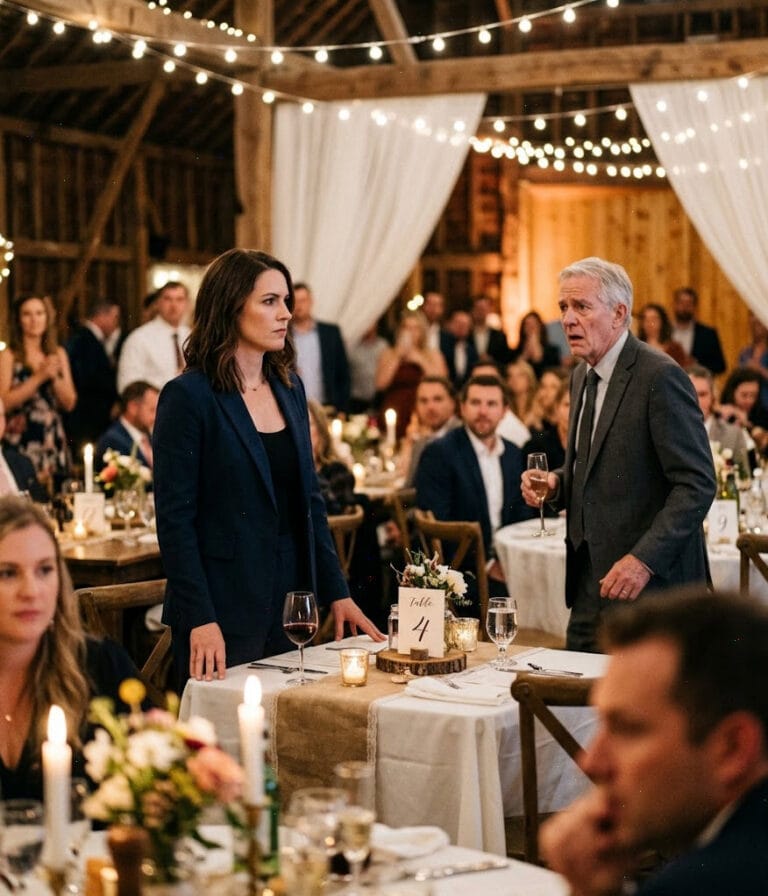
He spoke into the microphone like he owned the room.
Like he owned the barn, the string lights, the white drapery, and every person sitting underneath it.
His name was Richard Calloway. Silver-haired, heavy-watched, the kind of man who walks into spaces already written in the third person. And he had just told a room full of wedding guests — in polished, varnished, country-club language — that my sister was lucky to be marrying into something better than where she came from.
That “some relatives are better suited to support quietly.”
That was for me.
I sat there in my navy suit — the one I had pressed twice because this day mattered — and I felt the room shift before I fully processed what had happened. Lily’s face drained white. Ethan turned and hissed, “Dad—” but Richard kept going, smiling at the microphone like he was wrapping up a board presentation.
Lily was ten years old when our mother died.
I was twenty-two.
No one handed me a guide. No one handed me money. I learned to stretch a grocery run across nine days. I signed school forms with hands that shook from working a double shift the night before. I sat in pediatric waiting rooms at midnight, in plastic chairs bolted to linoleum floors, memorizing ceiling tiles because that was the only way I knew how to stay calm.
I braided her hair badly for three years before I got it right.
I taught her to laugh at things before she was old enough to understand them, because I needed her to know that laughter was still a tool she was allowed to use.
And this man — who had asked me three hours earlier whether I was “on the venue staff” because I was carrying centerpieces — had just implied in front of 140 people that Lily’s childhood was a rough circumstance she had thankfully escaped.
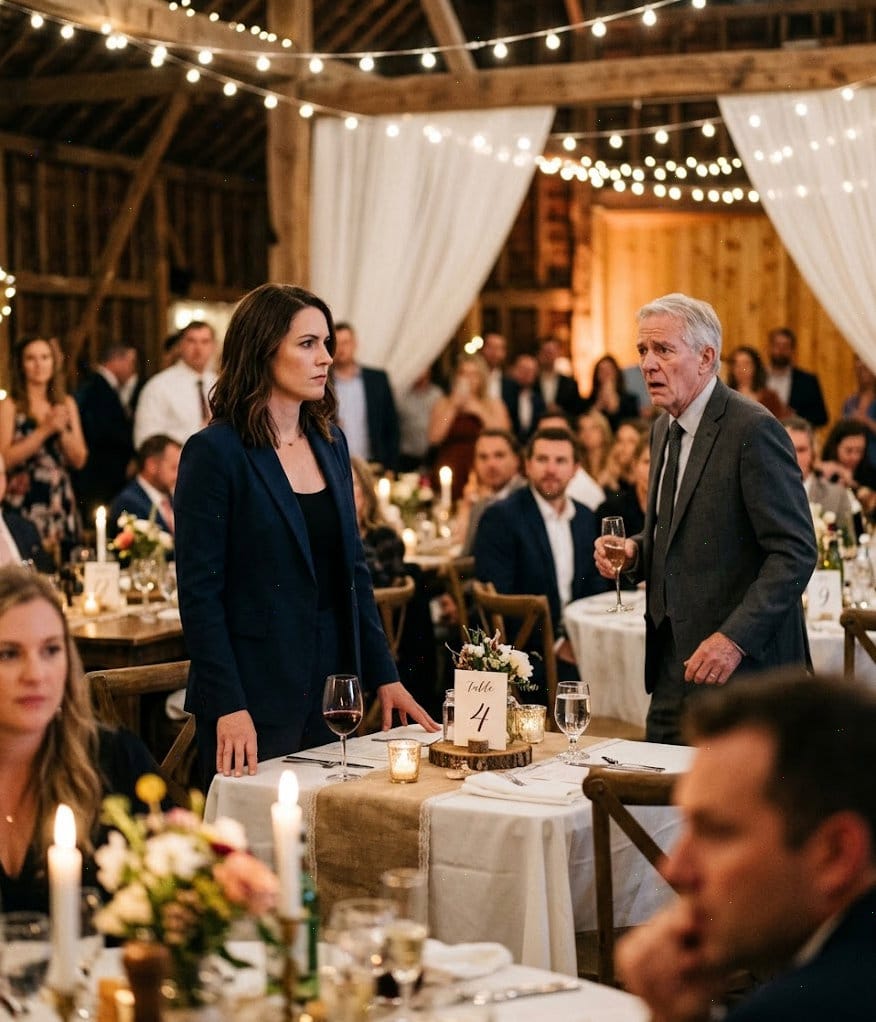
I pushed my chair back.
The legs scraped against the polished wood floor, and in the silence that followed Richard’s words, it sounded very loud.
I stood up.
He looked at me.
I looked at him across the white tablecloths and the trembling candle flames and the stunned faces of everyone I had spent the last sixteen years holding together.
I said it quietly. I didn’t need to be loud.
“Do you even know who I am?”
His face went pale.
Not embarrassed-pale. Not surprised-pale.
The other kind. The kind that happens when a man suddenly understands — too late, in public, with a microphone still in his hand — that he has made a very serious mistake.
Part 2: The Man Who Thought He’d Already Won
Richard recovered faster than I expected.
That’s what men like him do. They are practiced at recovery the way other people are practiced at apology — reflexively, without meaning, with enough charm to make the audience forget what they just witnessed.
He laughed softly into the microphone. “Well,” he said, glancing around the room with that silver smile, “it seems we have a passionate family member.” Light, easy. Like I had misread something he had intended as warm.
A few nervous guests laughed with him.
I understood what he was doing. He was offering the room a way out of the discomfort. And rooms full of dressed-up, champagne-holding people almost always take that exit when it is offered politely enough.
Ethan had gone rigid beside Lily. Lily’s hand was flat on the table, knuckles colorless. She looked at me with an expression I recognized from the night our mother died — that particular combination of terror and total trust that had first made me realize I was no longer just an older sister. I was the only solid thing in the room.
Richard set the microphone down and gave me a look.
Not hostile. Which somehow made it worse. It was the look of a man who has dismissed you and wants you to know it without saying it — a brief, practiced glance that said: sit down, this moment is over, I’ve already won it.
He turned back to the room and raised his champagne glass.
“To Ethan and Lily,” he said warmly. “May your future be everything you’ve worked for.”
The applause was genuine. Relieved. The sound of 140 people grateful that the tension had passed and they could go back to their salmon and their sparkling rosé.
And I was still standing.
I had been managing men like Richard Calloway my entire adult life. Not from a position of power — from a position of having absolutely nothing left to lose. When you are twenty-two years old and a ten-year-old is depending entirely on you, fear of conflict becomes a luxury you simply cannot afford. You learn to stand in rooms where people are louder, richer, and more confident, and you learn to be very, very still until it is your turn.
It was my turn now.
What Richard did not know — what no one in that barn except Lily knew — was what had been handed to me forty-eight hours earlier.
A document. A name. And a truth about Richard Calloway’s company, his “structure,” and his carefully constructed “values” that was about to make his toast the smallest mistake he had made all year.
I reached into my bag.
Part 3: The Turning Point
Forty-eight hours before the wedding, I had received a phone call from a woman named Diane Marsh.
Diane was a former financial controller at Calloway Property Group. She had worked there for eleven years before being let go six months ago — terminated, she said, after she flagged irregularities in how the company reported earnings on three mixed-use development projects in Asheville.
I knew Diane because she had been referred to me through a colleague. I work in corporate financial litigation. I am not loud about it at parties. I do not correct people when they assume I am in a supporting profession. I let people build their assumptions, because assumptions are almost always more useful to me than corrections.
Diane had documentation. Emails, internal reports, figures that didn’t align — a paper trail that described a very different picture of Richard Calloway’s “structure” and “values” than the one he delivered into microphones at weddings.
She had been trying to decide whether to come forward formally. She called me for advice.
After our conversation, she decided yes.
The documents were already with a regulatory attorney by Thursday evening.
I did not plan to use this at the wedding. I want to be clear about that. I had dressed in my navy suit with no intention other than watching my sister marry a man who loved her, eating too much, and crying quietly when no one was looking.
Richard Calloway chose to make this something else.
When I reached into my bag, I was not reaching for a weapon. I was reaching for something I had printed that morning — a single-page summary of the filing, which the attorney had sent me as a courtesy copy.
I walked toward the front of the room.
The guests went very quiet.
Part 4: The Final Confrontation
I did not take the microphone from him.
I simply walked to where he was standing, and I held the paper out, face-up, so that the words at the top were visible. The name of his company. The name of the regulatory body. The date.
I said, “My name is Claire Whitmore. I’m a financial litigation consultant. And I’ve been advising the attorney who filed a formal misconduct complaint against Calloway Property Group on Thursday.”
I watched his eyes move to the paper.
I watched his mouth stop working.
“I know about the Merriweather project,” I said. “I know about the Henderson Street reports. And I know about what happened to Diane Marsh when she tried to tell you the same thing I’m telling you now — that numbers, unlike people, do not stay quiet because you make them uncomfortable.”
The room had gone so still I could hear the string lights humming.
Richard’s champagne glass was still in his hand. He hadn’t put it down. He seemed to have forgotten it existed.
“You asked earlier,” I said, “whether some relatives were better suited to support quietly.” I folded the paper slowly. “I have been supporting my sister since she was ten years old. I learned her medications, her shoe sizes, her nightmares, her favorite books, and which teachers made her feel small so I could sit in those parent-teacher conferences and make those teachers reconsider their approach.”
My voice was level. I was not performing. I was simply saying the thing that had always been true.
“I paid the deposit on half this wedding. I spent four hours on the phone with the florist last month when the order came in wrong. I built a life with nothing so that my sister could stand in this barn tonight in a dress that fits her perfectly and smile without being afraid of what comes next.”
I looked at him directly.
“So yes, Richard. I know exactly who I am.”
Lily was crying quietly at the family table. Ethan had his arm around her and was not trying to stop her.
Richard Calloway set his champagne glass down on the nearest table.
He said nothing.
He walked out of the barn.
The room stayed very quiet for about four seconds. Then Ethan’s mother — a warm, small woman named Patricia who had been kind to me from the first time we met — began to clap. Slowly, then louder. Someone else joined. Then someone else.
I walked back to my seat.
Lily found me about ninety seconds later. She didn’t say anything for a long time. She just sat beside me with both arms around my shoulders, the way she used to do when she was small and the world felt too large.
“I know,” I told her. “I know.”
Conclusion: What I Learned Standing Up
I do not tell this story to celebrate humiliating someone publicly.
What Richard Calloway faces now is the consequence of his own choices — choices made long before he ever walked into that barn. I did not create his problem. I simply refused to pretend it did not exist.
What I learned in that barn — what sixteen years of quiet, invisible, unglamorous love had been building toward — is something I want to say clearly.
The people who build things without credit are not invisible. They are simply patient.
I was never waiting for a moment. I was never building toward a confrontation. I was building a person — a whole, capable, joyful woman who stood at the front of a restored barn in Asheville and married someone who looked at her like she was the most real thing he had ever seen.
That was the point of all of it.
Everything else — the navy suit, the paper, the silence when I said his company’s name — that was just what happened when a man mistook my silence for weakness.
Lily called me the next morning, the first morning of her marriage, and asked if I was okay.
I told her what I always tell her when she asks me that.
“I’m better than okay. I’m proud of you.”
She laughed in that way she has — the one I taught her, the one that sounds like everything is going to be fine.
It took me twelve years to teach her that laugh.
It was worth every minute.
Share this story if someone in your life deserves to be seen. Some people build entire worlds for others — and they deserve to be known.

Evan Cole Editor-in-Chief | Breaking News & Public Policy
“From Washington to Wall Street, and Main Street to Hollywood—Evan Cole connects the dots.”
As the Editor-in-Chief at Newskilo, Evan leads a dynamic team of journalists dedicated to uncovering the truth behind the headlines. With over 15 years in digital media, Evan has a reputation for cutting through the noise.
While he is widely recognized for his deep analysis of U.S. fiscal policy (IRS & Stimulus), Evan’s expertise extends to global current events, corporate accountability, and cultural trends. Whether he is breaking down a complex government bill, exposing a tech giant’s failure, or analyzing the societal impact of a viral celebrity moment, Evan’s goal is simple: To tell the stories that shape our world with clarity, accuracy, and integrity.
Leave a Reply