
My phone buzzed between gates at O’Hare, and for a second, the whole airport went muffled.
Lily (14): Mom… I woke up and Grandma left a note on my pillow. It says I have to move out.
I stepped out of the boarding line, backpack sliding off one shoulder, and called her. She answered on the first ring — whispering, like the house itself might overhear.
“Read it to me,” I said.
Paper rustled. Her voice trembled. “It says… ‘Pack your things and move out. We need to make space for your cousin. You’re not welcome.’ It’s signed by Grandpa and Grandma.”
My stomach dropped so hard it felt physical.
“Where are you right now?”
“In my room. They’re in the kitchen. They told me Aunt Rachel’s bringing Mason today and I should ‘be mature’ and go stay with a friend.”
A friend. Like my daughter was a sweater you toss aside when you need a bigger size.
“Lock your door. Put your phone on charger. Do not leave the house.” I was already walking. “I’m coming.”
“Mom, are they even allowed to—?”
“No,” I cut her off. “They are not.”
I wasn’t supposed to be home until Friday. A client meeting in Denver. A signed contract. A hotel already paid for. None of it mattered anymore.
I walked straight to the airline counter, bought the next flight back to Richmond, and texted my attorney from the terminal: Emergency. Need papers printed and ready.
Three hours later I was pulling into my driveway, knuckles bone-white on the steering wheel. The house looked exactly like it always does — white siding, blue shutters, the wreath Lily made in art class. Quiet. Peaceful. Like nothing inside it was already in pieces.
I opened the front door. The smell of coffee hit me first.
Then my mother’s voice, bright and pleased: “We’re doing what’s best for the family.”
My father turned, saw me, and his smile flickered. “Nora? You’re supposed to be—”
I walked past him. “Lily.”
She appeared at the top of the stairs, face blotchy from crying, a backpack half-zipped at her feet like she had been genuinely preparing for exile.
My chest tightened so hard it hurt.
“I’m here,” I told her.
Then I turned back to face my parents.
My mother lifted her chin. “Don’t start. Rachel needs help. Mason needs stability. Lily can stay with a friend for a while.”
My father nodded. “It’s crowded. We can’t have everyone under one roof.”
I looked at him. Steady. Quiet.
“You mean you can’t have everyone under my roof.”
My mother’s eyes narrowed. “Excuse me?”
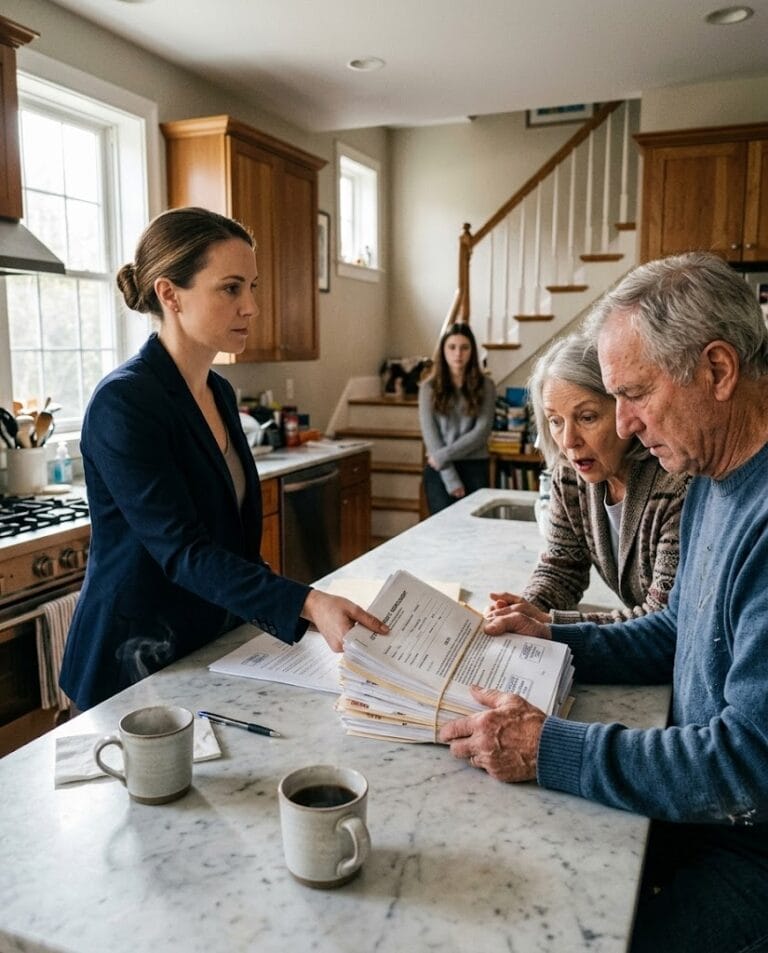
I reached into my tote and pulled out a thick envelope — freshly printed, stapled, still warm from the attorney’s office. I didn’t raise my voice. I didn’t have to.
I placed it on the counter in front of my father.
“Read it,” I said.
He flipped it open. My mother leaned in. And as their eyes moved down the first page, the color drained from both their faces at exactly the same time.
My father swallowed hard. “Wait — what? How…?”
My mother whispered, suddenly very small: “Nora… this can’t be real.”
Part 2: The Day They Realized What They Didn’t Know
My father’s hands were shaking.
Not a little. The kind of shaking that happens when the ground drops out from under a story someone has been telling themselves for years.
My mother set the papers down on the counter slowly, like they were hot.
“This is a mistake,” she said. Her voice had lost that bright, certain edge entirely. “There’s clearly been a mistake.”
My father kept staring at the first page. He flipped to the second. Then back to the first.
Meanwhile, I walked to the bottom of the stairs, looked up at Lily, and said, “Go unpack your bag, sweetheart. You’re not going anywhere.”
She looked at me. Then at them. Then she disappeared down the hallway, and I heard the soft click of her bedroom door.
My mother found her voice again — that sharp, offended tone she uses when she senses control slipping. “You had no right to do this without discussing it with us. This is a family matter. We were simply trying to help Rachel—”
“Help Rachel,” I repeated. I pulled out a chair at my own kitchen table and sat down. “By leaving a note on my daughter’s pillow.“
My father looked up. His face had gone completely gray.
“We didn’t know,” he said, almost to himself.
And that was the thing — they genuinely hadn’t known.
Because for six years, I had never told them.
Let me go back to the beginning, because you need to understand how a family ends up in a kitchen like this, with legal papers between them and coffee going cold on the counter.
My parents retired to Richmond four years before Lily and I moved there. When Marcus and I divorced, I needed a fresh start — a real one, not the kind you fake. Richmond made sense. My parents were there. Lily was nine. It felt like the responsible thing.
I had been working in corporate consulting for eleven years by then. I had savings. I had discipline. And when I found the house on Dellwood Court — white siding, blue shutters, a yard big enough for a kid to grow up in — I bought it.
I bought it.
My name on the deed. My down payment. My mortgage. My signature on every single line.
But I was also my parents’ daughter. I was raised to keep things smooth. To not make waves. So when they moved in temporarily after my father’s knee surgery, and “temporarily” stretched into a year, and then two — I let it go. I traveled for work. They helped with Lily. It felt, on the surface, like a system.
What I hadn’t realized was the story they’d begun telling themselves.
That the house was theirs too, in some meaningful way. That their presence had made it functional. That they were, in some unspoken arrangement, the ones running things. The ones in charge.
They had been guests who had quietly promoted themselves to landlords.
And nobody had corrected them.
Until now.
Part 3: The Turning Point — What Was Actually in That Envelope
The papers were not a threat.
They were not drawn up in anger. They were not a bluff.
I had spoken to my attorney — Karen, who has handled every significant legal moment of my adult life — three hours before I landed in Richmond. I told her what had happened. I told her what I needed.
She had everything ready when my Uber pulled up to her office.
The envelope contained two documents.
The first was a copy of the original property deed for 4417 Dellwood Court, Richmond, Virginia — showing my name, and only my name, as the sole legal owner of the property.
The second was a formal notice of tenancy — not eviction, not yet — which legally established my parents’ status in the home. Not as co-owners. Not as family members with implied rights.
As guests.
Guests who were now being formally informed of the actual ownership arrangement, in writing, with Karen’s firm letterhead at the top.
It wasn’t cruel. It was clean.
But it was the first time in six years that a legal document had placed the truth in a room with all of us at the same time.
On the flight home, somewhere over Ohio, my hands had stopped shaking and gone very still. I’m not an angry person by nature. I don’t carry grudges well — they’re heavy, and I’ve always traveled light.
But there is a specific kind of grief that comes from realizing people you love have been looking at your life as an asset they could rearrange.
That note on Lily’s pillow wasn’t just rude.
It was my parents acting as though they had the authority to expel a child from her own home — and genuinely believing they did.
That belief had to end.
So I sat on the plane and made my decision. Not from rage. From clarity.
Part 4: The Final Confrontation — The Moment They Understood
My mother read the deed page three times.
I watched her eyes track back to the top on the third pass, the way you reread something when the words say exactly what you don’t want them to say.
“This doesn’t change anything,” she said finally. Her chin was still up, but something behind her eyes had shifted. “You’re still our daughter. This is still our family.”
“It does change one specific thing,” I said. “It changes who had the authority to leave that note on Lily’s pillow this morning.”
My father set the papers down on the counter very carefully. He didn’t look at my mother. He looked at the papers, then at the space between his hands.
“We thought—” he started.
“I know what you thought,” I said. “That’s why I needed you to see this.”
“Nora.” My mother’s voice broke slightly. Not into tears — into something more exposed than tears. Into the particular sound of a person whose version of events has just publicly collapsed. “We have been here for four years. We have helped raise that child. We have—”
“I know,” I said, and I meant it. “And I’m grateful for that. I have never not been grateful for that.” I kept my voice even. “But gratitude is not a deed. It is not a mortgage. It is not a legal right to leave handwritten notes telling my daughter she is not welcome in my house.”
My father finally looked up.
“Where is Aunt Rachel taking Mason?” I asked.
Neither of them answered.
“Because I spoke to Rachel on the drive here,” I continued. “She told me she hadn’t asked for Mason to come here. She said you had offered — without asking her, and without asking me.”
My mother opened her mouth.
“She also said Mason has a perfectly stable placement and hasn’t needed to move anywhere.” I folded my hands on the table. “So I’m just trying to understand what this morning was actually about.”
The silence in that kitchen was unlike any silence I had ever sat in before.
My father rubbed his face with both hands. When he dropped them, he looked old in a way I hadn’t seen before — not tired, but diminished.
“We thought it was our home too,” he said quietly. “After everything.”
“I know you did,” I said. “And that’s on me, a little. I should have had this conversation years ago. I didn’t, because I wanted to keep the peace. And keeping the peace cost Lily a morning of believing she was being thrown out of her own house.” My voice tightened on the last few words, but I held it. “That’s the part I can’t let go.”
My mother looked at me for a long time.
She didn’t apologize that day. I won’t pretend she did.
But she was quiet in a way she had never been quiet around me before.
And sometimes, with certain people, quiet is the closest thing to reckoning you’re going to get.
What Came After
My parents moved out six weeks later.
I helped them find a rental in a neighborhood they liked, two miles away. I paid the first month’s deposit. I drove my father to his physical therapy appointments for the next four months.
We are not estranged. We are not at war.
But we are honest now, in a way we weren’t before.
Lily doesn’t know the full story yet. She knows I handled it. She knows she didn’t have to leave. She knows I got on a plane.
Someday, when she’s older, I’ll tell her the rest.
I’ll tell her that nobody — not grandparents, not aunts, not anyone with a history or a claim or a complicated feeling about your existence — has the right to make you feel like a guest in your own life.
And I’ll tell her the most important thing I know, which I learned standing at my own kitchen counter holding a stack of legal papers:
The people who love you will not ask you to make yourself smaller to fit their comfort.
And the people who ask you to make yourself smaller?
Make sure they know exactly whose name is on the deed.

Evan Cole Editor-in-Chief | Breaking News & Public Policy
“From Washington to Wall Street, and Main Street to Hollywood—Evan Cole connects the dots.”
As the Editor-in-Chief at Newskilo, Evan leads a dynamic team of journalists dedicated to uncovering the truth behind the headlines. With over 15 years in digital media, Evan has a reputation for cutting through the noise.
While he is widely recognized for his deep analysis of U.S. fiscal policy (IRS & Stimulus), Evan’s expertise extends to global current events, corporate accountability, and cultural trends. Whether he is breaking down a complex government bill, exposing a tech giant’s failure, or analyzing the societal impact of a viral celebrity moment, Evan’s goal is simple: To tell the stories that shape our world with clarity, accuracy, and integrity.
Leave a Reply