
I came home from the hospital with my newborn son and a heart full of exhausted joy. Three days of labor, two days of recovery, and all I wanted was to walk through my own front door and hold my four-year-old again.
The second I stepped inside, something felt wrong.
Not wrong like a mess or a bad smell. Wrong like the air itself had changed. The kind of wrong your body registers before your brain does.
My husband Daniel was smiling too fast. Reaching for my bags too eagerly. Telling me to sit, to rest, to let him handle everything. My mother-in-law Margaret was right behind him, holding a casserole dish like it was a shield, using that particular helpful voice she saves for when she wants a thank-you later.
“You shouldn’t even be standing,” she said. “You just gave birth.”
I barely heard her.
Because I had already spotted Emma.
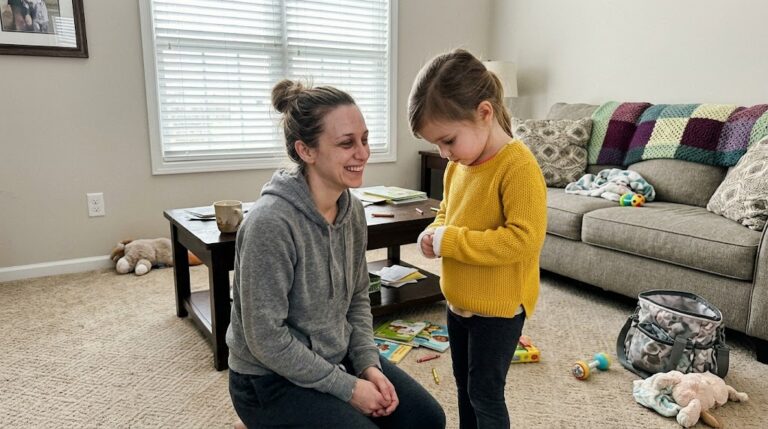
My four-year-old daughter — the kid who narrates cartoons to herself, sings to her dolls at full volume, and shouts “MOMMY!” like it’s a national holiday every time I walk through a door — was sitting on the rug by the couch, completely still.
She was wearing the yellow sweater I’d laid out for her three days earlier. She hadn’t moved. Hadn’t looked up. Hadn’t made a sound.
Her hands were folded in her lap so tight her knuckles had gone white.
I handed the baby carrier to Daniel and walked straight to her.
“Emma?”
She flinched. Not big. Not dramatic. Just a tiny recoil, like my voice had pulled her back from somewhere dark.
I knelt down. Up close, she looked pale and hollow-eyed. And then I saw it — on the inside of her wrist, just barely visible beneath her sleeve.
A bruise. The shape of fingers.
A cold wave moved through my entire body from my scalp to my feet.
I kept my voice steady with everything I had. “What happened while Mommy was gone?”
Emma’s eyes met mine. They weren’t confused. They weren’t sad. They were afraid.
Her lower lip trembled and she leaned in close, barely a breath, and whispered two words that stopped the world.
“…Dad and Grandma…”
I stood up. I took my keys off the entry table. I picked Emma up.
Daniel’s voice went sharp. “Where are you going?”
Margaret stepped toward me. “Don’t be ridiculous—”
I looked at my daughter’s wrist. I looked at my husband’s face. And in that single second, I saw something in his expression that confirmed every terrible thing I was already thinking.
I walked out that door and I did not stop.
Part 2: What the Walls Had Been Hiding
I drove to the police station with Emma buckled in the back seat, my newborn son in his carrier beside her, and my hands shaking so badly I had to grip the steering wheel with both fists just to keep steady.
Emma was quiet the whole drive. She held her doll against her chest and stared out the window and didn’t say another word.
I kept checking the rearview mirror. Kept watching her eyes.
At the station, a female officer named Reyes took us into a side room with a low table and a box of crayons and a poster of a cartoon dog on the wall. She sat with Emma while I sat nearby, trying to keep my breathing normal, trying not to fall apart in front of my daughter.
What Emma told Officer Reyes over the next hour destroyed me.
Daniel had been drinking. Not the way normal people drink at a family dinner — the other kind. The hidden kind. The kind that had apparently been going on for months without me seeing it clearly because I was nine months pregnant and exhausted and telling myself the signs meant something else.
On the second night I was in the hospital, he’d lost his temper with Emma over something as small as a spilled cup of juice.
Margaret had been in the kitchen. She heard it happen. She did not intervene.
She told Emma afterward, in that stiff, practical voice of hers, not to say anything because it would “upset Mommy during a hard time.”
Emma had spent three days keeping that secret. Sitting in her yellow sweater. Folding her hands in her lap. Being very, very quiet.
My four-year-old had been protecting me.
I pressed my hand over my mouth in that small room with the cartoon dog on the wall and I made myself hold it together for exactly as long as it took to sign the initial report.
Then I stepped into the hallway, and I let myself break.
Part 3: The Quiet Before
Child Protective Services opened a case within 24 hours.
I took Emma and the baby to my sister Carla’s house in Naperville — she had a spare room, a Lab named Biscuit who Emma loved, and zero tolerance for Daniel, which she’d been quietly maintaining for two years before I was ready to hear it.
I didn’t return Daniel’s calls. I didn’t respond to Margaret’s texts, which cycled rapidly from apologetic to accusatory to a final message that said: You’re destroying this family over nothing.
Over nothing.
I took a screenshot of that one and sent it directly to my attorney.
I spent those first two weeks in Carla’s guest room doing four things: nursing my son, watching Emma slowly come back to herself, coordinating with CPS, and building a paper trail that a freight train couldn’t derail.
Phone records. A journal I found in Emma’s room that a child psychologist later described as a four-year-old’s attempt to “organize scary feelings.” Medical photos of the bruise taken at the station. A neighbor — a retired schoolteacher named Pat who lived two doors down and had always made Daniel nervous for reasons I now understood — who had seen things through the window that she was willing to put in writing.
I did not do any of this in anger. I did it quietly. Methodically. The way you do something when you know you only get one shot and you cannot afford to miss.
Daniel called me 34 times in the first week. On the 35th call, he left a voicemail telling me I was “overreacting” and that Margaret “barely touched her.”
I saved that one too.
Part 4: The Day It All Came Down
The family court hearing was on a Thursday morning in March.
Daniel showed up in a gray suit I recognized from our wedding rehearsal dinner. Margaret sat behind him in a cream-colored blazer, her posture perfectly straight, her expression carefully arranged into something that was meant to look like dignity.
I sat across the aisle with my attorney and thought about Emma whispering in my ear in our living room.
The judge reviewed the CPS findings. The medical documentation. Pat’s written statement. The voicemail.
When Daniel’s attorney tried to characterize the incident as “an isolated moment during an extremely stressful week,” the judge stopped him mid-sentence.
She didn’t raise her voice. She didn’t need to.
She looked at Daniel and said, very evenly, “Your four-year-old daughter spent three days in silence because she was afraid. That is not a stressful week. That is a failure of protection.”
Daniel opened his mouth. His attorney put a hand on his arm.
Margaret, for the first time in the years I had known her, had nothing to say.
I got primary physical custody. Supervised visitation for Daniel, pending completion of a certified alcohol treatment program and a psychological evaluation. A formal no-contact order for Margaret until the full review was complete.
I walked out of that courthouse with my attorney beside me and stood in the parking lot in the cold March air and called Carla.
She picked up on the first ring.
“Well?” she said.
I couldn’t speak for a second.
“We’re okay,” I finally said. “We’re going to be okay.”
Aftermath
Emma started seeing a child therapist named Dr. Holt twice a week. Within a month, she was singing to her dolls again.
Within six weeks, she started shouting “MOMMY!” when I walked into a room.
The first time she did it, I sat down on the kitchen floor of Carla’s house and cried like I hadn’t cried since that first night at the station.
My son is four months old now. He has no idea what happened before his life really started. Someday, when both of them are old enough, I’ll figure out what to tell them.
What I know is this: the moment Emma flinched at the sound of my voice — not because she was startled, but because something had made her afraid — was the moment I understood that being a mother is not about keeping the peace.
It is about keeping your children safe. Even when it costs you everything you thought your life was.
Especially then.

Evan Cole Editor-in-Chief | Breaking News & Public Policy
“From Washington to Wall Street, and Main Street to Hollywood—Evan Cole connects the dots.”
As the Editor-in-Chief at Newskilo, Evan leads a dynamic team of journalists dedicated to uncovering the truth behind the headlines. With over 15 years in digital media, Evan has a reputation for cutting through the noise.
While he is widely recognized for his deep analysis of U.S. fiscal policy (IRS & Stimulus), Evan’s expertise extends to global current events, corporate accountability, and cultural trends. Whether he is breaking down a complex government bill, exposing a tech giant’s failure, or analyzing the societal impact of a viral celebrity moment, Evan’s goal is simple: To tell the stories that shape our world with clarity, accuracy, and integrity.
Leave a Reply