
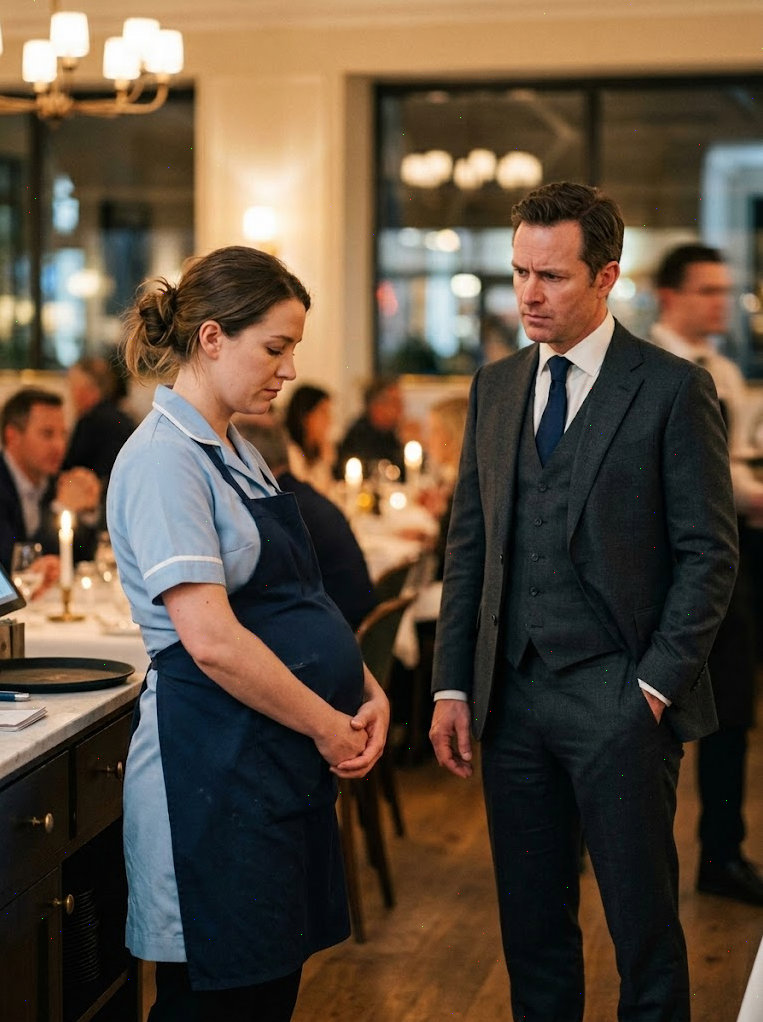
I had just closed a $40 million deal that afternoon.
My assistant had booked the best table at Vincenzo’s to celebrate. I was sitting there, jacket on, glass of wine in hand, feeling like a man who had finally won at everything.
Then she walked out of the kitchen carrying a tray.
Pale blue uniform. Hair pulled back. Moving slowly, carefully, the way pregnant women do when their bodies have become something they have to negotiate with.
My ex-wife. Elena.
We had signed the divorce papers two years ago. I had told myself it was the right thing. That we wanted different lives. That love sometimes just runs out of road. I had told myself all of it, every night, until I almost believed it.
But sitting there watching her balance that heavy tray between tables, my chest did something I was not prepared for. She hadn’t seen me yet.
The hostess leaned close to her and whispered something. I watched Elena’s face change. She looked up slowly, the way you do when you already know what you’re going to find.
Our eyes met across that crowded room.
She did not smile. She gripped the tray a little tighter and turned back toward her tables.
I excused myself from my business partner and crossed the floor. She was at the service station, refilling a water pitcher, eyes down.
“Elena,” I said.
She went very still.
“Please,” she whispered. “Not here. Not tonight.”
“Then tell me when,” I said. “Because I’m not leaving without understanding what I’m looking at.”
She set the pitcher down. Her hand was shaking. And when she finally looked up at me, I saw something I hadn’t seen in two years of silence and distance — she was terrified. Not of me. Of what she was about to say.
Part 2: What Two Years of Silence Had Been Hiding
Her shift ended at nine.
I waited in my car in the parking lot like some kind of man I didn’t recognize. My phone buzzed with messages from Drew asking where I had gone. I left them all unread.
Elena came out through the side door, coat over her uniform, moving slowly in the cold air. She stopped when she saw me leaning against my car.
For a long moment, neither of us spoke.
“How long?” I finally asked.
“Seven months,” she said.
Seven months. I did the math without meaning to. Seven months ago I had been in Tokyo for three weeks closing the Pacific Rim contracts. Elena and I had been divorced for five months at that point.
“Whose is it?” I asked.
The question came out harder than I intended. She flinched.
“Does it matter?” she said.
“It matters to me.”
She looked at the ground, then back up. Her eyes were wet, but her chin was set in the way I remembered. Elena had always cried quietly and stood straight at the same time. It had been one of the things I had loved most about her.
“His name was Marco,” she said. “We dated for three months. He left when I told him.”
Something moved through me that I couldn’t name right away. It took me a few seconds to understand it was relief. And then, immediately after, shame — because she had been alone for seven months carrying a child, working double shifts at a restaurant, and I had been closing deals and celebrating in fine dining rooms and never once picked up the phone to ask how she was.
“Why didn’t you call me?” I said. My voice came out rough.
“We’re divorced, Nathan,” she said quietly. “You aren’t responsible for my life.”
“You were my wife for six years.”
“Were,” she said. “Past tense.”
She pulled her coat tighter. She looked exhausted in the bone-deep way that goes beyond one bad night. This was months of exhaustion, the kind that settles in and makes a home.
“I have to go,” she said. “I have an early shift tomorrow.”
“Let me drive you.”
She hesitated. And then, because she was seven months pregnant and it was cold and she was tired, she said yes.
Part 3: The Night I Started Paying Attention
I drove her to a small apartment building twenty minutes from the restaurant.
It was nothing like the house we had shared. Three floors, no elevator, a buzzing light above the entrance. She had her hand on the door handle before I had fully stopped the car.
“Elena,” I said.
She paused.
“I know I don’t have the right to ask for anything,” I said. “But I need you to know — if you need help, I’m here.”
She looked at me for a long moment.
“You were never not here, Nathan,” she said quietly. “You were just never present.“
She got out of the car and walked to her door.
I sat in that parking lot for a long time after her light came on in the window.
She was right. That had been the whole problem, the entire architecture of our failure. I had provided everything except the one thing she had actually needed: my attention. My time. The parts of me that weren’t already spoken for by boardrooms and flight schedules and quarterly targets.
I had thought love was about what you built. Elena had always known it was about who you showed up as.
I drove home. I sat in my apartment — the one I had bought after the divorce, modern and empty and aggressively expensive — and I thought about what a man is supposed to do when he has been handed a second chance he hasn’t earned.
I called my attorney the next morning. Not for any legal reason. Just to understand what, if anything, I was allowed to offer.
Then I started paying attention the way I should have six years ago.
Part 4: The Conversation That Changed Everything
I showed up at the restaurant three days later during her break.
I didn’t call ahead. I brought two cups of tea from the place down the block that she had always liked, and I sat at the small table near the back exit and waited.
She came out through the kitchen door, saw me, and stopped walking.
“Nathan.”
“I brought tea,” I said. “The kind with cardamom.”
She looked at the cups. She sat down.
For a while we just sat there. The kitchen noise came through the door in waves — clattering, voices, the hiss of something on a hot pan.
“I’m not here to complicate your life,” I said. “I need you to know that first.”
“Then what are you here for?”
“I’m here because I spent three days thinking about what you said in the car,” I said. “About being present. And I think I owe you a real conversation about who I was when we were married. Not an argument. Not a defense. Just the truth.”
She wrapped her hands around her cup.
“I was so focused on building something,” I said, “that I forgot to live in it. You kept telling me. In a hundred different ways, you kept telling me. And I kept saying soon, after this deal, after this quarter. And then one day you stopped asking.”
Her eyes were steady on mine.
“The day you stopped asking,” I said, “was the day I should have understood something was over. But I didn’t. I just noticed the quiet and was relieved.”
She was quiet for a moment.
“I didn’t stop asking because I stopped caring,” she said finally. “I stopped asking because I got tired of feeling like a problem you were managing.”
That landed exactly where it was meant to.
“I know,” I said.
“I don’t want your money, Nathan.”
“I know that too.”
“Then what are you actually asking me for?”
I looked at her — really looked, the way I hadn’t in years. The tiredness in her face. The strength in it. The way she was doing all of this, all of it, alone and without complaint and without asking anyone for a single thing.
“I’m asking for a chance to be different,” I said. “Not your husband. Not anything you don’t want me to be. But present. The way I never was.”
The kitchen door banged open and a busboy walked past us without looking up.
Elena looked at her tea for a long time.
“I have a doctor’s appointment Friday,” she said at last. “The big one. Where they confirm everything is okay.”
She paused.
“I’ve been going alone.”
She didn’t say anything more than that. She didn’t have to.
“I’ll be there,” I said.
She nodded once, slowly, and went back to work.
The Life We Built From the Wreckage
Elena’s daughter was born six weeks later.
She named her Rose.
I was in the waiting room when she arrived, not in the delivery room — that wasn’t my place, not yet, maybe not ever in the way I had once imagined. But I was there. Present. For the first time in a long time.
We did not get back together the way stories like this are supposed to end. Life is not a film where love is enough to erase the years of damage. We were two people who had hurt each other and needed to build trust from scratch, carefully, on honest ground.
What we became was something harder to name and more real than what we had before: a friendship, a partnership, a steady presence in each other’s lives and in Rose’s. I was there for her first word and her first steps and the nights when Elena was too tired to manage alone.
I sold the empty apartment and bought a house ten minutes from Elena’s. Not to crowd her. Because proximity is how you show up.
Elena still works. Not at Vincenzo’s — she moved to a management role at a hotel group six months after Rose was born. She is sharp and capable and she always was. She just needed the ground under her feet to stabilize.
I still close deals. I still travel. But I come back. And when I come back, I am actually here.
Here is what I know now, sitting across from a two-year-old girl who has her mother’s eyes and absolutely no idea what it cost the two people who love her most to become the people they needed to be:
You can build an empire and still lose everything that matters. The real work is never on a balance sheet.
I was a millionaire the night I walked into that restaurant.
But I walked out of that parking lot — that first night, watching her light come on in the window — as something I had never managed to be before.
A man who was finally paying attention.
If this story stayed with you, share it with someone who needed to read it today.

Evan Cole Editor-in-Chief | Breaking News & Public Policy
“From Washington to Wall Street, and Main Street to Hollywood—Evan Cole connects the dots.”
As the Editor-in-Chief at Newskilo, Evan leads a dynamic team of journalists dedicated to uncovering the truth behind the headlines. With over 15 years in digital media, Evan has a reputation for cutting through the noise.
While he is widely recognized for his deep analysis of U.S. fiscal policy (IRS & Stimulus), Evan’s expertise extends to global current events, corporate accountability, and cultural trends. Whether he is breaking down a complex government bill, exposing a tech giant’s failure, or analyzing the societal impact of a viral celebrity moment, Evan’s goal is simple: To tell the stories that shape our world with clarity, accuracy, and integrity.
Leave a Reply