
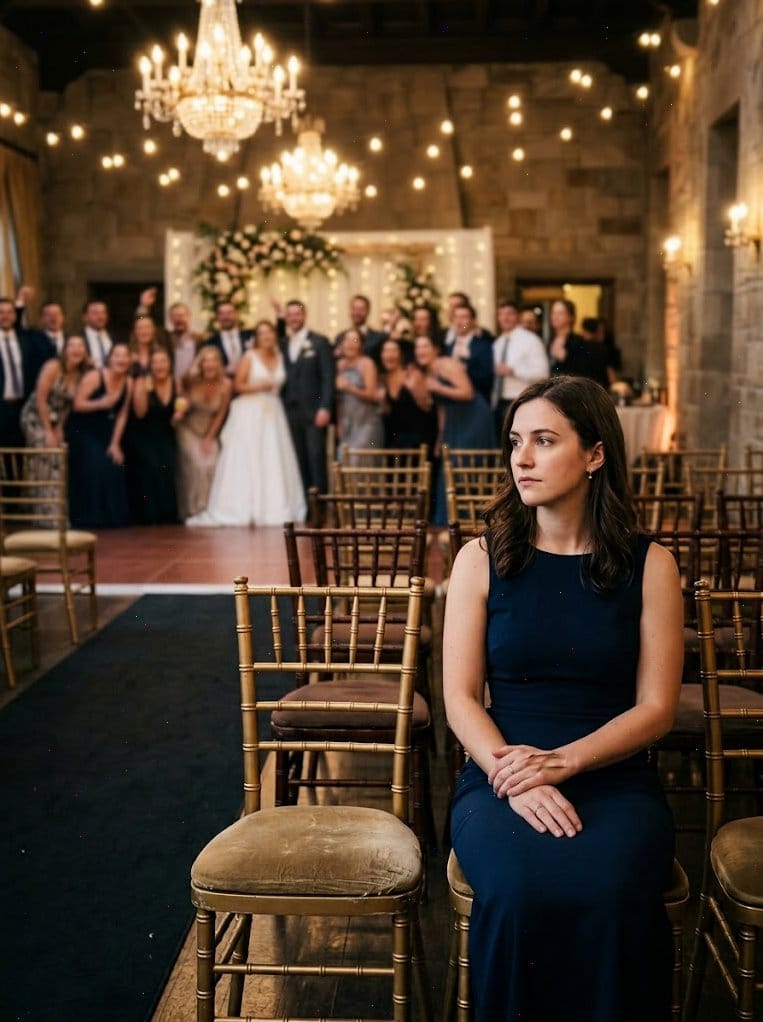
My mother’s message sat in my phone like something sharp I couldn’t stop touching.
“Sophia, we need to talk about your seating. Considering the guest list, it’s best if you sit toward the back during the ceremony and skip the formal photos. Clare’s future in-laws are very prominent. You understand, right?”
I read it four times. Each time, I gave the words the benefit of the doubt. Each time, they meant exactly what I feared.
This was my sister’s wedding. My own family. And I had just been quietly, politely, asked to disappear.
I know what it feels like to be the one who doesn’t fit. I’ve known it for most of my life. I’m twenty-seven, a policy analyst in Washington D.C.—a job that turns heads at cocktail parties but never once turned my mother’s. To her, I was always the one who made things complicated. The one who asked too many questions at the dinner table. The one who didn’t marry by twenty-five, didn’t follow the path Clare followed, didn’t shape herself into the version of a daughter that photographs well next to wealthy strangers.
Clare had always been the one who understood the game. I didn’t blame her entirely. When love inside a family comes with invisible conditions, you learn early how to meet them. Clare learned. She built her life around it. And now she was marrying James Wellington, whose family carried the kind of name that got whole hospital wings named after them.
My mother treated the Wellingtons like a second chance at everything she felt she’d missed. Margaret Wellington, James’s mother, became the standard by which my mother measured every room she walked into.
I typed back: I’ll be there. Sit me wherever you think is best.
Not out of weakness. Out of restraint. I refused to turn my sister’s wedding into a confrontation she didn’t deserve.
Then my phone rang.
Daniel.
Even after a year together, something about his name still surprised me in a quiet way. We met at a formal reception fourteen months before—two people standing slightly off to the side of a room that felt staged and airless. He noticed me studying the ceiling molding instead of working the crowd. He made a dry, specific joke. I laughed a real laugh—not a polished one. We talked for nearly two hours, and at some point I stopped tracking time altogether.
That was what I noticed first: he listened. Completely. He didn’t scan the room while I was speaking. He didn’t wait for his turn to talk. He just listened like what I was saying actually mattered.
What my family didn’t know—what I had kept deliberately, carefully private for over a year—was who Daniel was outside of our relationship. Not just to me. To the world.
“Hey,” I answered.
“Hey.” His voice was steady but careful. “The security team just contacted me. About a wedding this weekend.”
My chest went tight. “They called you directly?”
“They flagged my name during a local advance security check,” he said. “Sophia—were you going to tell me about this?”
I leaned against the counter. Stared at the ceiling fan turning slowly overhead.
“I didn’t think you’d want to come.”
“Why wouldn’t I?”
“My family is… complicated.”
“How complicated?”
The words were harder to say than I expected. “They’re seating me in the back. Leaving me out of the photos.” I took a breath. “Because they think I might embarrass them.”
Silence stretched across the line.
Then, quietly: “So they’re trying to hide you.”
He said it the way you’d say something that genuinely didn’t compute. Not with anger—with a kind of bewildered disbelief. Like hiding me was a category of action that simply had no logic to him.
Something in my chest cracked open.
“I’ll be there Saturday,” he said.
“Daniel, you don’t have to—”
“I’ll be there. Save me the seat next to you.”
Part 2: The Day My Mother Finally Looked at Me
I arrived at the venue forty-five minutes early, in the navy dress I’d spent three days second-guessing. I told myself it was appropriate. Understated. Forgettable in all the right ways.
My mother was waiting near the entrance. She greeted me with a hug that lasted exactly as long as it needed to and guided me toward the back rows before I’d even set down my clutch.
“You look lovely,” she said.
You’ll do.
The hall was everything the Wellingtons would have approved of. Cream roses. Tall pillar candles. Gold-rimmed chairs arranged in perfect symmetry. Staff moved silently between the rows like they’d rehearsed it. Everything was curated, considered, expensive in the way that tries not to look expensive.
Clare appeared from a side corridor in her gown and took my breath away—not because of the dress, but because beneath all the white lace and soft curls, she still looked like my sister. Still had that small crease between her brows when she was nervous. Still fidgeted with her rings.
I waved. She waved back. Then someone from the Wellington side appeared at her elbow and her attention slid away, and that was that.
Margaret Wellington held court near the front. My mother orbited her like a satellite that had been waiting its entire life to be caught by that particular gravity. I watched from the back as my mother laughed at something Margaret said—head tilted, hand briefly touching Margaret’s arm—and felt the distance between us close into something harder.
At one point, Margaret’s gaze drifted across the room and landed near me—not on me, just near—and my mother shifted, just slightly, repositioning her body so the natural flow of the conversation redirected away from where I sat.
She didn’t even think about it. It was automatic. The way you move away from a shadow without deciding to.
That small pivot. That instinctive correction.
I pressed my palms flat against my thighs and breathed through it.
Then, thirty-eight minutes before the ceremony, a man in a dark fitted suit appeared at the main hall entrance. He wore a wire earpiece. He moved with the particular calm of someone trained to make themselves invisible while seeing everything. He spoke quietly to the venue’s event coordinator, who nodded once, briskly, and then began quietly, efficiently clearing the back section of the hall.
Guests were redirected with polite smiles and no explanation.
Within four minutes, the space around me had emptied out.
My mother stood at the front of the hall and watched this happen with an expression I couldn’t fully read from where I sat. Her eyes moved across the emptying rows, then landed on me—sitting alone in the back, completely unbothered—and I saw it happen in real time.
The first crack in her certainty.
Her lips parted slightly. Her chin lifted. She was doing the math, and the numbers weren’t adding up yet.
My phone lit up.
“Two minutes out. Save me that seat.”
I looked up from the screen. My mother was still watching me. And for the first time in as long as I could remember, she was the one who looked uncertain.
Part 3: The Turning Point — What She Never Asked About
People assume that when you keep a relationship private, it’s because you’re ashamed of it. Or afraid. Or protecting yourself from something.
I kept Daniel private because he asked me to. He’d spent years watching people reframe themselves entirely just to get close to him—changing opinions, adjusting personalities, performing warmth at a frequency calculated to impress. He was exhausted by it before we even met.
What he wanted was something real. A relationship that existed because two people genuinely chose it, not because one of them needed proximity to his world.
So we were careful. I didn’t post about him. He didn’t appear in my social media. When people asked if I was seeing anyone, I said yes, and left it there. Not a lie. Not a performance.
My family had never thought to ask about my life in any real detail. My job was an abstraction to them. My apartment in D.C., my friendships, the person I’d become in the years since I stopped trying to meet their expectations—none of it had ever registered as interesting or important.
My mother knew I was dating someone. She knew it had been over a year. She had never once asked his name.
That’s the thing about being dismissed: people stop paying attention to you before they ever realize what they’re missing.
Daniel had asked me, the night before the wedding, if I was ready for what might happen. I told him I wasn’t sure what was going to happen. He said: “Neither am I. But I’ll be next to you. That much I know.”
I held that. Carried it into the morning.
I sat in my assigned seat near the back of that beautiful, immaculate hall, alone, surrounded by empty chairs that had been cleared by a team whose job was to prepare a room for his arrival.
And I waited.
Part 4: The Final Confrontation — When the Room Changed
The doors opened.
He walked in with two members of his advance team flanking him at a discreet distance. He wore a charcoal suit, no tie, and the particular expression he wore when he was trying to be present without creating a scene.
He found me immediately. Crossed the room directly toward me.
The hall, which had been running at the full-volume hum of pre-ceremony conversation, dropped by about forty percent in the span of fifteen seconds. I watched people notice. I watched them look. I watched the sequence of recognition move across faces like a slow wave.
He reached my row, stepped past the empty chairs, and sat down beside me.
“Hey,” he said.
“Hey,” I said. “You made it.”
“I said I would.”
He reached over and took my hand.
From the front of the hall, I could feel my mother watching. I didn’t turn to look. I didn’t need to.
Margaret Wellington, however—I heard her. The sharp inhale. The low, controlled murmur to someone beside her. I heard my mother’s voice cut through the ambient noise, brittle and confused: “Who is—”
And then the answer. Someone near her supplied it. Quietly. Completely.
The ceremony hadn’t started yet, but something else already had.
An event coordinator approached our row. She leaned down, apologetic, professional, slightly wide-eyed.
“Sir, we’d like to offer you a seat at the front of the venue if—”
“Thank you,” Daniel said pleasantly. “We’re fine here.”
She hesitated. “Of course. Of course.” She straightened. Moved away.
The ceremony was beautiful. Clare cried at the vows. James held her hands in both of his and didn’t look away once. Whatever I thought about the Wellingtons and their world, he clearly loved her. That part was real.
Afterward, during the gathering before the reception, my mother found her way across the room to me. She moved with deliberate calm, but her face hadn’t fully recovered its usual composure.
“Sophia,” she said. She looked at Daniel. Then back at me. “I didn’t know.”
“No,” I said. “You didn’t.”
She opened her mouth. I watched her cycle through the architecture of several different responses before landing on: “Why didn’t you tell us?”
“You never asked.”
A long silence.
Daniel stood beside me, perfectly still, not interjecting. He had understood instinctively that this wasn’t his moment to fill.
My mother’s voice dropped. “I want you to know… you’re in the photos. We’d love for you to be in the photos.”
I looked at her for a long moment.
“I know,” I said. “But I think I’d rather just enjoy the day from here.”
She nodded. Slowly. And walked away.
What That Day Gave Me
I didn’t tell this story to humiliate my mother. I’m not proud of how I carried it in the years before—the quiet shame of feeling like not enough, the way I’d learned to make myself smaller so her disappointment had less surface area to land on.
What I’m saying is: the hardest thing isn’t being overlooked. The hardest thing is the moment you realize it never had anything to do with your actual worth.
My mother seated me in the back because she was afraid. Afraid of the Wellingtons’ approval, afraid of imperfection, afraid of anything she couldn’t control or categorize. She didn’t see me clearly. But she also didn’t see herself clearly.
That day in the wedding hall, I didn’t feel vindicated. I felt something quieter than that. Something like finally being able to set down a weight I’d been carrying for so long I’d stopped noticing it was there.
I am not the version of myself my mother needed me to be.
I am the version I chose.
And sometimes, that’s the only revenge that actually means anything.

Evan Cole Editor-in-Chief | Breaking News & Public Policy
“From Washington to Wall Street, and Main Street to Hollywood—Evan Cole connects the dots.”
As the Editor-in-Chief at Newskilo, Evan leads a dynamic team of journalists dedicated to uncovering the truth behind the headlines. With over 15 years in digital media, Evan has a reputation for cutting through the noise.
While he is widely recognized for his deep analysis of U.S. fiscal policy (IRS & Stimulus), Evan’s expertise extends to global current events, corporate accountability, and cultural trends. Whether he is breaking down a complex government bill, exposing a tech giant’s failure, or analyzing the societal impact of a viral celebrity moment, Evan’s goal is simple: To tell the stories that shape our world with clarity, accuracy, and integrity.
Leave a Reply