
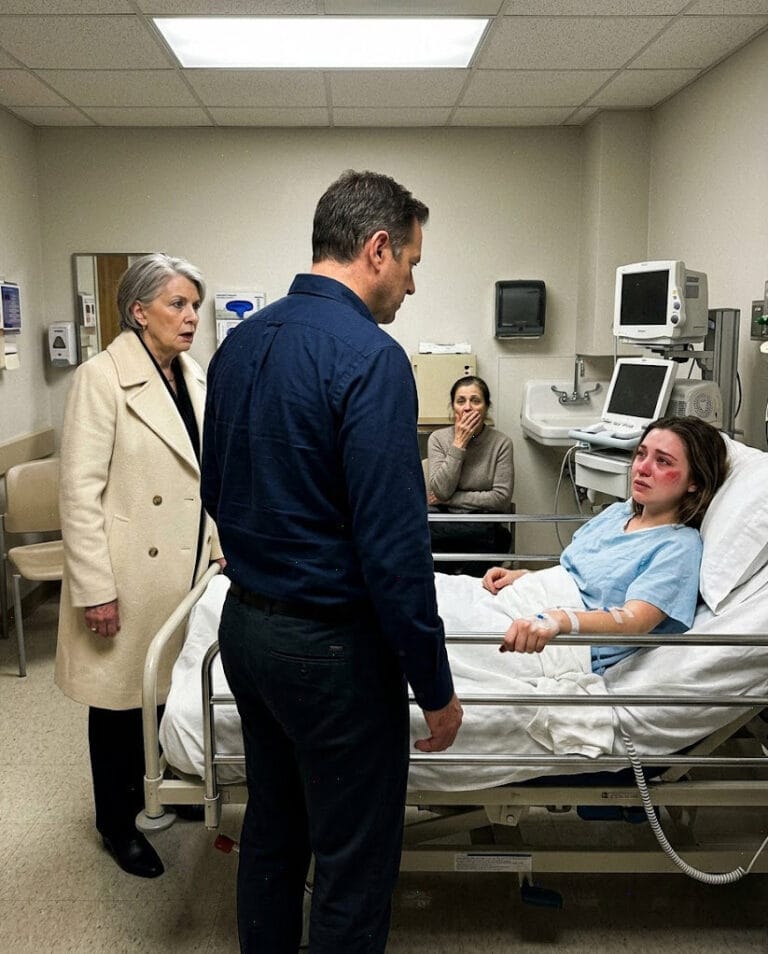
The hospital room smelled like antiseptic and stale coffee, and the fluorescent lights made everyone look colder than they really were — everyone except Diane Mercer, my husband’s mother.
She didn’t need bad lighting to look cruel.
She walked in wearing a cream coat and expensive perfume, like she was arriving at a luncheon, not a hospital room where her son’s wife lay hooked up to monitors following surgery.
I had been admitted the night before. Severe abdominal pain, dehydration, complications from a procedure I’d been terrified of for weeks. I was thirty-one years old, and I couldn’t sit upright without gripping the bed rail for balance. Ryan had told his mother not to come. He had been clear about it. She came anyway.
She didn’t ask how I was. She didn’t look at the chart clipped to the foot of my bed or acknowledge the IV line in my arm. She looked directly at me and said, “So this is what you do now? Lie in a hospital bed and make everyone run around for you?”
My mother stiffened in the chair beside me. “She just had surgery,” she said carefully.
Diane waved a dismissive hand. “I’m speaking to my son’s wife. Not to you.”
My husband Ryan stood near the window with his hands in his pockets, looking at the floor.
I swallowed hard and tried to keep my voice level. “Please leave. I am not doing this today.”
That only made her louder.
“Oh, now you have boundaries?” she snapped. “You didn’t have boundaries when you dragged Ryan away from his family, spent his money, and turned him into a man I barely recognize.”
“Mom, stop,” Ryan said. Weak. Reflexive. The kind of stop that isn’t a stop at all.
She stepped closer to the bed. “Do you know what this family thinks of you, Emily? They think you are dramatic, manipulative, and lazy.”
My heart monitor started climbing. Sharp, rapid electronic beeps filling the room.
My mother rose from her chair. My father, Daniel Brooks, stood near the door where he’d been since Diane arrived — still, quiet, watching with eyes that didn’t blink much.
“Get out,” I said.
Diane leaned down over me and hissed, “You are not the victim here.”
And then she slapped me across the face.
The crack of it went through the room like a shot. My mother screamed. Ryan lunged forward a half-second too late. Pain spread across my cheek — hot, radiating, humiliating — and for one suspended moment, the room went completely still.
Then I heard my father’s voice.
Not raised. Not trembling. Low. Controlled in the specific way that is more frightening than any volume.
He stepped between Diane and my bed. He placed himself directly in front of her, not touching her, not threatening — just standing there like something that wasn’t going to move.
“You just touched my daughter,” he said. “In a hospital bed. In front of me.”
He looked her directly in the eye.
“You touched her once. Now you answer to me.”
Part 2: The Woman Who Had Never Been Told No
Diane didn’t flinch. Not immediately.
She let out a short breath through her nose — almost a laugh — and drew herself up to her full height. She was used to rooms arranging themselves around her. She was used to people backing down.
“Excuse me?” Her voice had that particular precision of someone accustomed to winning conversations before they start. “Do you have any idea who you’re speaking to?”
My father didn’t answer that question.
He reached over, picked up the call button clipped to my bed rail, and pressed it once. Slowly. Without looking away from her.
“Security will be here in under two minutes,” he said. “You will be escorted from this building. And then we will discuss what happens next.”
Ryan stepped forward with his hands half-raised, the way you approach a fire. “Sir, I’m — she shouldn’t have — I’m sorry —”
“I know what she shouldn’t have done,” my father said. “You told her not to come. She came. You said stop. You didn’t mean it. You stood at that window, Ryan, while my daughter’s heart rate went up on that monitor.”
The room was so quiet I could hear the ventilation system in the ceiling.
A nurse appeared in the doorway — young, professional, one look at the scene and she immediately pressed the radio on her badge and asked for support at my room number.
Diane straightened her coat. Lifted her chin. She turned to me with an expression I hadn’t seen from her before — not contempt, not dismissal, but something that looked almost like calculation. Like she was deciding something.
“This family will never forgive you for this,” she said.
My father turned to look at me. His eyes, which had been iron for the last two minutes, went soft.
“You okay?” he asked quietly.
I nodded. My hands were shaking under the blanket.
“Good.” He turned back to Diane. “She didn’t do a single thing. You did.”
Two security officers appeared behind the nurse. Diane looked at them, then at my father, then at Ryan — who said nothing, who did nothing — and for the first time since I had known her, Diane Mercer left a room without having the last word.
What nobody in that hospital room knew was that my father had already stepped into the hallway twenty minutes before that moment. While Diane was still in the elevator on her way up, he had made two phone calls.
He hadn’t told me. He hadn’t made a scene. He had simply, quietly, started the process.
Part 3: The Turning Point — What My Father Never Said Out Loud
My father is not a man who talks about himself much.
He was a public defender for nineteen years before going into private practice. He spent two decades standing in rooms where powerful people expected to win simply because they’d always won before, and he learned early what I was still learning: that the loudest person in the room is almost never the most dangerous one.
He had watched Diane Mercer operate for three years of my marriage. He had watched her dismiss me at dinners, redirect conversations away from anything I contributed, speak about me in the third person while I was standing four feet away. He had watched Ryan absorb it and normalize it and slowly, degree by degree, begin to reflect it.
He had watched me apologize for things that weren’t my fault and shrink into spaces that were already too small.
He had never said much about any of it. Not because he didn’t see it. Because he was waiting to understand the full shape of it before he moved.
The two calls he made from the hospital hallway were to his attorney and to a former colleague who specialized in civil assault cases. By the time Diane was escorted from the building, a formal process had already been set in motion.
When visiting hours ended and my parents were getting ready to leave, my father sat on the edge of the chair my mother had been in all day. He looked tired for the first time.
“I should have said something sooner,” he said.
“You didn’t know she’d do this,” I told him.
“No. But I knew the direction it was going.” He looked at my hands on the blanket. “You don’t have to protect everyone from the truth about your own life, Emily. Not even me.”
I didn’t answer that. I’m still working on it.
Part 4: The Final Confrontation — What Happened in the Days After
Diane’s attorney contacted mine four days after the incident.
The letter was measured, careful, full of softened language about a “regrettable moment of high emotion” and “mutual tensions that had reached a difficult point.” It suggested — without quite saying — that everyone involved might benefit from letting the matter rest quietly.
My father read it at the kitchen table with his reading glasses on and his coffee going cold beside him.
“No,” he said, and set it down.
The hospital had security footage. Three witnesses, including two nurses and my own parents. Diane had struck a patient in a monitored medical room, surrounded by people, with no ambiguity and no room for interpretation.
What followed over the next several weeks was not dramatic. It was methodical. There were no shouting matches, no confrontations in parking lots, no moments from a movie. Just paperwork. Meetings. Careful, deliberate steps taken by a man who had spent his career understanding exactly how accountability works — and exactly how people with money try to avoid it.
Ryan called me the week after. He was staying at his parents’ house.
“I’m sorry,” he said. “For what she did. And for — everything.”
I asked him what “everything” meant to him. He didn’t have a clean answer. That told me more than the apology did.
“I needed you to stand up,” I said. Not angry. Just honest. “Not just for me. For yourself. For us. And you didn’t.”
He was quiet for a long time.
“I know,” he said finally.
Diane did not go to jail. That’s not how civil cases typically resolve. But she faced legal consequences, financial consequences, and a formal record she would carry for the rest of her life. The Wellington family — the one she had spent decades curating an image for — found out. The people whose approval she valued above everything else found out.
I don’t know if that hurt her. I don’t know if anything does.
But I know that her attorney’s letter asked me to let it rest quietly. And I know that I didn’t.
What I Know Now
For three years, I had made myself smaller in that marriage. I had apologized reflexively, absorbed cruelty that was handed to me with a smile, and told myself it was temporary — that things would shift, that people would change, that I just needed to be patient and gentle and good enough.
The hospital room stripped all of that down to something true.
What I learned in that bed, with a monitor beside me and a mark on my face, is that the quietest people in the room are sometimes the ones paying the closest attention. My father hadn’t been passive all those years. He had been watching, and waiting, and trusting me to find my own footing — and when the line was finally crossed, he didn’t hesitate for a single second.
That’s what love that doesn’t need to perform looks like.
I’m not fully healed from those three years. I don’t think healing works on a clean timeline. But I know who I am outside of the version of myself I was asked to be inside that marriage. I know what I will and won’t accept. I know the sound of my own voice when I mean it.
And I know that the most powerful thing my father did in that hospital room wasn’t what he said to Diane.
It was turning to look at me afterward — with all of that still in his eyes — and asking softly: “You okay?”
Because after everything, that was still the most important question in the room.

Evan Cole Editor-in-Chief | Breaking News & Public Policy
“From Washington to Wall Street, and Main Street to Hollywood—Evan Cole connects the dots.”
As the Editor-in-Chief at Newskilo, Evan leads a dynamic team of journalists dedicated to uncovering the truth behind the headlines. With over 15 years in digital media, Evan has a reputation for cutting through the noise.
While he is widely recognized for his deep analysis of U.S. fiscal policy (IRS & Stimulus), Evan’s expertise extends to global current events, corporate accountability, and cultural trends. Whether he is breaking down a complex government bill, exposing a tech giant’s failure, or analyzing the societal impact of a viral celebrity moment, Evan’s goal is simple: To tell the stories that shape our world with clarity, accuracy, and integrity.
Leave a Reply