
I woke up to the sound of scissors.
Not in a dream. In my actual bedroom. At 11 PM. The night before my sister’s wedding.
My mother was standing over me with fabric shears from the sewing kit. By the time I was fully conscious, twenty inches of my hair was on the pillow.
She set the scissors down like she’d just trimmed a hedge. “You were making it about yourself,” she said. “Chloe needs tomorrow.”
I sat up and touched the ends. Uneven. Hacked. One side shorter than the other by two full inches.
My father appeared in the doorway, took one look, and said, “Wear a hat. Julian’s family has photographers everywhere and you’re going to embarrass us.”
I didn’t scream. I didn’t cry. Something just went very still inside me.
Because here’s what they didn’t know.
Three weeks earlier, a man named David Reese had slid into my LinkedIn messages. He was a compliance investigator. He’d been quietly building a case for fourteen months. He had one question: had I ever received financial documents from Julian Sterling’s real estate group?
I had. Because I was the one who paid the vendors. Every invoice. Every deposit. Every quiet financial disaster this family called a wedding.
I sat on my bed with butchered hair, my father’s voice still in the room, and I picked up my phone. Not to cry. Not to call anyone.
To forward sixty-three documents.
The next morning, I walked down that aisle in front of five hundred guests. No hat.
And right as the officiant said “Is there anyone who objects—”
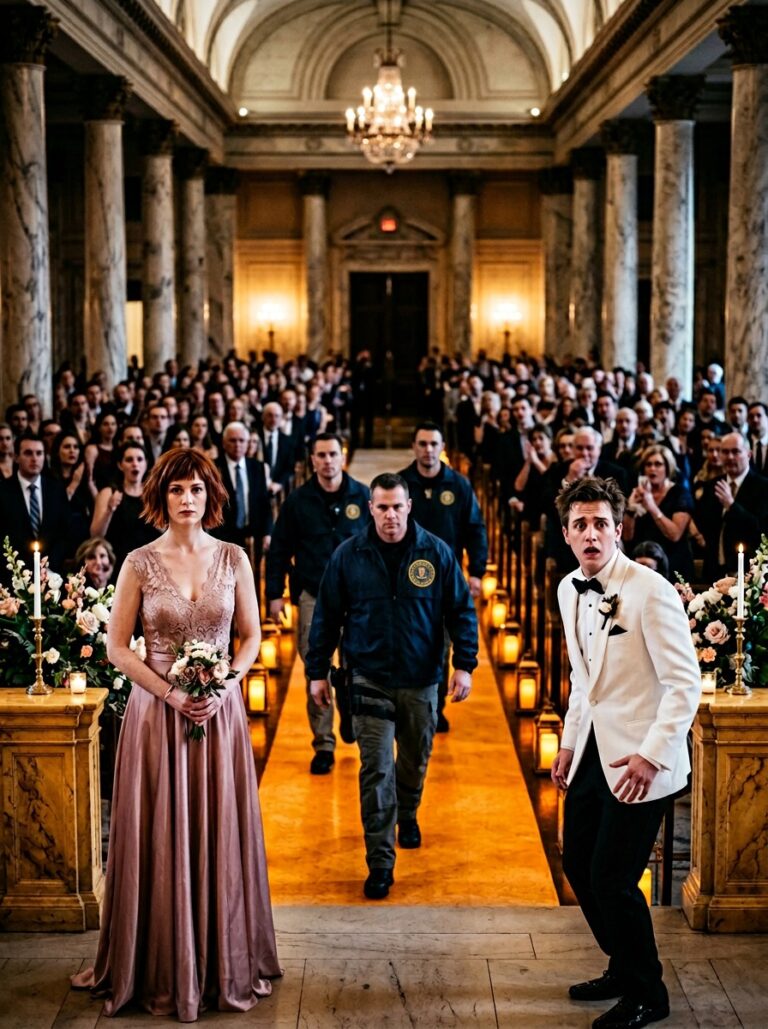
Three federal investigators walked through the back doors.
Part 2: The Useful Sister
I was twenty-six and had spent the better part of a year being my family’s best-kept financial secret.
My sister Chloe was twenty-eight, effortlessly beautiful in the way that had always made rooms rearrange themselves for her. When she announced she was marrying Julian Sterling — heir to Sterling Capital Group, a real estate conglomerate with properties across six states — my parents didn’t react like parents at a daughter’s engagement. They reacted like lottery winners.
My mother started referring to Chloe as “our connection to real society.” My father — a man who had spent thirty years in middle management and was quietly three months behind on his car payment — began dropping Julian’s family name into conversations with the casualness of someone who had known them for decades.
I was the infrastructure nobody talked about.
For twelve months, I routed sixty thousand dollars of my own savings into a wedding that was never described to me as a loan. It was framed as contribution. Family. Love. We’re all doing this together. Venue deposits when the family account ran short. Emergency florist payments when the original vendor walked. Last-minute upgrades to the catering package because Chloe decided the salmon was “not the right energy.”
No one kept a ledger. No one was meant to.
I kept one anyway. Force of habit — I work in financial compliance. Numbers are how I think. By March, I had a spreadsheet that showed my name attached to $61,400 in outgoing payments for an event I was attending as a bridesmaid.
I never showed anyone. What would have been the point?
Chloe was the star. She had always been the star. I was the wiring inside the walls — invisible until something stopped working, and then blamed when it did.
The one thing they had never been able to diminish was my hair.
It was long, auburn, naturally thick. The kind of hair that moved when I walked and caught light in a room. My mother had always had complicated feelings about it. She’d say things like “you’d be pretty if you toned it down” and “Chloe has such a delicate look, you don’t want to overwhelm her.”
I’d learned to hear it and say nothing. In my family, silence was a survival skill.
At the final dress fitting in April, Chloe stood in her $15,000 gown and caught my reflection in the three-way mirror. I was in the bridesmaid dress — dusty rose, floor length, structured bodice. I thought it looked fine. Chloe started crying.
“She’s going to upstage me,” she told my mother, loud enough for the boutique attendants to hear. “Look at her. She’s going to make the whole day about herself.”
My mother apologized to my sister. Not to me.
Then the boutique manager appeared with the final invoice. Fifteen thousand dollars, balance due.
My mother’s face went white.
I handed over my card. Chloe never even looked over.
On the drive home, my mother took my hand in the backseat and said, very quietly, “You need to tone down your whole presence tomorrow. Your sister gets one chance at greatness. Stop competing.”
I nodded. I was too tired for anything else.
Part 3: The LinkedIn Message That Changed Everything
Three weeks before the wedding, I was eating lunch at my desk when a connection request came in from someone named David Reese.
His profile was sparse — compliance and regulatory work, no employer listed, a government-adjacent gray zone I recognized immediately from my own industry. I accepted out of professional habit.
His message came four minutes later.
“Ms. [my name], I apologize for the informal contact. I’m a financial crimes investigator currently looking into Sterling Capital Group and certain affiliated entities. I understand you may have had financial dealings with Julian Sterling in relation to an upcoming event. I’d like to speak with you at your earliest convenience. This is entirely voluntary.”
I read it three times.
Then I closed my laptop, went to the bathroom, and sat in a stall for six minutes processing the fact that the man my sister was marrying in three weeks was apparently under federal investigation.
I called David Reese from my car at lunch. He was careful, measured, professional. He couldn’t tell me everything. But he could tell me that Sterling Capital had been flagged for wire fraud across multiple transactions — vendor payments, escrow manipulation, falsified property valuations. The investigation had been active for fourteen months.
“Had I received any documentation from Julian Sterling?” he asked. “Anything financial? Contracts, wire receipts, transfer confirmations?”
I thought about the bounced $40,000 venue deposit in February.
Julian had called me personally. Not Chloe. Not my parents. Me — because he knew I was the one handling the money. He’d been warm, apologetic, charming. His corporate account had a “temporary processing issue.” Could I cover the deposit and he’d wire it back within 48 hours?
I covered it.
He never sent the wire.
When I brought it up two weeks later, he laughed it off — “it’s coming, I promise, family doesn’t need contracts” — and somehow I’d let it go because the wedding machine was already moving too fast and I didn’t want to be the one to derail it.
I had, however, kept everything.
Every email with his name. Every text chain. The original wire request. The bounce notification from the venue. His follow-up messages. All of it, archived in a folder I’d labeled “Wedding — Julian Financials” because that is simply how my brain works.
I told David Reese I had documentation. Sixty-three files.
He asked me to hold onto them and think carefully. No pressure. Entirely my decision.
For three weeks, I thought about it every single day. I thought about Chloe. I thought about my parents. I thought about sixty thousand dollars and a card nobody looked at when I handed it over. I thought about the word family used as a substitute for thank you.
Then my mother stood over my bed with a pair of scissors.
Part 4: The Morning of the Wedding
I got up at 6 AM.
I looked in the bathroom mirror for a long time. The cut was worse than I’d registered in the dark — jagged along one side, a full two inches shorter than the other. I had a hair appointment at 8 for the bridal party styling. I kept it. I sat in the chair and told the stylist there had been “an incident.” She did what she could. It wasn’t much. The damage was structural.
My mother saw me at the venue and visibly flinched. Then she composed herself and said, “It actually looks better shorter. Very modern.”
I smiled.
At 9:47 AM, I forwarded sixty-three files to David Reese with a single message: “I’ve thought carefully. Here’s everything.”
He replied in four minutes: “Thank you. We’ll take it from here.”
I put my phone in my clutch, picked up my bouquet, and went to take my place in the processional line.
The ceremony was held in a grand ballroom in Newport — chandelier lighting, marble columns, rose petals down the aisle, five hundred guests in black-tie. Everything my family had spent a year performing for. The Sterling family occupied the front three rows: composed, well-dressed, the particular variety of wealthy that doesn’t need to announce itself.
My parents were two rows back, radiating pride so intense it was almost a smell.
I walked the aisle in my dusty rose gown. Hacked hair and all. No hat.
I took my position at the altar and watched Julian at the front — tall, tanned, perfectly tailored white tuxedo, that easy smile he deployed like a tool. He caught my eye briefly. I smiled back. His smile flickered.
The ceremony began.
The officiant moved through the standard opening. Guests settled. My mother dabbed her eyes. Chloe floated down the aisle in her $15,000 gown looking genuinely beautiful, and I felt something — not bitterness, not satisfaction. Just clarity. A very clean, quiet kind of clarity.
“Is there anyone present,” the officiant said, “who has reason to believe these two should not be joined in marriage?”
The back doors opened.
Three investigators in dark windbreakers walked in, badges already in hand, moving with the specific unhurried certainty of people who had done this before and were not sorry about it.
Five hundred heads turned.
The lead investigator walked directly to the altar. He was not loud. He didn’t need to be.
“Julian Sterling?”
Julian’s face didn’t collapse immediately. There was a half-second where his expression held — charm on autopilot — and then it fell completely, like a building losing its load-bearing wall.
“Sir, you need to come with us.”
Chloe screamed.
My father stood up and then sat back down.
My mother turned and looked at me from across the aisle — not with anger, not yet. With the first honest expression I’d seen from her in years. Pure, unfiltered shock.
I looked back at her. Said nothing.
Because I had already said everything. Sixty-three files’ worth.
Conclusion: What Happened After
Julian Sterling was formally charged six weeks later — wire fraud, securities manipulation, falsification of escrow accounts across four states. Sterling Capital Group’s assets were frozen pending investigation. The wedding venue never got its $40,000 back from his corporate account. But mine was refunded, eventually, through the legal proceedings.
Chloe didn’t speak to me for five months. When she finally called, she didn’t apologize. She said, “You could have warned me.”
I thought about that for a long time.
She was right that I could have. What I couldn’t explain easily — what I’ve spent a lot of time understanding about myself — is that I needed them to show me who they were first. Completely. With scissors, in the dark, the night before. I needed to know that the transaction was total before I could walk away from it cleanly.
My mother eventually sent a text that said: “I know we have things to discuss.”
We do. We haven’t yet.
My father hasn’t contacted me.
I cut my hair properly two days after the wedding — a blunt lob, intentional, even. The stylist called it “very chic.” I didn’t tell her how it started. I just looked in the mirror and thought: this is the first thing in a year that is entirely mine.
I kept the spreadsheet. All $61,400 of it.
That discussion is still coming too.

Evan Cole Editor-in-Chief | Breaking News & Public Policy
“From Washington to Wall Street, and Main Street to Hollywood—Evan Cole connects the dots.”
As the Editor-in-Chief at Newskilo, Evan leads a dynamic team of journalists dedicated to uncovering the truth behind the headlines. With over 15 years in digital media, Evan has a reputation for cutting through the noise.
While he is widely recognized for his deep analysis of U.S. fiscal policy (IRS & Stimulus), Evan’s expertise extends to global current events, corporate accountability, and cultural trends. Whether he is breaking down a complex government bill, exposing a tech giant’s failure, or analyzing the societal impact of a viral celebrity moment, Evan’s goal is simple: To tell the stories that shape our world with clarity, accuracy, and integrity.
Leave a Reply