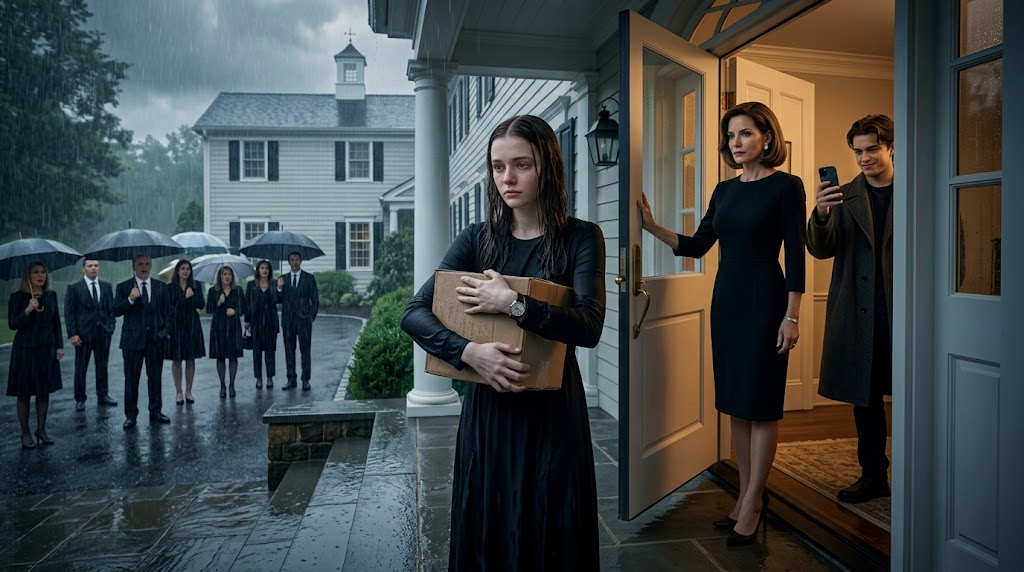
She handed me a cardboard box while my father’s grave was still wet.
I stood on the front porch in my black funeral dress, rain soaking through the fabric, holding everything she’d decided I was allowed to keep. A few clothes. My college acceptance letter. One photograph — my dad lifting me onto his shoulders at a state fair, me maybe seven years old, both of us laughing.
Vanessa Cross had been waiting for this moment for six years.
“This house was never yours, Emma.” She said it the way people say things they’ve been rehearsing. Calm. Almost gentle. The way you speak when you’ve already won and you know it.
Her son Blake was leaning against the wall behind her, wearing my father’s coat. My father’s charcoal wool coat that still had his handwriting on a grocery receipt in the pocket. He hadn’t waited a full day.
“Don’t make this a scene,” Blake said. “Things change.”
I looked at him steadily. “He wasn’t your father.”
Something moved across Vanessa’s face — a crack, just for a second — and then she pressed the cardboard box into my arms and told me I had ten minutes.
I didn’t argue. My father’s voice was already in my head. And what was inside my coat — pressed against my ribs beneath the wet fabric — was more powerful than anything I could have said on that porch.
I stepped into the rain. I walked to the black car at the curb. I handed a sealed envelope to a silver-haired lawyer named Mr. Hale.
What happened next took three weeks, two court hearings, and one very long deposition.
But it started six years earlier, the day Vanessa Cross first walked through our front door.
Part 2: The Woman Who Moved Into Our House
My father, Robert Calloway, was a structural engineer who built things with his hands and his money and his time and gave credit to no one in particular. He was not a man who expressed himself easily. He showed love through presence — showing up, staying, fixing things.
When my mother died, I was thirteen. My father grieved quietly and completely, the way he did everything. He kept going to work. He kept making dinner. He came to every school event with a notepad, like he was there to take notes on how to be a good father.
Three years later, he met Vanessa.
She was forty-one. She had a son, Blake, who was eighteen, already out of the house and very aware of his mother’s social calendar. She was attractive in a curated way — the kind of attractive that takes significant infrastructure — and she knew exactly how to make a man who wasn’t good at being cared for feel cared for.
My father proposed within a year. He told me separately, the night before he told anyone else. He sat across from me at the kitchen table and said, “She makes me less alone. I know you’re almost grown. I just — I need you to tell me if this is wrong.”
I was sixteen. I told him it wasn’t wrong.
I wish I’d known what to look for.
The first year, Vanessa was careful. She was considerate in observable ways — asking about my school, remembering small things, not pushing into spaces that were mine. She was, I now understand, performing an audition for the person she needed to fool most: my father.
By the second year, the performance had relaxed.
She began referring to the house as “our home” in a way that didn’t include me. Small things disappeared — a photo from the mantle, a shelf of my mother’s books — and when I mentioned it, my father looked confused, like he was sure I was misremembering. Blake started staying for longer visits, occupying the guest room, appearing at the dinner table with the ease of someone who’d already calculated the inheritance math.
I was in my final year of high school. I told myself it would be fine when I left for college.
Then my father got sick.
Part 3: What My Father Knew
The diagnosis was pancreatic cancer. Stage three. He found out in October and by February he had lost forty pounds and the ability to walk to the end of the driveway without stopping.
I deferred my college enrollment. I came home.
What I found when I got there was a version of my father I didn’t fully recognize — not because of the illness, but because of what the illness had clarified for him. He was alert, deliberate, purposeful in a way sick people sometimes become when they understand that time is now a specific and limited quantity.
He was also, I would later understand, watching Vanessa very carefully.
He never said anything directly to me. He asked questions — careful, sideways questions about what I’d seen, what I’d noticed, whether there were things that seemed off. He asked me once, almost casually, whether I knew what the house was worth.
I didn’t. He told me. It was worth $1.4 million. The mortgage had been paid off eleven years ago. He’d built equity through thirty years of careful work.
He asked if I knew who was on the deed.
I didn’t know that either.
Three days before he died, he called me into the bedroom alone. Vanessa was downstairs. He reached beneath his pillow and produced a sealed envelope — thick, legal-weight paper, already notarized. His name was in the return corner and mine was on the front.
His grip when he pressed it into my hands was weaker than I expected. But his eyes were exact.
“This goes to Mr. Hale. Nobody else. If she shows you who she really is — and she will, Emma, she won’t be able to help herself — you take this to Gerald Hale. The address is inside. Do you understand me?”
I told him I understood.
“Don’t open it. Don’t tell anyone. Don’t give her a reason to take it from you.”
He died on a Thursday morning, February 14th.
Vanessa didn’t show her true colors at the hospital. She was composed, tearful, doing grief correctly in public.
She waited until the funeral reception was winding down.
Then she handed me a cardboard box on the front porch in the rain, and told me to be gone in ten minutes, and said the words she’d probably been shaping in her mind for years:
“This house was never yours.”
I walked to the black car. I handed Mr. Hale the envelope. He opened it in the front seat while rain ran down the windshield.
He read for about ninety seconds without speaking.
Then he looked up at the house — at the warm light in the front windows, at Vanessa’s silhouette passing behind the glass — and said, very quietly:
“She has no idea.”
Part 4: What Was Inside the Envelope
Gerald Hale had been my father’s attorney for twenty-two years. He was seventy, semi-retired, the kind of lawyer who wore the same suits for a decade and billed with the precision of someone who had never needed to be impressive because he was simply correct.
My father had met with him six times in the final four months. Vanessa knew about one of those meetings. She thought it was a routine estate update.
It was not.
What my father had done — methodically, quietly, over the course of those four months — was reconstruct the legal architecture of everything he owned. He had done this in a way that was entirely legal, carefully documented, and specifically designed to withstand a challenge.
The house was the first piece.
My father had placed the property into a revocable living trust two months before he died — the Calloway Family Trust — with me named as sole beneficiary. The trust had been structured so that upon his death, ownership transferred to me directly, bypassing probate entirely. Vanessa’s name was not on the trust. Her name was not on the deed. Her name had never been on the deed.
She had assumed it was. She had assumed a great many things.
The second piece was the investment accounts. My father had three: a brokerage account, a retirement account, and a smaller discretionary fund he’d quietly built over eight years without discussing it with anyone. The beneficiary designations on all three — which supersede a will entirely, a fact Vanessa apparently did not know — had been updated to my name eleven weeks before he died.
The third piece was a hand-written letter, included in the envelope, which detailed something specific: a pattern of financial behavior he had observed over the previous eighteen months, documented with dates and amounts. Withdrawals from joint accounts Vanessa had characterized as household expenses. A loan she had taken in his name, without his knowledge, that he had discovered three months before his death. The exact figure was $47,000.
He had not confronted her. He had documented it.
The letter was addressed to me. The last paragraph read: “You were always the thing I built that I was most proud of. Don’t let anyone tell you what you’re owed. You already know.”
Mr. Hale filed the trust documentation the following morning. He also referred the loan matter to a financial crimes attorney, a colleague of his named Patricia Osei, who specialized in exactly this kind of elder financial abuse.
Vanessa received the first legal notice eight days after the funeral.
Conclusion: The Courtroom
The hearing was held on a Tuesday morning in March. I wore a gray blazer and my father’s watch. Mr. Hale sat to my left. Patricia Osei sat to my right.
Vanessa arrived with a lawyer she had retained three days after receiving the trust notice — an aggressive litigator named Carter who had apparently told her the trust could be challenged on the grounds of my father’s mental competency at the time of signing.
That argument lasted approximately forty minutes before the judge set it aside.
My father had signed the trust documents in the presence of two independent witnesses and a notary. He had also, Mr. Hale had noted with the quiet satisfaction of someone who had planned for exactly this moment, recorded a brief video statement at the time of signing — a standard practice his firm had adopted — in which my father appeared on camera, stated his name, the date, his understanding of the document he was signing, and his intentions clearly and in complete sentences.
Carter had not known about the video.
The judge reviewed the trust documentation, the beneficiary designations, and the letter. She looked at the financial records Patricia Osei submitted regarding the $47,000 loan.
She did not look at Vanessa for a long time.
When she did, her expression was not unkind. It was something more precise than unkind.
The house was formally recognized as mine. The estate assets transferred according to the trust. The $47,000 matter was referred to the district attorney’s office for review of potential elder financial abuse charges — a separate proceeding that was still ongoing at the time I’m writing this.
Vanessa had thirty days to vacate.
I didn’t go back to watch her leave. I didn’t need to. I enrolled in college for the fall semester. I kept the photo from the cardboard box — my father lifting me onto his shoulders, both of us laughing — and put it back on the mantle where it belonged.
The staircase he built with his own hands is still exactly as he left it.
Some things, it turns out, were always mine. He just made sure of it quietly, the way he did everything — showing up, staying, and building something that would last.

Evan Cole Editor-in-Chief | Breaking News & Public Policy
“From Washington to Wall Street, and Main Street to Hollywood—Evan Cole connects the dots.”
As the Editor-in-Chief at Newskilo, Evan leads a dynamic team of journalists dedicated to uncovering the truth behind the headlines. With over 15 years in digital media, Evan has a reputation for cutting through the noise.
While he is widely recognized for his deep analysis of U.S. fiscal policy (IRS & Stimulus), Evan’s expertise extends to global current events, corporate accountability, and cultural trends. Whether he is breaking down a complex government bill, exposing a tech giant’s failure, or analyzing the societal impact of a viral celebrity moment, Evan’s goal is simple: To tell the stories that shape our world with clarity, accuracy, and integrity.