My phone lit up the room at exactly 2 a.m.
I didn’t want to answer. At my age, late-night calls only carry one kind of news.
But I saw the name on the screen.
Daisy.
My eight-year-old granddaughter.
I answered immediately. “Sweetheart — what’s wrong?”
For a moment, just breathing. Uneven. Hollow. The kind that comes after someone has already cried themselves empty.
Then, barely a whisper.
“Grandpa…”
I sat up straight. “I’m here. Tell me what happened.”
“They left.”
I thought I’d misheard her. “Who left?”
“Dad… Mom… and Toby.”
I stood up. “Say that again.”
“They went to Disney World,” she whispered. “They went to Florida. Last night.”
Everything inside me went completely still.
“Who’s with you right now?” I asked carefully.
“No one.”
That one word hit harder than anything I’d heard in thirty years as a family attorney.
“No one at all?”
“Mrs. Gable next door said I could come over if I needed anything… but it’s two in the morning.” She paused. Then, in the softest voice — “Grandpa… why didn’t they take me?”
I had no answer.
I have argued in courtrooms. I have handled the worst of what families do to each other. I know how to stay composed when everything falls apart.
But hearing that question, from her, at 2 a.m. —
It nearly broke me.
“You didn’t do anything wrong,” I said. “Not a single thing.”
“Then why?”
“I don’t know yet,” I admitted. “But I promise — I’m going to find out.”
By 2:11 a.m., I had already called Arthur to watch my dog.
By 5:02 a.m., he showed up in slippers, holding a coffee, and said: “Bring her home if you need to.”
I had already booked the earliest flight to Orlando.
Before I walked out — I opened my office drawer and took out the old voice recorder I hadn’t used in years.
Instinct. Or experience. Something told me I was going to need it.
Part 2: The Flight to Orlando
The plane touched down at Orlando International Airport at 9:47 a.m.
I hadn’t slept on the flight. I’d spent the two hours going over everything in my head — not in anger, but in the deliberate, methodical way I used to prepare for court.
Because that’s what thirty years as a family attorney teaches you. Emotion is fuel. But you don’t run on it raw. You refine it. You convert it into something precise and purposeful.
I knew where they were staying. My son had mentioned the Grand Floridian weeks earlier when I’d called to discuss Easter plans. At the time, he’d made it sound like a family trip — “We’re thinking of doing something big this year, Dad.”
I had assumed “family” meant all of us. Or at minimum — all of the children.
Daisy had been in their home for three years. She came to them at five years old — small, quiet, and careful in the way that only children who have learned not to take up too much space can be. She learned their routines. She learned to call them Mom and Dad. She loved Toby like a brother, even when he didn’t always return the kindness.
She was, in every way that mattered, their daughter.
Or so I had believed.
I took a cab directly to the resort.
The Grand Floridian is exactly what its name promises — white Victorian architecture, a red-roofed entrance, the kind of sweeping lobby that makes guests feel like they’ve stepped into another era. The afternoon sun was blazing across the exterior as I pulled up.
I paid the driver, straightened my blazer, and walked in.
The lobby was busy. Families moved in every direction — parents with strollers, children in Mickey ears, couples checking in at the long front desk. Everything smelled of sunscreen and sugar and that particular artificial magic that Disney engineers into every square foot of their property.
I didn’t stop at the front desk. I found a seat near the main corridor with a clear sightline to the elevators and the main walkways. I ordered a coffee from a passing server. And I waited.
It took less than forty minutes.
I saw them come in from the pool entrance — my son Marcus, his wife Renee, and seven-year-old Toby, sunburned and laughing, carrying a pair of light-up Mickey wands from one of the park gift shops.
They were all smiles.
Marcus had his arm around Renee. Toby was practically bouncing.
I let them walk all the way to the elevator bank before I stood up and said, quietly:
“Marcus.”
He turned.
And I watched his face go completely white.
Part 3: The Confrontation
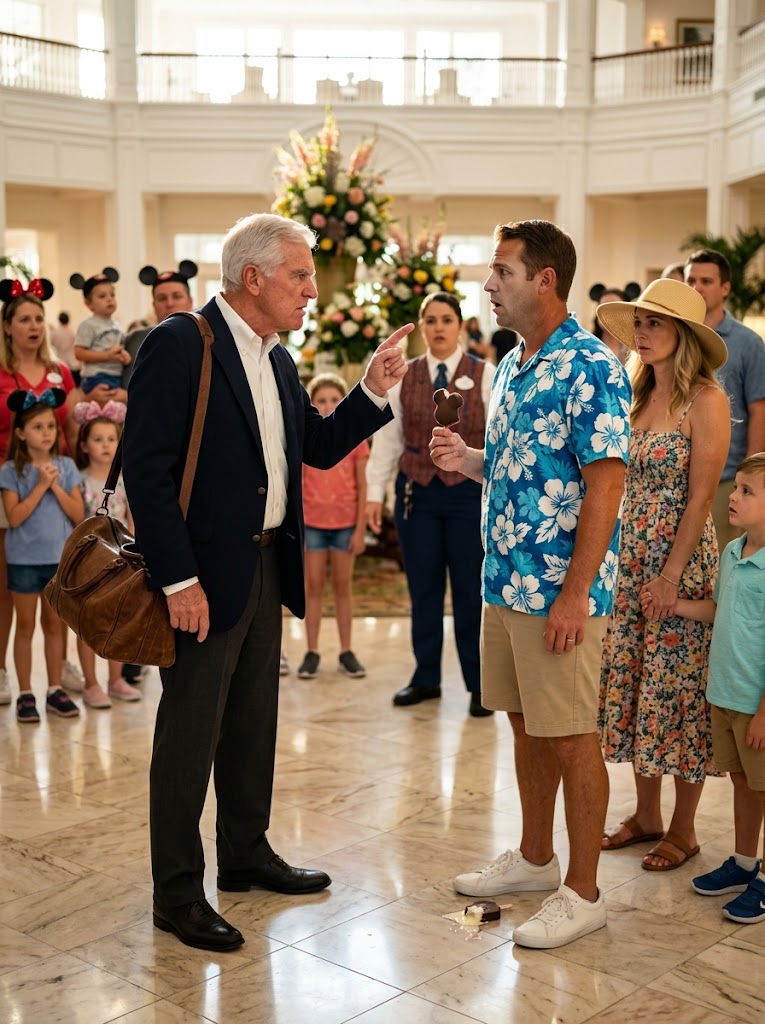
To his credit, Marcus didn’t run. He didn’t pretend he hadn’t heard me. He stood there, and in the span of about three seconds, I watched four different emotions move across his face — shock, guilt, a flash of something like defiance, and then the collapse of it.
Renee grabbed Toby by the hand instinctively and pulled him slightly behind her.
“Dad,” Marcus said. “What are you — how did you—”
“Come sit with me,” I said. Not a request.
He looked at Renee. She said nothing. I noticed she couldn’t quite meet my eyes.
The four of us moved to a cluster of chairs near the far side of the lobby, away from the main traffic. I sat down first. They sat across from me.
Toby, to his credit, seemed to sense the gravity. He sat very still and looked at the floor.
“Daisy called me at 2 a.m.,” I said.
Renee’s jaw tightened.
“She was alone,” I continued. “In the house. At 2 in the morning. Eight years old.”
“Dad—”
“She asked me why you didn’t take her.” I kept my voice level. “I didn’t have an answer for her. I was hoping you’d give me one.”
Marcus exhaled slowly. He leaned forward with his elbows on his knees. “It’s complicated.”
“It’s really not,” I said.
“She just — she doesn’t travel well. She gets anxious. Last year at the lake house, she had that panic episode, and it ruined the whole—”
“She was anxious,” I said, “because she was in an unfamiliar environment with people who made her feel like a guest instead of a family member. That’s not an excuse. That’s a diagnosis of the problem.”
Renee looked up. “Grant, you don’t understand the full picture.”
“Then paint it for me,” I said calmly. “Because from where I’m sitting, the full picture is that you left an eight-year-old child alone in a house overnight and flew to Walt Disney World with her brother and told her she had school on Monday.” I paused. “Without her.”
Silence.
“The neighbor offered to check in,” Marcus said quietly.
“The neighbor,” I repeated.
“Mrs. Gable is—”
“Is not her parent. Is not her grandparent. Is not her legal guardian.” I reached into my jacket and placed the small black recorder on the arm of the chair beside me. “Mrs. Gable is a sixty-seven-year-old woman who lives next door.”
Both of them stared at the recorder.
“What is that?” Renee asked carefully.
“Habit,” I said simply.
I didn’t tell them it was running. I didn’t tell them it had been running since I sat down.
Marcus looked at it for a long moment, then looked back at me. “Dad. I know how this looks.”
“Tell me how it looks to you,” I said. “Because I want to understand your perspective.”
What followed was forty-five minutes of the most painful conversation I’ve had since my wife passed six years ago. Marcus spoke carefully. Renee spoke defensively, then tearfully, then defensively again. Toby was quietly ushered to the game room by a resort staff member who read the room better than most adults would have.
The reasons they gave — and there were several — I won’t repeat in full here. Some were practical. Most were rationalizations. All of them circled the same unspoken truth that nobody said aloud until I said it.
“You treat her differently because she isn’t biologically yours,” I said. “You haven’t said it, but that’s the center of everything you’ve told me in the last forty minutes.”
Marcus didn’t deny it. That, more than anything else, broke something in me.
But it also clarified everything.
Part 4: What I Did Before I Left That Lobby
I had come to Florida with two possible outcomes in mind.
The first was that Marcus would have an explanation that was difficult but reasonable — something that, when examined, revealed poor judgment rather than deliberate cruelty. In that case, I would have been firm, I would have set clear expectations, and I would have gone home.
The second was what actually happened.
I reached into my travel bag and placed three documents on the low table between us.
“What is this?” Marcus asked, his voice suddenly wary.
“The first,” I said, “is a copy of Daisy’s adoption papers — which I’ve had on file since the day you finalized the adoption. The second is a letter I drafted on the flight here, which I will be sending to a colleague of mine who specializes in family law. I am not filing anything. Not yet. I am informing you that I have drafted it.” I let that land. “The third is a behavioral assessment from Daisy’s school counselor that was sent to me — at my request — six weeks ago, when I noticed changes in her during our Sunday calls. I’ve been watching this for a while, Marcus.”
Renee made a sound I can’t adequately describe.
Marcus looked at the papers for a long time. Then he looked at me. “You’ve been building a case.”
“I’ve been paying attention,” I said. “Which is apparently more than I can say for the two of you.”
I want to be clear: I did not threaten them. I did not raise my voice once during the entire conversation. I did not use the word legal in a threatening context. I simply laid out what I had observed, what I had documented, and what I intended to do next.
What I told them I intended to do next was this:
First — I was flying home that evening to be with Daisy. Not because they asked me to. Because she was alone.
Second — I would be contacting a family attorney colleague of mine — not to pursue legal action, but to understand what options existed should the situation not improve.
Third — I wanted a formal, written agreement — not a legal document, but a personal commitment between family members — about how Daisy was to be treated going forward. Vacations included.
Fourth — and this is the one that changed the air in the room entirely — I told them that I had already been in contact with my estate attorney. And that the division of my estate — which Marcus had long understood would come to him primarily upon my passing — was something I was now actively reconsidering, depending on how this situation resolved.
Marcus stared at me.
“You wouldn’t,” he said quietly.
“I already have the appointment scheduled,” I replied. “For next Thursday.”
The Twist: What Happened Three Weeks Later
I booked a return flight home late that afternoon. I didn’t stay for dinner. I didn’t hug anyone. I told Marcus I loved him — because I do, despite everything — and I told Renee that I hoped she would think very carefully about the kind of woman she wanted Daisy to remember when she grew up.
Renee cried in the elevator. I saw it in the reflection of the lobby mirror as the doors closed.
I called Daisy from the cab to the airport.
She answered on the first ring.
“Grandpa?”
“Hey, sweetheart. I just want you to know — I saw your dad.”
A pause. “Did you talk to him?”
“I did.”
Another pause. “Are you okay?”
She asked if I was okay. Eight years old.
“I’m fine,” I told her. “I’m coming home tonight. And I need you to do something for me.”
“What?”
“Pack a bag for five days. Nothing fancy. Comfortable shoes, a couple of outfits, your stuffed elephant.”
“…Why?”
“Because,” I said, “next Saturday, you and I are going to Disney World.”
The sound she made — I don’t have the words for it. It was something between a laugh and a sob and complete disbelief.
“Are you serious?”
“I’m a retired attorney,” I said. “I’m always serious.”
She laughed. Really laughed. And I sat in the back of that cab with Orlando traffic moving slowly past the windows, and for the first time since 2 a.m. the night before, I felt something loosen in my chest.
Three weeks later, I kept that promise.
We spent five days at Walt Disney World — just the two of us. We rode every ride. We watched the fireworks from the terrace of the Contemporary Resort. We ate Dole Whip by the bucket. We wore matching Mickey ears that she picked out herself — blue glitter, because “blue is the best color, Grandpa, obviously.”
On the third day, she took my hand while we were walking through Fantasyland and said, without looking up at me: “I think you’re my favorite person.”
I squeezed her hand.
“The feeling is entirely mutual,” I told her.
As for Marcus and Renee —
Marcus called me the night they returned from Florida. We spoke for two hours. It was not an easy conversation, but it was an honest one — possibly the most honest we’ve had in years. He admitted things I suspect he’d never said aloud before. About the pressure of adoption. About fears he’d never processed. About the way biology had become a quiet, ugly wall in his mind that he’d never examined because examining it was too uncomfortable.
I told him that discomfort was exactly where the work had to begin.
Renee enrolled herself and Marcus in family counseling two weeks later. I found out not from Marcus, but from their counselor — a woman I knew professionally — who reached out to ask if I’d be willing to participate in a joint session down the road.
I said yes. Without hesitation.
The voice recorder — which had, in fact, captured the entire lobby conversation — remains in my desk drawer. I haven’t played it back. I don’t intend to use it against anyone. I never did.
I brought it because experience told me to. And experience also tells me when to put something away and leave it there.
Daisy started calling me every Sunday again. The calls last longer now. She tells me about school, about her friends, about a book she’s reading about horses. She sounds different than she did at 2 a.m. on that first night.
She sounds like a child who knows someone is in her corner.
That is, at the end of everything, the only outcome that ever mattered.
If this story moved you — share it with someone who needs to read it. And if you’ve ever been the child in this story, or the grandparent, drop a comment below. You’re not alone.

Evan Cole Editor-in-Chief | Breaking News & Public Policy
“From Washington to Wall Street, and Main Street to Hollywood—Evan Cole connects the dots.”
As the Editor-in-Chief at Newskilo, Evan leads a dynamic team of journalists dedicated to uncovering the truth behind the headlines. With over 15 years in digital media, Evan has a reputation for cutting through the noise.
While he is widely recognized for his deep analysis of U.S. fiscal policy (IRS & Stimulus), Evan’s expertise extends to global current events, corporate accountability, and cultural trends. Whether he is breaking down a complex government bill, exposing a tech giant’s failure, or analyzing the societal impact of a viral celebrity moment, Evan’s goal is simple: To tell the stories that shape our world with clarity, accuracy, and integrity.