
I didn’t scream when she grabbed my hair.
I couldn’t.
The shock of it — Brenda’s acrylic nails twisting into my scalp like she was wringing out a wet cloth — it knocked the air straight out of my lungs.
“You careless, spoiled little brat.”
She said it in a whisper. That was the part that terrified me. Not screaming. Whispering. Like she’d been waiting for this moment so long she didn’t need to raise her voice anymore.
I was fourteen years old. Barefoot. Still in my pajamas at 3 in the afternoon because it was a Saturday and I’d been reading in my room all morning trying to stay invisible.
I’d made it eleven months without a single incident.
Then I dropped a plate.
Not just any plate. I know that now. I didn’t fully understand it then — I was just a kid who slipped on the wet kitchen tile and watched something shatter. But the way Brenda went still when she heard it hit the floor… the way her whole body turned slowly, like a machine switching modes…
I knew before I looked up.
It was one of Mom’s plates.
Blue-and-white vintage Spode. Tiny willow trees painted around the rim. My mother, Carol Whitmore, had bought the full set the year before she got sick. She used to set the table with them on Sunday mornings and make Belgian waffles and let me put the blueberries on top.
She died of breast cancer when I was nine.
Brenda moved in when I was twelve.
By thirteen, the Spode plates had been moved to the highest shelf in the cabinet — the one I needed a step stool to reach. I’d been getting them down carefully for a year. Every Sunday. Because it was the only way I still felt close to her.
I never told Dad. He would’ve told Brenda. And Brenda would’ve found a way to make them disappear, the way she’d made other things disappear. The perfume bottle from Mom’s vanity. The throw blanket from the reading chair. The framed photo of Mom and Dad’s first dance that used to hang in the hallway.
One by one. Until the house forgot her.
She dragged me from the kitchen floor across the marble tile, past the dining table, past the portraits in the hallway where Brenda always stood just a little too close to my father, smiling like she’d won a competition nobody else knew they were in.
I clawed at her hand. I begged. I told her I was sorry, I didn’t mean to, I would clean every piece up myself.
She didn’t say another word.
That was the worst part.
She just dragged me.
Through the living room. Through the foyer. Across the welcome mat.
And shoved me through the front door.
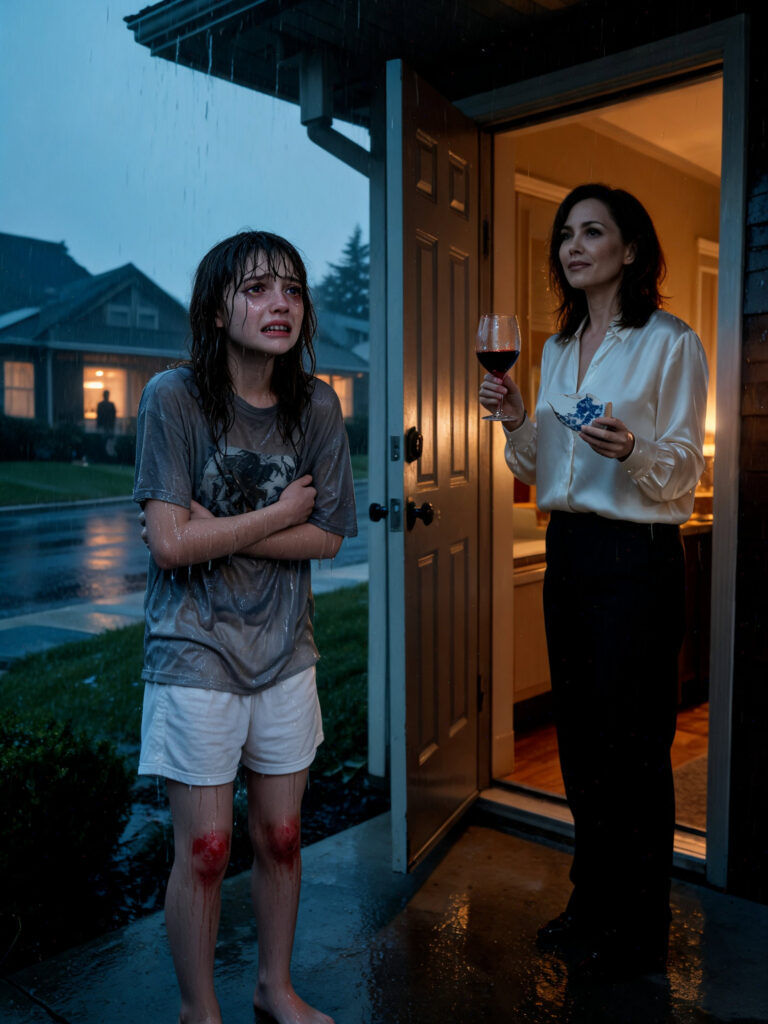
I hit the wet concrete on both knees. Rain immediately soaked through my cotton shorts. My palms scraped the porch. I turned around just fast enough to see her face — calm, almost satisfied — and then the door shut.
The deadbolt turned.
Click.
It was mid-November in Oak Creek, Ohio. Thirty-eight degrees. The kind of rain that doesn’t fall so much as it presses — heavy and continuous, like the sky decided to lean on you personally.
I was in an oversized T-shirt. Cotton pajama shorts. No socks. No shoes.
Within thirty seconds I was completely soaked.
I pounded on the frosted glass with both fists. I screamed her name. I screamed for anyone. The neighborhood was quiet the way rich neighborhoods get quiet in bad weather — everyone sealed inside their warm houses, living rooms glowing amber through the windows, nobody interested in the sound of a teenager crying in the rain.
Then I saw her.
Brenda.
Standing in the foyer, about six feet from the door. She had picked up her wineglass from the entry table. She lifted it to her mouth and took a long, slow sip.
Looking directly at me.
Like I was scenery.
I turned toward the street. Mrs. Gable next door was the only person I could see — a seventy-year-old widow who missed absolutely nothing on this street. She was at her bay window, two fingers parting the white shutters.
Our eyes met through the downpour.
Help me, I mouthed.
She stared at me for a long moment.
Then she let the shutters fall shut.
I slid down the brick wall until I was sitting on the freezing porch, knees pulled to my chest, rain streaming into my eyes. My fingers stopped feeling like fingers. My feet went from aching to just… absent. I kept waiting for the cold to be the worst thing I felt.
It wasn’t.
The worst thing was realizing I had done nothing wrong.
Part 2: What Dad Didn’t Know
My father, David Whitmore, was the kind of man who believed that problems, if left alone long enough, eventually solved themselves.
He was a senior partner at a corporate litigation firm in Columbus. Charcoal suits. Early mornings, late nights. He billed four hundred dollars an hour to people who needed someone to believe in them unconditionally, and he was very good at his job.
At home, he was less practiced.
After Mom died, he did what a lot of men do — he went somewhere inside himself and locked the door. He hired a grief counselor for me, bought me a dog that Brenda later insisted we rehome because of her allergies, and worked fourteen-hour days because the alternative was sitting in a quiet house that smelled like someone missing.
He met Brenda at a firm fundraiser eighteen months after the funeral. She was a corporate event planner. Polished, competent, immediately warm to him in a way that probably felt like oxygen after two years of holding his breath.
They dated for eight months. He brought her home on Thanksgiving. We got engaged — his word, not mine; he said we like I had been consulted — by February. Married the following June.
I was twelve years old and I stood at the altar in a lilac dress holding a small bouquet of white roses while a woman I barely knew slid a ring onto my father’s finger.
I smiled. I was good at smiling.
That first year, Brenda wasn’t cruel. She was something subtler than cruel. She was curating. The house was slowly edited. New throw pillows. A different painting in the hallway — modern and angular, replacing the watercolor landscape Mom had loved. Fresh paint in the kitchen, a shade of gray that made the whole room feel colder.
The Spode plates moved from the everyday cabinet to the top shelf.
“They’re antiques,” Brenda said, touching one edge like it had offended her by existing. “They belong somewhere safe.”
I didn’t argue. I was twelve. I was still in the phase where I believed that if I stayed small enough and quiet enough, I would be left alone.
I was wrong.
The cruelty arrived gradually, the way cold moves through a house — not all at once, but room by room, until you realize you haven’t been warm in a long time.
It was little things first. A comment about my weight at dinner. A pointed observation that I had my mother’s “dramatic flair” when I cried. A school concert she forgot to attend and then suggested I was being overly sensitive when I mentioned it.
By year two, the little things had weight to them.
By thirteen, I had developed a routine of strategic invisibility. Wake up before Brenda. Eat before she came downstairs. Finish homework before Dad got home. Disappear into my room with a book before dinner, emerging only when called.
I was getting good at making myself small.
But here is the thing about people like Brenda.
They don’t want you small.
They want you gone.
Part 3: The Phone Call Nobody Was Supposed to Hear
My father came home at 4:30 that afternoon for a reason.
I didn’t know this until much later — three weeks later, when he told me everything while we sat in the parking lot of a Dairy Queen in Columbus because neither of us could figure out how to have the conversation in the house.
At 2:17 PM, while I was reaching for that plate on the top shelf, my father was in a conference room forty minutes away finishing a deposition.
At 2:45 PM, while Brenda’s hand was in my hair, my father was standing at the elevator bank waiting to go back to his office.
The woman standing next to him was Karen Delacroix.
Karen Delacroix was a paralegal who had worked at the firm for six years. She lived four streets over from us in Oak Creek. She walked her golden retriever past our house three mornings a week.
And two weeks earlier, Karen Delacroix had watched Brenda scream at me in the driveway until I ran inside. She had seen it from the sidewalk and debated with herself for fourteen days about whether it was her business.
Standing at that elevator, she looked at my father and said: “David. I need to tell you something. About your daughter.”
By 3:15, my father was in his car.
He was crying before he hit the highway.
Not because he was surprised, exactly. That was the part that destroyed him — not the shock of it, but the recognition. The slow terrible understanding that some part of him had known something was wrong and had been choosing, day after day, to believe the simpler story.
He told me the whole drive home he kept thinking: she is fourteen. She is fourteen. She is fourteen.
Like the number itself was an indictment.
He pulled into the driveway at 4:30 in a November rainstorm and saw his daughter sitting on the porch in soaked pajamas, barefoot, with scraped knees and rain-plastered hair and a face that had gone somewhere very far away.
And his briefcase just… fell.
He didn’t decide to drop it. His hand simply stopped working.
Part 4: The Thing She Was Holding
When Brenda heard the truck, she moved fast.
I heard the deadbolt turn before my father had even made it halfway up the driveway. She pulled the door open and stepped into the frame, and I could feel the calculation happening in real time — the rapid reset from predator to victim, the way her face rearranged itself, the soft wounded quality she could manufacture in seconds.
I had seen her do it before. Once with my dad’s mother, once with my school counselor who had called the house after I came to class exhausted three days in a row.
Brenda was exceptionally skilled at the performance of being reasonable.
But she miscalculated one thing.
She was still holding the broken piece of the Spode plate.
She’d picked it up in the kitchen — I’d seen her do it. I had assumed she was going to throw it away, or use it as evidence of my carelessness, or keep it as a private trophy of whatever she believed she had won.
She hadn’t put it down.
My father came up the driveway at a pace that was not quite running but was something that had running inside it — controlled, directed, like a man who had decided something and was walking toward it.
He looked at me first.
Just for a second. His eyes moved across my wet hair and my scraped palms and my bare feet and my knees, and something crossed his face that I cannot describe except to say it was the look of a man who was finally letting himself see something he had refused to see for two years.
Then he looked at Brenda.
At the broken china in her hand.
His jaw moved. No sound came out.
Brenda started talking. Something about how I had broken a plate and she had simply asked me to go outside to cool down, how I had been getting more and more out of control lately, how she had been trying to handle it on her own because she didn’t want to burden him—
“That’s Carol’s plate.”
His voice was very quiet. Much quieter than I expected.
“That’s Carol’s plate, Brenda.”
“David, she was being—”
“How long.”
It wasn’t a question. The flatness of it stopped her.
He said it again. “How long.”
Brenda looked at me, and for a single unguarded moment I saw it — the calculation ending, the performance running out of script.
“David, I think you should come inside and we can—”
“I need you to step away from my daughter right now.”
Brenda stepped back. Slowly. Still holding the broken plate.
My father walked past her without touching her. He came directly to me and crouched down on the wet concrete and put his hands on my face and looked at me the way I had not been looked at in a very long time.
“Emma,” he said. “Emma, I’m so sorry.”
My name, in his voice, sounding like the first time he’d said it in years.
I didn’t cry. I had run out of that somewhere in the second hour of rain.
I just said: “She threw away mom’s blanket, too. The one from the chair.”
And something in my father’s face finished breaking.
Conclusion: What Happened After the Rain
Brenda left the house that night.
Not dramatically. There was no explosion, no screaming match, no thrown objects. My father had gone very quiet in the way that some men go quiet when they have made a decision that cannot be unmade. He walked back inside, picked up the phone, and called his brother in Westerville.
Then he came back outside with a towel and his coat, wrapped both around me, and sat with me on the porch swing — the same porch swing I had been locked outside of for the last two hours — until the rain let up.
At some point Brenda appeared at the door with a duffel bag.
My father said: “I’ll have the rest of your things sent.”
She looked at me once. I don’t know what she was looking for. I had nothing left to give her — not fear, not defiance, not the satisfaction of watching me react.
I looked at the rain.
She left.
The divorce took eleven months. Brenda hired a lawyer who specialized in contested asset claims and spent four months arguing over the kitchen renovation she had personally overseen. My father’s firm handled it quietly and efficiently, which is a polite way of saying she left with considerably less than she had entered with.
I was called to speak with a family court counselor twice. I told the truth both times. It was remarkably simple, once I was actually asked.
The Spode plates — the surviving ones — now live in a glass-front cabinet in the kitchen, at eye level.
I set the table with them on Sundays.
Mrs. Gable from next door knocked on our door the week after Brenda left. She stood on the porch with a foil-wrapped pan of lasagna and said she was sorry. That she had seen things over the past two years. That she had told herself it wasn’t her place.
She said it had been her place.
I told her I appreciated the lasagna. I meant it.
My dad started therapy in January. Real therapy, not the performative kind where you go twice and decide you’re cured. He goes every Tuesday. He talks about my mother, about grief, about the things we tell ourselves when we’re too scared to look at the truth directly.
He talks about me, too. About what it means to protect someone. About how love is not just presence — it’s attention. It’s choosing, every day, to actually look.
I am sixteen now.
I still get the plates down every Sunday morning.
Last week, my dad got up early and made the batter before I was even out of bed. When I came downstairs, he was standing at the griddle in his socks, and the blue-and-white plates were already on the table, and the kitchen smelled like butter and warm syrup.
He didn’t say anything about Mom.
He didn’t have to.
She was there in the plates. In the waffles. In the way he had learned, slowly and painfully and too late and then just in time, to stop locking grief in a room and start letting it sit at the breakfast table with us.
I put the blueberries on top.
We ate together.
Share this story if it moved you. Someone who needs to read it will find it.

Evan Cole Editor-in-Chief | Breaking News & Public Policy
“From Washington to Wall Street, and Main Street to Hollywood—Evan Cole connects the dots.”
As the Editor-in-Chief at Newskilo, Evan leads a dynamic team of journalists dedicated to uncovering the truth behind the headlines. With over 15 years in digital media, Evan has a reputation for cutting through the noise.
While he is widely recognized for his deep analysis of U.S. fiscal policy (IRS & Stimulus), Evan’s expertise extends to global current events, corporate accountability, and cultural trends. Whether he is breaking down a complex government bill, exposing a tech giant’s failure, or analyzing the societal impact of a viral celebrity moment, Evan’s goal is simple: To tell the stories that shape our world with clarity, accuracy, and integrity.
Leave a Reply