
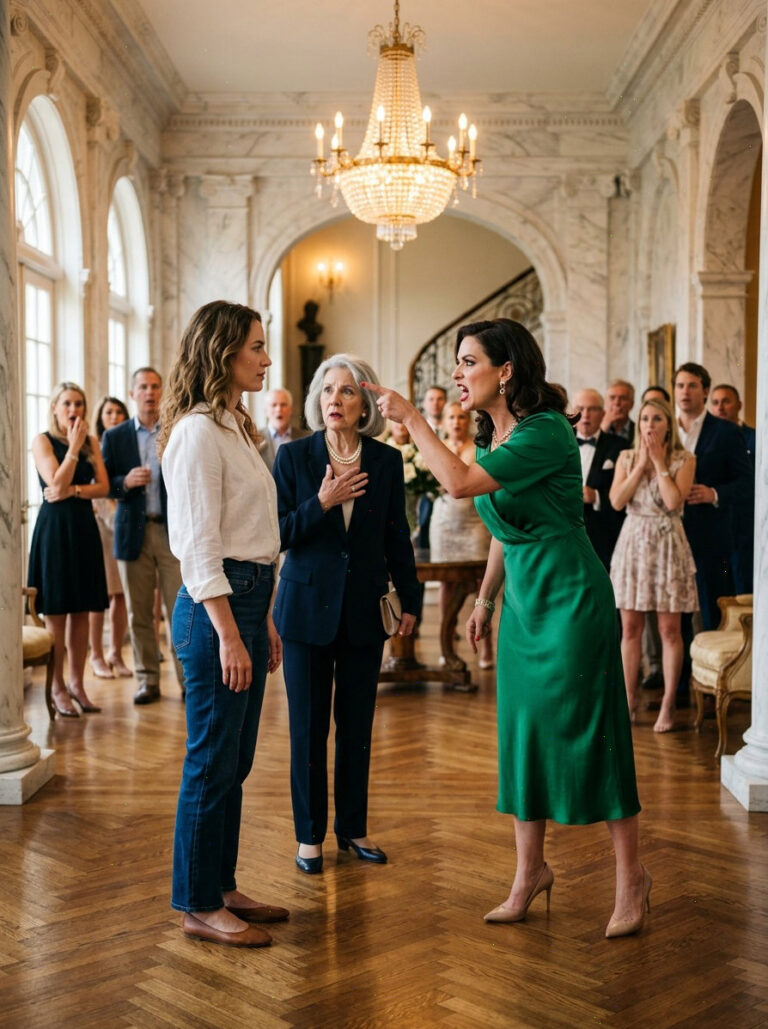
I was already standing up when Clare grabbed my arm.
Her grip was light. Practiced. The kind of touch that looks polite from across the room.
“Actually, Emily.” Her voice dropped to something like concern. “You can’t leave through the main entrance.”
I looked at her.
“Like this,” she said, gesturing at my jeans and white sneakers with a small smile that had never, not once in my entire life, reached her eyes. “People might think you’re not a member.”
My mother unfolded her hands from her lap. “Use the side entrance. It would be easier.”
I had driven two hours from the city for a family birthday lunch that turned out to be a setup. I had sat through forty-five minutes of Clare explaining why I would be seated in the back row of her wedding, if allowed to attend at all. I had listened to my mother tell a table of strangers that Richard’s family had mistaken me for hired help at Thanksgiving.
And now they wanted me to leave through the side door.
Like the help.
A few people near the foyer had already turned to look.
Clare caught that. She always caught that. She was the kind of person who was never more comfortable than when she had an audience.
She turned to the security guard posted near the entrance and raised her voice just enough.
“Could you please remove her? She’s embarrassing us.”
The guard looked from her to me. He was maybe twenty-five, broad-shouldered, visibly unsure who the problem actually was.
“Ma’am, I—”
“She’s not dressed appropriately,” Clare continued. “She doesn’t belong here.”
I need to back up.
Because none of this would make sense without the part Clare didn’t know.
I am not a tech person, despite what my mother tells people at dinner parties. I don’t have some vague computer job that nobody understands. What I actually do — what I have been quietly doing for the past four years while my family assumed I was failing softly in a city apartment — is buy things.
Undervalued things. Overlooked things. Things that look like nothing from the outside and turn out to be everything when you actually pay attention.
I bought my first property at twenty-four. A commercial building in Providence that three different brokers told me was a money pit with a complicated title history. I sold it two years later for three times what I paid.
I bought two more after that.
Then a portfolio of coastal land parcels in Connecticut.
Then, eighteen months ago, through a holding company that my family had no reason to connect to me, I acquired the Madison Estate Country Club.
All forty acres. The clubhouse, the course, the membership rolls, the operating license, the parking easements, the catering contracts — all of it — in a single transaction from a previous ownership group that had been quietly bleeding cash for three years and needed a quiet exit.
I told exactly two people. My attorney. My accountant.
Not my mother. Not my sister. Not anyone in the family who had spent the better part of a decade treating me like a mildly embarrassing footnote in their social calendar.
I had intended to keep it that way indefinitely.
Then Clare told security to escort me out.
The foyer had gone quiet in the way expensive rooms go quiet when something uncomfortable is about to happen — all the pretending-not-to-listen sharpening into absolute attention.
Clare was still talking. Something about dress codes and first impressions and Richard’s mother and the reputation she and her fiancé needed to protect. Her voice had taken on that particular quality it always gets when she believes she is winning a situation.
Then the doors opened.
David Morrison stepped into the foyer.
He was the kind of man who had managed old-money environments for decades. Polished, precise, allergic to unnecessary drama. He carried his tablet under his arm and wore the expression of someone who had already assessed the situation from the hallway.
“What seems to be the problem?” he asked.
Clare turned at once, visibly relieved. An authority figure in her corner. Exactly what this moment needed.
“This person does not belong here,” she said, gesturing at me with practiced authority. “She needs to leave.”
David looked at Clare.
Then he looked at me.
And something moved across his face that was not confusion, not neutrality, and not the cautious diplomacy of a man trying to manage a scene.
It was recognition.
Then something that looked very much like deference.
“Miss Thompson,” he said.
Clare straightened. “Yes. That would be me. Clare Thompson. My family has been members here for —”
“I was speaking,” David said quietly, “to Miss Emily Thompson.”
The room stopped breathing.
My mother, still seated at the edge of the restaurant entrance, turned so slowly she looked like a film played at the wrong speed. Clare’s hand dropped from my arm. Her friends near the window had gone completely motionless.
David glanced at his tablet once. Then back up at me.
“Miss Thompson. Would you like me to revoke the memberships first, or would you prefer I explain the ownership documentation to the room?”
Clare’s mouth opened.
Closed.
Opened again.
“The — ownership—”
I had not planned this moment. I want to be clear about that.
I had not come today to reveal anything. I had driven up from the city because my sister sent a text about birthday lunch and somewhere buried under everything that had happened between us, I still had the reflex of showing up when family called.
But standing in that foyer in my jeans and my sneakers, with the whole room suspended around me, I felt something unfamiliar and very solid settle under my feet.
Part 2: What My Family Never Noticed
The thing about being the quiet one is that people confuse quiet with absent.
My mother had been doing it my entire life. Clare had learned it from her.
I was the younger daughter. The one who didn’t have Clare’s blond highlights or Clare’s talent for entering rooms. I was good at math in a way that impressed teachers and bored everyone else. I read too much. I asked questions about things people had already decided not to think about.
By the time I was in high school, my family had developed a working theory of me: smart enough to do fine, not enough of anything else to do exceptional. I would graduate, get a job with benefits, maybe marry someone reliable. An accountant, maybe. Something useful but quiet.
They were not entirely wrong about the useful part.
I graduated with a finance degree and took a job at a commercial real estate advisory firm in Manhattan. Entry level. Four years of eighteen-hour days and deals I didn’t get credit for and learning everything I could about how undervalued assets worked and why the people who owned them usually didn’t know what they had.
At twenty-three, I had saved enough for a small down payment.
At twenty-four, I bought the Providence building. Everyone told me not to. My boss thought I was making an emotional decision. My mother, when I mentioned it at Christmas, said she hoped I knew what I was doing. Clare didn’t ask any questions because Clare wasn’t interested in anything that didn’t have a recognizable label on it.
I knew exactly what I was doing.
The Providence deal paid out eighteen months later, and I used the proceeds to buy two smaller commercial parcels in coastal Connecticut. Those sold within a year, and by the time I was twenty-six, I had a track record and a holding company and a lawyer who stopped asking me to explain myself.
The Madison Estate property came across my desk through a distressed-asset broker I had worked with twice before. The previous owners — a partnership of four old-money families who had run the club for twenty years — had overcapitalized on a renovation, lost two anchor members, and were sitting on debt they couldn’t service quietly anymore.
They needed out fast. They needed it private. They needed someone who would not blow up the club’s reputation or the social fabric of the membership in the process.
I needed a parcel adjacent to two land investments I was holding four miles up the coast.
The numbers were clean. The deal closed in eleven days.
I became the owner of the Madison Estate Country Club on a Thursday afternoon in February. I drove back to the city that night and made pasta and watched a movie and told no one.
The reason I kept it quiet from my family had nothing to do with strategy.
It was simpler than that.
I had stopped expecting them to see me clearly a long time ago. Not with bitterness. Just as a fact of the landscape, the way you accept that certain rooms will always be cold. I had stopped needing them to understand my work or approve of my choices or seat me somewhere other than the back row.
What I had not stopped doing, apparently, was showing up when they called.
That was the vulnerability Clare had found.
It was also the one she was about to regret exploiting.
Part 3: The Membership Records
David led us to his office.
Not a suggestion. A gentle, professional, entirely non-negotiable redirection. He had thirty years of managing volatile social situations and he moved Clare and my mother and me out of the foyer before the room had time to fully process what it had just witnessed.
Clare walked in front of me. Her posture had changed. It was still upright, still controlled, but there was something brittle in it now — the posture of a person holding themselves together through sheer social reflex.
My mother had not spoken since the foyer.
That alone told me something. My mother always spoke. She had a comment for everything — a repositioning, a reframing, a way of making whatever had just happened make more sense inside the story she preferred to be living. Silence from my mother meant the story had moved somewhere she couldn’t follow yet.
David’s office was dark wood and framed member portraits going back to the 1960s. He sat behind the desk and opened the ownership documentation on his laptop, then turned the screen to face us.
“The Madison Estate Country Club is owned by Thompson Coastal Holdings LLC,” he said. “The registered principal of that entity is Emily Anne Thompson.” He looked at me. “Which is, as I understand it, you.”
Clare looked at the screen. Then at me. Then back at the screen.
“That’s — that’s not possible.”
“The acquisition completed in February of last year,” David said. “Fully documented. I have the transfer of title, the operating agreement, and the updated membership authority records if you’d like to review them.”
“Emily.” My mother’s voice had gone very careful. “How.”
“Commercial real estate,” I said. “I’ve been doing it for four years.”
“You said you worked in finance.”
“I do work in finance. It turns out finance and ownership are not mutually exclusive.”
Clare turned to me, and for the first time in my life I watched her face try on several expressions in rapid succession and find none of them adequate.
“You own this club.”
“Yes.”
“You’ve owned it for—”
“Eighteen months.”
“And you didn’t—” She stopped. “You never said anything.”
“You never asked what I did,” I said. “You asked whether I still lived in that tiny apartment. You asked why I drove the Honda. You told Richard’s mother I was in tech.”
“Because you never explained—”
“Because every time I started to talk about my work, the conversation moved somewhere else.” I said it without heat. Just the flat geography of it. “You were not interested. Mom was not interested. It was fine. I stopped bringing it up.”
My mother looked at the wall behind David’s desk for a moment. There was a photograph of the club from 1987. The columns looked exactly the same.
“Richard’s family,” she said quietly.
I looked at her.
“His grandfather’s name is on one of those portraits in the hallway.” Her voice had lost its usual careful modulation. “His mother has been a member for forty years. His family — they helped establish the current membership structure.”
“I know,” I said.
A pause.
“Do they know?” Mom asked.
David cleared his throat gently. “The ownership transition was managed privately, as per the previous owners’ request. The membership at large was informed that the club had changed financial structures. The specific details of the acquiring entity are in the public record but were not announced by name.”
My mother processed this.
“So Richard’s family,” she said slowly, “has been coming to a club owned by you for eighteen months. Without knowing.”
“Yes.”
The room was quiet for a long time.
Then Clare said, almost to herself: “She told security to remove the owner of the building.”
Nobody corrected her.
Part 4: The Thing in the Membership Records
I would have left it there.
I genuinely would have. I had made my point without intending to make any point at all. I was prepared to have David process whatever Clare and my mother needed to process, revoke nothing, change nothing, and drive back to the city and order Thai food and not think about any of this until therapy on Thursday.
Then David said: “There’s something else you should probably be aware of, Emily.”
He navigated to a different section of the records. The historical membership file.
“When we completed due diligence at acquisition, we did a full audit of the membership rolls going back to the club’s founding. That’s standard practice for a transfer of this size.”
He turned the screen again.
“This membership,” he said, pointing to a line in the ledger, “has been maintained in continuous good standing since 1987.”
He pointed to the name.
Carol Anne Whitmore.
My grandmother.
I stared at the screen for a long moment.
“She died in 2004,” I said.
“Yes. The membership is technically an estate membership — it was converted to that status in 2004 and has continued to accrue annual dues against the estate ever since. The previous ownership kept it on the rolls as a courtesy to the family.”
I looked at my mother.
Her face had gone the color of the walls.
“Mom.”
She didn’t answer.
“Mom.” Sharper now. “Grandma Carol was a member here?”
“Your grandmother,” my mother said, in a voice that sounded like it was coming from somewhere far away, “was a founding member. Her family helped build this club.”
Clare turned. “You never told me that.”
“I never told anyone.” Mom folded her hands very precisely in her lap. “When she died, the membership went to the estate. Your grandfather let it lapse in everything but name. He was too proud to cancel it and too stubborn to maintain it properly.”
I looked at the records again. The founding member rolls. The 1987 ledger.
Whitmore, Carol Anne — Founding Member, Class of 1987.
“Grandma Carol built this club,” I said.
“Her family financed the original construction. The first clubhouse. The course design.” My mother’s voice had changed entirely now. Every layer of performance had dropped out of it, leaving something that sounded like a woman who had been carrying something very heavy for a very long time. “She was proud of it. She was here every week for twenty years.”
“And you never brought us here?” I asked.
“By the time you were old enough, things had changed.” She glanced at Clare, then back at me. “Your father and I — it was complicated. After the divorce, I didn’t want to come here alone. I let it go.”
“But you didn’t cancel the membership.”
“No.”
“Because you couldn’t let it go entirely.”
She didn’t answer. Which was the answer.
I looked at the founding member photograph on David’s wall. 1987. A group of women in summer dresses, standing in front of the original clubhouse. I had not looked at it closely when I came in.
I looked now.
Third from the left. Dark hair. My cheekbones. My eyes.
Carol Anne Whitmore.
My grandmother.
I owned the club she had helped build.
I had bought it eighteen months ago from a failing ownership group without knowing any of this.
Without knowing that the ground under my feet, in the most literal possible way, had been hers first.
Conclusion: What the Documents Said About All of Us
We stayed in David’s office for almost two hours.
Clare stopped performing at some point in the first thirty minutes. I watched it happen — not dramatically, not all at once, but gradually, the way light changes in a room as the afternoon moves. She stopped repositioning and framing and started just sitting in the chair across from me like a person who needed to sit down.
She didn’t apologize in the foyer. That would have been too public, too visible, too expensive in the social currency she ran on.
But in the office, quietly, she said: “I didn’t know.”
“I know you didn’t,” I said.
“Not just about the ownership.” She paused. “About any of it. About what you’d been building.”
“It’s all right.”
“It’s not, actually.”
She was correct. It wasn’t.
We talked, the three of us, for the first time in years without the performance layer. My mother told us about Grandma Carol in a way she never had before — not the edited version, not the one that supported whatever current narrative she was managing, but the actual woman. The one who had financed a building because she believed in something. The one who had come here every week and sat by the windows overlooking the course and felt, genuinely, like she was somewhere she had made.
I thought about buying this property eighteen months ago. About reading through the due diligence documents in my apartment at two in the morning and feeling, for reasons I couldn’t explain, like the parcel was familiar in a way I couldn’t account for.
I understood it now.
Some places carry the people who built them.
As for the engagement party — Clare called Richard that evening. She told him she wanted to have it at the club. She told him she’d spoken to the ownership and there would be no issue with the space.
She did not explain further.
Richard’s mother sent a warm note the following week expressing her pleasure at the venue selection.
I was seated at the head table.
Not because I had made a point. Not because I had leveraged anything.
Because Clare moved me there herself, without being asked.
She called me the night before the party and said: “Grandma would have wanted you in the front.”
I thought about a woman in a summer dress, third from the left in a 1987 photograph, standing in front of the building she helped build with her money and her belief.
I thought about how she never got to know I’d come back to it.
Then I thought: maybe she did.
“Yeah,” I said. “She probably would have.”
If this story moved you, share it. Someone in your life needs to read it today.

Evan Cole Editor-in-Chief | Breaking News & Public Policy
“From Washington to Wall Street, and Main Street to Hollywood—Evan Cole connects the dots.”
As the Editor-in-Chief at Newskilo, Evan leads a dynamic team of journalists dedicated to uncovering the truth behind the headlines. With over 15 years in digital media, Evan has a reputation for cutting through the noise.
While he is widely recognized for his deep analysis of U.S. fiscal policy (IRS & Stimulus), Evan’s expertise extends to global current events, corporate accountability, and cultural trends. Whether he is breaking down a complex government bill, exposing a tech giant’s failure, or analyzing the societal impact of a viral celebrity moment, Evan’s goal is simple: To tell the stories that shape our world with clarity, accuracy, and integrity.
Leave a Reply