
The smell hit me first.
That sharp, chemical bite of burning synthetic fabric — the kind that doesn’t smell like a campfire or something natural. It smells like something wrong. Like something that should exist being turned into nothing.
I was in the bathroom touching up lipstick I could barely afford when it reached me through the open window. My first thought was that a neighbor was burning trash. My second thought was to check the backyard.
I should have stayed in the bathroom.
I should have finished getting ready, walked out the front door, and driven myself to the Vanguard Dominion gala like the proud, tired, quietly hopeful woman I was twenty minutes earlier.
Instead, I sprinted down the hallway in my flats, threw open the back door, and froze on the concrete step.
Adrian was standing at the backyard grill.
In his tuxedo.
Holding a bottle of lighter fluid.
And on the grill — curling at the edges, blackening at the center, already past saving — was my dress.
My blue dress. The modest, knee-length, carefully chosen blue dress I had been hiding in the back of the closet for four months because I didn’t want him to see it before tonight. The dress I had budgeted for over sixteen weeks of double shifts and skipped lunches and one terrible month where I ate oatmeal for dinner six nights in a row.
The dress was gone.
“Adrian.” My voice came out wrong — too quiet, too small for what I was feeling. “What did you do?”
He didn’t flinch. Didn’t even have the decency to look ashamed. He set the lighter fluid down on the patio table with a small, deliberate click and turned to face me, and the expression on his face was the one I had been slowly, quietly afraid of for the last two years without ever letting myself name it.
Contempt.
Pure, settled, comfortable contempt.
Like I was a problem he had already solved.
“It was embarrassing,” he said. “The whole outfit. The color, the cut, the fabric — everything about it screamed clearance sale, Clara. I’m a VP now. Do you understand what that means? Do you understand the room I’m walking into tonight?”
My mouth opened but nothing came.
“These are board members. Directors. People with names you’ve seen in Forbes. And you were going to walk in beside me in a discount dress with your callused hands and your diner smell and your—” He stopped himself, but the sentence was already finished. I heard the rest of it clearly in the silence. You.
You were going to walk in beside me and be you.
“Adrian.” I tried again. Steadier. “That dress cost me four months of—”
“You’re not coming.”
Three words.
Delivered like a business decision.
“Tonight is about building relationships,” he continued, adjusting his cufflinks — the silver ones I’d given him on our fifth anniversary, the ones I saved for by not replacing my winter coat that year. “And every relationship I build tonight is one you would complicate. You understand, don’t you? You’re not a liability I can manage right now.”
The word liability landed somewhere behind my sternum and just sat there, burning slower than my dress.
“Vanessa is coming with me,” he added. “Director Hale’s daughter. She’s appropriate for this environment. She fits.”
I had known about Vanessa for six weeks. I hadn’t said anything because I didn’t have proof yet, or maybe because some part of me was still protecting the seven-year story I had told myself about who we were to each other. But hearing her name said out loud, in my own backyard, by the man I had rebuilt my entire life around — something finalized in me at that moment.
Not anger. Not heartbreak. Something colder.
Something that had been asleep for a very long time.
“If you show up tonight,” he said, picking up his jacket from the patio chair, “I will instruct security to remove you. Don’t make a scene, Clara. You’ve always been smarter than that.”
He walked through the side gate. I heard his car start. I heard it pull away.
And I stood in my backyard in the dark, smelling burning fabric, and I finally let myself remember who I was.
My full name is Clara Vaughn-Ashford.
Not Clara Weston, which is the name I took when I married Adrian.
Not the Clara who waits tables and splits tips and reuses teabags and owns exactly one pair of dress shoes.
Clara Vaughn-Ashford. Sole heir to the Vaughn Ashford Group — the private holding company that founded, funded, and for the last forty years has controlled a portfolio of assets that includes, among other things, a majority stake in Vanguard Dominion Corporation.
The billion-dollar corporation that just promoted my husband to Vice President of Operations.
Seven years ago, I was twenty-nine years old and I had everything and I was profoundly, desperately lonely in the specific way that people with everything often are. I had advisors and attorneys and staff and a calendar booked six months in advance, and I sat alone at a corner table in a coffee shop near Columbia University one October afternoon because the shop was crowded and a man with dark, tired eyes asked if he could share my table, and I said yes.
His name was Adrian Weston. He was studying for his second attempt at a financial licensing exam. He had a spiral notebook full of handwritten notes and a granola bar he kept dividing into smaller pieces to make it last. He was brilliant and directionless and so earnest it almost hurt to look at him.
I didn’t tell him who I was that day. I told him my name was Clara and I worked in finance and I knew the material he was studying, and I helped him for two hours, and when I left I thought about him for the rest of the week.
I made a decision then that I had never made before.
I wanted to know if someone could love me. Not my name. Not my access. Not the rooms I could open and the favors I could call in. Just me — the woman with the coffee and the quiet laugh and the notebooks full of thoughts she never shared with anyone at the board table.
So I stepped back.
I transferred operational authority to Harrison Blackwood, my family’s Chief Legal Officer and the man who had managed our interests since before I was born. I moved out of my apartment on the Upper East Side and into a smaller place in Brooklyn. I got a job. I started over.
I told Harrison I needed time. A year, maybe two. He didn’t approve, but he understood. “You will tell me immediately if anything requires your direct authority,” he said on the phone, in the same tone he used for everything — measured, formal, immovable. “And you will call if you need anything at all.”
“I’ll be fine,” I told him.
And for a while, I was.
Adrian and I got married eighteen months after we met. By then I had moved into the diner job and he was still climbing — slowly, struggling, but climbing. I told him I had some savings from a previous job. I told him I had good instincts with money. Both things were true, technically. I paid for his exams. I covered our rent during the months he had nothing. I sold pieces of jewelry I had kept from my previous life, one at a time, carefully, telling myself it was temporary.
I told myself he would find out eventually. When the time was right. When I was sure.
But years passed and there was never a right time and the longer I waited the more weight the secret carried, and somewhere in year four I started to suspect that the version of Adrian who had earned my love was not the same version who was emerging now that success was within reach.
He became harder. More distant. Critical in ways that started small — a comment about what I wore to a dinner, a sighing correction when I said something at a work event, a slow and consistent erosion of my confidence that I kept explaining away because I was the one keeping secrets, wasn’t I? Maybe I owed him patience. Maybe I owed him grace.
What I didn’t owe him was my dress.
I went inside after his car disappeared and I sat at the kitchen table for approximately four minutes.
Then I picked up my phone and called Harrison.
He answered on the first ring.
“My Lady Chairwoman.” His voice was exactly as I remembered it — formal, warm, immediate. Like no time had passed. Like I had never left. “We’ve been monitoring the gala preparations as routine. Are you attending tonight?”
“Yes,” I said. “But not as Adrian’s wife.”
A brief pause. “I see. Shall I make the arrangements?”
“The Paris gown. The ivory one from the Paris collection.”
“The Valentino structured column gown, yes. And jewelry?”
I looked at the back door. The grill had gone cold. The ash was already gray.
“The diamond set,” I said. “The full set. The estate pieces.”
“The Vaughn Ashford Collection — the full arrangement is appraised at approximately forty-eight million dollars, my lady. For a corporate gala, I want to ensure—”
“Harrison.”
“…Yes, my lady.”
“Send everything.”
He sent a team.
Twelve people. Two SUVs. One garment carrier and one case that required two people to carry it. They arrived at my door in Brooklyn forty minutes later, quiet and efficient, moving through my small rented house like water finding its level.
The woman who styled my hair had done it for every significant event of my life since I was nineteen. She didn’t say much. She just looked at my face when she arrived, read whatever was written there, and got to work.
When I stood in front of the mirror at 9:15 PM, I did not recognize the woman I had been for seven years.
She was still there — I could see her in the set of my jaw, the steadiness of my eyes. But she was standing inside something larger now. Something that had been waiting, patient and silent, for exactly this night.
Harrison arrived at 9:30 in the lead SUV. He stepped out in his dark suit with the document folder under his arm — the folder he always carried to events where legal authority might be exercised — and when he saw me he did something I had only seen him do twice in my life.
He smiled.
“Welcome back, my lady,” he said quietly.
“Thank you, Harrison.” I took his arm. “Let’s go.”
The Vanguard Dominion Annual Advancement Gala was held at the Grand Meridian Hotel in Midtown Manhattan — forty-second floor, panoramic windows overlooking the city, six-hundred-person guest list, the kind of event where the floral budget alone could feed a family for a year.
I had attended this gala before.
Not as Clara Weston, the VP’s wife.
As Clara Vaughn-Ashford, whose family’s investment had made the building these people were standing in possible in the first place.
The motorcade arrived at 9:44 PM. Three vehicles. We didn’t park in the general structure — we used the private entrance on 54th Street, the one most guests didn’t know existed, that opened directly to the private elevator bank.
Harrison walked beside me. Two members of the Vaughn-Ashford legal team followed. Two board members — directors I had appointed years ago and who had maintained their positions in my absence — were waiting for us at the elevator. They greeted me formally, by title, and fell into step.
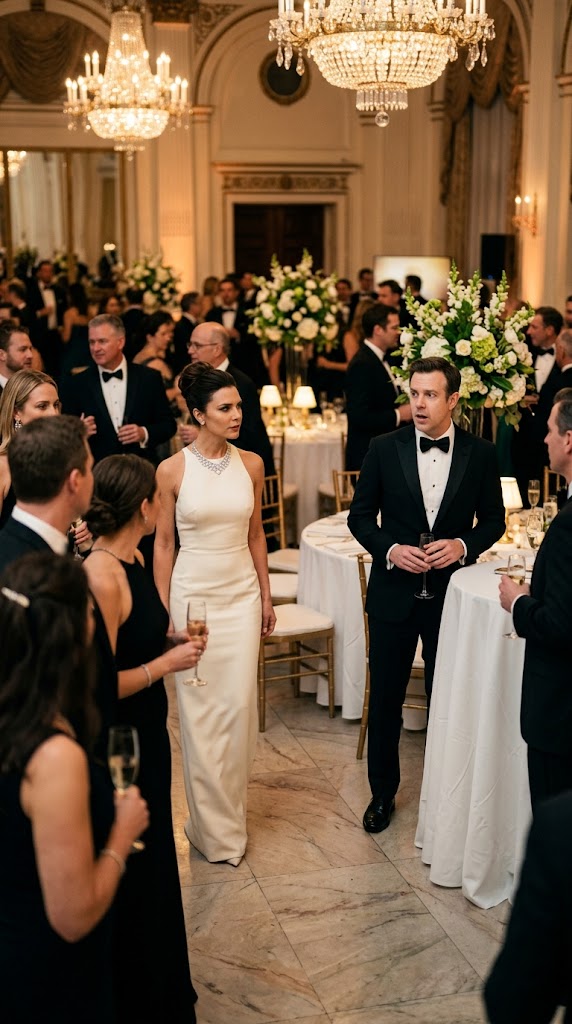
At 9:47 PM, the grand ballroom doors opened.
I want to tell you that I felt nervous. That there was some flicker of the woman who had been standing barefoot in her backyard two hours ago watching her dress burn, some echo of the Clara who ate oatmeal for dinner and reused teabags and tried so hard to be enough.
I felt none of that.
I felt clear.
The sound in the room dropped within five seconds. Not all at once — it rolled from the entrance inward, table by table, as heads turned and conversations stalled and champagne glasses paused at lips.
I found Adrian immediately.
He was at a round table near the front — prime placement, VP positioning. He was mid-laugh, his head tilted toward Vanessa, who was in red, her hand resting on the table near his. She was beautiful. She was appropriate for his environment. She fit.
He hadn’t seen me yet.
I watched him for exactly three seconds.
Then he turned.
I saw it happen in stages. His eyes caught the movement at the entrance. His laugh finished mechanically, without his brain behind it. He focused. He registered the gown. The diamonds. The entourage. The board members.
And then he registered my face.
The glass in his hand stopped moving.
His mouth closed.
His face, over the course of perhaps two seconds, went through more honest emotion than I had seen from him in the last three years combined. Confusion. Recognition. Calculation. And then — arriving last, settling deepest — a fear he had never shown me before.
Because Adrian Weston was a smart man.
And smart men, when they see the board members of the company they’ve just been promoted into walking behind their wife — their wife they left at home in a burned dress — understand very quickly that they have made a catastrophic error in judgment.
Harrison walked directly to the event podium.
The room was nearly silent now.
He adjusted the microphone and opened his folder, and his voice, which had always carried the particular authority of someone who had never once in his professional life doubted that he was the most prepared person in the room, filled the ballroom without effort.
“Good evening. For those who don’t know me, I am Harrison Blackwood, Chief Legal Officer of the Vaughn-Ashford Group, primary holding entity and majority stakeholder of Vanguard Dominion Corporation.” He paused. “I have the privilege of introducing, this evening, the individual whose family founded this company, who serves as Chairwoman of the Board of Directors, and who will be reassuming active executive oversight effective Monday morning. Ladies and gentlemen — Clara Vaughn-Ashford.”
Applause started somewhere in the back and built forward.
I didn’t look at it.
I looked at Adrian.
He had stood up from his chair. I don’t think he chose to stand — I think his body made the decision while his mind was still catching up. Vanessa’s hand had fallen from the table. She was looking between us, confused, her social intelligence working overtime to map the geography of what was happening.
I walked through the room.
People stepped back. Not out of fear — out of that instinctive, animal acknowledgment of authority that happens in rooms full of ambitious people when someone who outranks everyone enters their orbit.
I stopped six feet from Adrian’s table.
He looked at me. Really looked at me — maybe for the first time in years. Not at the woman who was inconvenient, not at the liability, not at the thing he had burned and dismissed and replaced. At me.
“Clara,” he said. His voice was barely above a whisper.
“Adrian,” I replied. Calm. Cold. Clear.
“I didn’t know—” he started.
“I know you didn’t.” I tilted my head slightly. “That was the point.”
Vanessa touched his arm. He didn’t move.
“Seven years ago,” I said, not raising my voice — there was no need, the room was utterly still, “I gave up everything I had to see if you would love me without it.” I let that sit for exactly one beat. “You answered that question very clearly tonight.”
“Clara, please—” His voice cracked on the second word.
“You told me I didn’t belong here,” I said. “You told me security would remove me if I showed up.” I looked around the room, at the board members, at the director whose daughter was standing at his side, at the six hundred people in this room who worked for a company that had my name in its foundation documents. “This building exists because of my family. This company operates because of my family’s investment. And you—” I returned to his face. “You have a job tonight because seven years ago I decided the man I loved deserved a chance he couldn’t build for himself.”
The silence was absolute.
“You will have a letter from Harrison’s office in the morning,” I said. “I’d suggest reading it carefully.” I turned to Harrison, who stood at my shoulder. “Are we done here?”
“One more item, my lady.” He stepped forward and addressed the room. “As Chairwoman’s first act of resumed oversight, the appointment of Adrian Weston to Vice President of Operations is under immediate review, pending an HR and conduct audit. All of Mr. Weston’s executive access credentials have been suspended as of 10:04 PM this evening. Thank you.”
The sound that followed was not applause.
It was the sound of four hundred people simultaneously processing the complete professional and personal destruction of someone who had, four hours ago, stood in a backyard holding lighter fluid.
Adrian sat back down. Slowly. Like something had gone out in him.
I did not stay to watch the rest.
I walked toward the windows. Harrison followed. One of the board directors handed me a glass of sparkling water and said, very quietly, “It’s good to have you back, Chairwoman.”
“Thank you,” I said.
I looked out at the city. Forty-two floors up. Midtown Manhattan. Every light a company, every company a story, every story built on someone’s sacrifice and someone’s trust and the specific kind of love that doesn’t ask for anything back.
I had asked for nothing back for seven years.
I had gotten my answer tonight.
And now I was done being small.
The letter Harrison delivered to Adrian the following morning was fourteen pages.
It outlined the full scope of the Vaughn-Ashford Group’s ownership interest in Vanguard Dominion. It included a detailed record — compiled by Harrison’s office over the years at my quiet instruction — of every contribution I had made to Adrian’s professional development: the exam fees, the tutoring, the financial support, the introductions made quietly and without credit through family connections he never knew I had.
It also included the divorce filing.
Adrian called me eleven times that day. I didn’t answer.
He showed up at the Brooklyn house on Saturday morning. The house was empty. I had moved out Friday night.
He left a voicemail that was seven minutes long. I listened to it once. He said he loved me. He said he had been afraid. He said the pressure of becoming someone had made him into someone he didn’t recognize. He said he was sorry.
He said every true thing too late.
On Monday morning, I walked into Vanguard Dominion’s executive floor for the first time in seven years, and the board stood when I entered the room, and Harrison placed the company’s founding documents in front of me, and I signed my name.
Clara Vaughn-Ashford. Chairwoman.
Not liability. Not embarrassment. Not the woman in the discount dress who didn’t belong.
The woman who built the room he was standing in.
I had waited seven years to come home.
The dress he burned cost me four months of tip money.
What he lost cost him everything else.

Evan Cole Editor-in-Chief | Breaking News & Public Policy
“From Washington to Wall Street, and Main Street to Hollywood—Evan Cole connects the dots.”
As the Editor-in-Chief at Newskilo, Evan leads a dynamic team of journalists dedicated to uncovering the truth behind the headlines. With over 15 years in digital media, Evan has a reputation for cutting through the noise.
While he is widely recognized for his deep analysis of U.S. fiscal policy (IRS & Stimulus), Evan’s expertise extends to global current events, corporate accountability, and cultural trends. Whether he is breaking down a complex government bill, exposing a tech giant’s failure, or analyzing the societal impact of a viral celebrity moment, Evan’s goal is simple: To tell the stories that shape our world with clarity, accuracy, and integrity.
Leave a Reply