
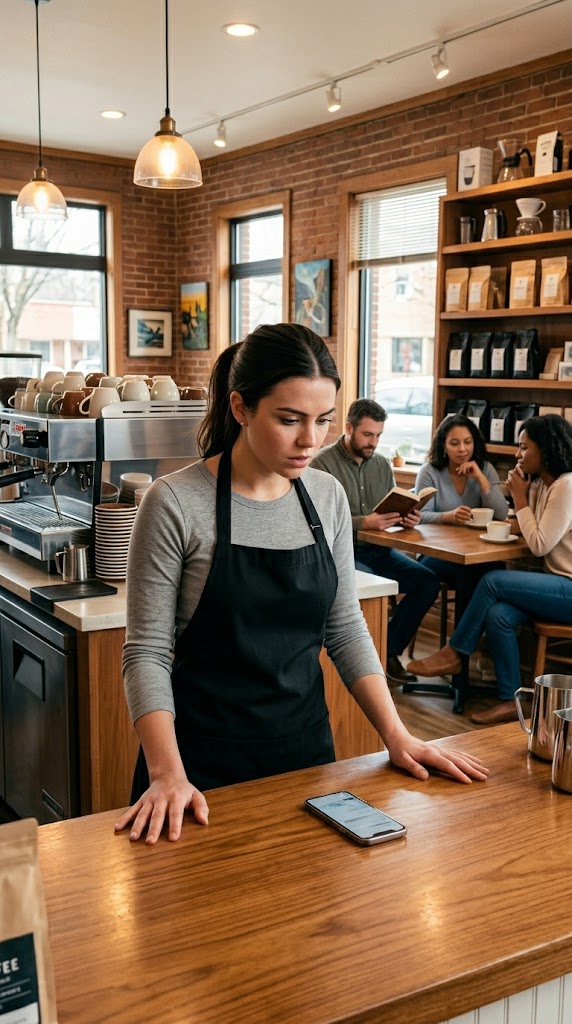
The espresso machine behind me had been hissing the same broken note all afternoon.
I had been on my feet since 6 AM. My lower back had started sending signals around noon that I was choosing to ignore. The lunch rush had finally slowed to a trickle and I was doing the thing I always do in quiet moments at work — wiping the counter, the same long strokes, back and forth, the motion that lets me look busy while my brain actually rests.
It was my birthday.
I was twenty-three years old and I was wiping a café counter and waiting for something — not a party, not even a call, just some small acknowledgment that the day existed, that I existed in it, that somewhere in the arithmetic of my family I was counted as a person and not just a function.
My phone buzzed at 4:17 PM.
Mom.
I actually felt something in my chest lift for a half second. I want to be honest about that. Even then — even after everything — some part of me still reached for hope like it was a reflex I hadn’t managed to untrain.
I unlocked the screen.
“We sold your car. Family comes first. Be grateful we even let you live here.”
I read it once. Read it again. Read it a third time because there is a specific kind of message that your brain refuses to process at full speed — it keeps slowing the words down, searching for an alternate meaning that isn’t there.
There was no alternate meaning.
The car was gone.
My car. The one I had saved for across twenty-two months of opening shifts and closing shifts and double shifts on holidays and the kind of tip-counting that happens alone in a car in a parking lot because you’re too tired to go inside yet and you need sixty more seconds of silence before you can face another human being.
I had bought that car in January. It wasn’t impressive — a 2017 Honda with 80,000 miles and a passenger-side window that was slow in the cold. But it was mine. I had paid for it entirely, in cash, from money I had earned in a way that had cost me something real.
It represented something I had been building toward my whole life.
It meant that I could leave.
I put the phone face-down on the counter and picked up the cloth and started wiping.
Maya, my coworker, glanced over from the register. “You good?”
“Yeah,” I said. “Fine.”
The second message came at 4:21 PM.
“Your brother’s starting college. You’ll pay his first semester. $6,000. This week.”
No question mark.
Not “could you” or “would you consider” or even the performance of asking. Just a number and a deadline, delivered with the confidence of someone who has never had to wonder whether they would be obeyed.
Six thousand dollars.
My entire emergency fund was forty-two hundred.
I finished my shift. I don’t remember the last two hours in any real detail. I remember the motion of it — orders, counter, register, clean, repeat — the physical autopilot that kicks in when your brain has gone somewhere else to deal with something it can’t handle in public.
When I clocked out, I sat in Jenna’s car — she had driven me that day, knowing mine was in the shop, or so I had believed — and I typed one word.
No.
I pressed send before I could reconsider.
Not because I was brave. I want to be clear about that. I typed it because I needed to know if the word still had weight in my family. I needed to know if I was a person who could refuse something or if I was simply a resource with feelings that everyone had agreed to politely ignore.
My phone rang eleven seconds later.
My dad.
I answered it.
He didn’t say hello.
“Who do you think you are?”
His voice through the phone speaker was loud enough that Jenna, in the driver’s seat, glanced over. I could hear my mom in the background already — not words, just tone, the particular vocal pitch she uses when she’s constructing her version of events in real time, building the story she’ll tell herself and everyone else about why she’s the victim of this moment.
My dad kept going. His voice got louder, then sharper, then he made a sound that wasn’t quite a word — a disgusted exhale — and hung up. Not because the conversation was over. Because he didn’t think it was worth continuing.
That was the part that stayed with me on the drive home.
Not the yelling. I had grown up with the yelling. It was the hanging up. The you’re not even worth finishing this sentence. The casual certainty that I would absorb whatever he said and be there waiting, ready to be spoken at again whenever he chose to resume.
Jenna pulled into my parents’ driveway.
The space where my car used to sit was empty in the particular way that deliberate absences are — not just an absence, but a statement.
Inside, my mom was at the kitchen counter. Phone in hand, scrolling. Completely, infuriatingly calm.
“Did you actually sell it?” I asked.
She didn’t look up.
“We did what we had to. Your brother’s future matters more than your comfort.”
The word comfort landed wrong in a way I couldn’t immediately articulate. It took me a second to understand why. It was the reclassification. Two years of labor — real, physical, grinding labor — had been quietly downgraded in her framing to comfort. A luxury. Something negotiable. Something that, when weighed against the family’s needs, was obviously the thing to sacrifice.
My dad was in the doorway. Arms crossed. The posture he uses when he’s already decided how things end.
“You live under our roof,” he said. “After everything we’ve done for you, you don’t get to refuse.”
Everything we’ve done for you.
I thought about the list. I genuinely tried to construct it. The housing — yes, though I paid rent and utilities and groceries for the last two years. The childhood — yes, though I had spent much of it trying to be invisible enough not to be a problem. The opportunities — and here I genuinely tried to find them, reached for them in my memory, looked for the specific moments of investment or encouragement or belief that would make the phrase meaningful.
I found my grandmother’s jewelry box.
That was the thing that kept surfacing. A small wooden box she had given me when I was sixteen — not valuable, not expensive, just mine. The only object in that house that existed entirely outside of their story about what I was and what I owed them.
I walked to my room.
My hands were shaking when I opened the closet.
I noticed when they stopped.
It wasn’t a conscious decision — the steadying. It happened the way most important things happen: without announcement, arriving quietly while you’re busy doing something else. I was pulling my duffel bag from the top shelf when I realized my hands were completely still. And something in my chest that had been clenched for years was doing the same.
I packed methodically. Clothes first — the practical ones, not the nice ones, the ones that would actually serve me. Laptop. All the chargers. My documents — birth certificate, Social Security card, the folder of tax returns and pay stubs I had been keeping since I was eighteen because some part of me had always known this day was possible.
The jewelry box last.
From the hallway, my mom said — still calm, still so certain of herself — “You’re not actually leaving.”
She said it the way you say things you’ve never had to mean. The way people speak when they have never genuinely considered the possibility that you might do what you’re saying you’re going to do.
My dad moved to the doorway when he heard the bag. He stood there — arms still crossed, body filling the frame — in that posture that says I am the structure of this house and you cannot pass through me.
But I was done with the posture.
“Move,” I said.
And I think it was the absence of emotion in my voice — not anger, not tears, just flatness — that made him step aside. You can argue with emotion. You can escalate against anger and comfort against crying. There is no move against someone who has simply finished.
I walked out.
Jenna’s apartment was a third-floor walkup in a part of the neighborhood that smelled like a laundromat and someone’s grandmother’s cooking. Her couch had a spring that found my lower back within five minutes of sitting down. The overhead light was too bright and one of her cats kept walking across my bag like it was testing whether I was staying.
It was the safest place I had ever been.
She made tea she didn’t really know how to make and sat across from me and looked at me in the direct, undefended way that good friends look at you when they want you to know they’re not going to look away.
“Ava,” she said. “That’s not okay.”
I nodded.
I couldn’t speak yet. Not because I was too emotional — almost the opposite. I was so far past emotional that words felt unnecessary. Something had been resolved inside me at a very basic level, the kind of resolution that doesn’t require an audience or a speech.
I drank the tea. It was too strong. I didn’t say anything.
Later — after Jenna had fallen asleep on the other end of the couch with the TV on low — I opened my laptop.
The folder was exactly where I had left it. A pale yellow icon, labeled with a date from four months ago, the last time I had opened it and then closed it and told myself it wasn’t time yet, that maybe things would change, that I should give it one more month.
I had given it four.
My fingers hovered over the trackpad.
I thought about what was in the folder. I thought about the conversation I’d had with my grandmother before she passed — the specific things she had told me about what she had set aside, and how, and why. I thought about the fact that I had never mentioned any of it to my parents. Not out of strategy. Just because it had never felt necessary. Because I had believed — for a very long time, past the point where belief was warranted — that it wouldn’t come to this.
Jenna stirred and opened one eye. “What are you doing?”
I considered the question.
“Stepping out of something,” I said, “that they think I still belong to.”
She looked at the screen for a second, then closed her eye again. “Okay,” she said, in the tone of someone who trusts you.
I turned back to the laptop.
Here is what my grandmother had done.
Eleanor Vasquez — my mother’s mother, the woman who gave me the jewelry box, who smelled like rose water and kept butterscotch candies in her coat pocket and once told me, when I was nine, that the most important thing a woman can own is something no one can take from her — had been quietly, carefully building something for thirty years.
She had a small investment account. Nothing dramatic — the accumulated savings of a woman who had worked in a hotel laundry for fifteen years and then a school cafeteria for twelve more, who spent almost nothing on herself and invested small amounts regularly because a man at her church had once given a talk about compounding interest that she never forgot.
When she died, the account had grown to a little over ninety thousand dollars.
She left it entirely to me.
Not to my parents. Not split among the family. Not held in trust with conditions. To me, directly, because she had spent the last decade of her life watching what my parents did with money and with people, and she had drawn her conclusions.
My parents knew the account existed in a general way. What they didn’t know — because my grandmother had been deliberate about this, and I had been careful not to correct the misunderstanding — was that they had access to none of it. They believed, somehow, that the money was held in a family trust. That it was accessible with the right combination of paperwork and family agreement.
It was not.
It was in my name. My name only. Accessible to me with a password and a two-factor authentication code sent to my phone.
What I had been doing — the thing I had been refusing to do for four months while I kept hoping things would change — was transfer the account to a new institution entirely. One my parents had no knowledge of, no account numbers for, no pathway to.
The transfer took eleven minutes to initiate.
It would complete in three to five business days. But the account number would change immediately. The old access pathway — the one my parents had apparently been researching, which I had discovered in my mom’s search history six months ago when I borrowed her laptop — would return an error.
By morning, whatever they thought they had access to would be gone.
I closed the laptop.
I turned off the light.
I lay down on the couch with the bad spring and the cat who kept changing positions and Jenna’s TV still making noise at low volume, and I slept better than I had in four months.
My phone started at 6:48 AM.
Mom first. Three calls in seven minutes, no voicemails. Then a text: Pick up the phone, Ava.
Then my brother Marcus. Two texts and a call, the texts reading like he had been coached on what to say: Ava, we should talk. Mom and Dad made a mistake. Come home. Then, twelve minutes later, the coached version abandoned: What did you do to the account? I have orientation fees due on Monday.
Then my dad. Calling without stopping, not leaving messages, just cycling through — call, voicemail, call, voicemail — the pattern of someone who has realized something and is not handling it well.
Then, at 8:23 AM, a number I had not seen in six years.
My uncle David. My father’s older brother, who had moved to Phoenix, who called at Christmas some years and most years didn’t, who existed in my life as a peripheral figure I associated with awkward holiday dinners and the particular tension that moves through a room when two brothers are in it.
He never called me.
He was calling now.
I was in the middle of Jenna’s kitchen making coffee when it came through. I stood there watching the screen — David Reyes in my phone’s dim morning light — and I thought about what it would take for my father to make that call. To call his older brother and say: Call Ava. She needs to answer. The specific kind of pride that would have to break for that request to exist.
I let it ring.
Then I sat down with my coffee and I thought about the eleven minutes.
Here is what they didn’t understand, and what I had spent years not saying: I had never needed them the way they assumed I did. I had needed their love — that is a different thing, and an honest thing, and I will not pretend otherwise. I had wanted my parents’ love in the particular, specific, irreplaceable way that children want it, and I had organized significant portions of my life around trying to earn or maintain or simply not lose what I imagined they felt for me.
But I had not needed their roof. Not really. Not financially.
I had been choosing to stay — out of hope, out of habit, out of the belief that proximity might eventually produce the warmth I was looking for.
It hadn’t.
And now they had sold the one physical object that represented my independence, demanded six thousand dollars I didn’t have, and evicted me on my birthday — and in doing so, they had done something they did not intend.
They had released me.
I called David back at 10 AM.
He answered on the first ring.
“Ava.” His voice was careful. The voice of a man who has been briefed on a situation he doesn’t fully understand and is trying to figure out his role in it. “I’m not calling to pressure you. I want you to know that.”
“Okay,” I said.
“Your dad told me what happened.” A pause. “He’s… not telling the whole story. I know that. He never does.” Another pause, longer. “But your mom is really scared, Ava. I don’t know what’s in this account or why she thought it worked the way she thought it worked, but whatever happened — she’s genuinely scared.”
I thought about my grandmother. About the specific clarity she had about her daughter. About the way she had set things up with a quietness that I now understood was deliberate — not angry, not punishing, just clear. She had loved my mother. She had also known exactly what my mother was capable of.
“I know,” I said. “That’s not my fault.”
“No,” David said, after a moment. “I don’t think it is.”
We talked for twenty minutes. He didn’t try to fix anything. He didn’t ask me to forgive anyone or go home or reconsider. He just talked to me like I was a person who had been through something real and was navigating it with more composure than he expected. At the end, he said: “For what it’s worth, your grandmother would be proud of you.”
I had to put the phone down for a minute after that.
My mother called at 2 PM.
I answered.
She was crying — genuinely, not performatively, the kind of crying that sounds like it started hours ago and hasn’t fully stopped. She said she was sorry. She said she hadn’t thought about it the way it looked. She said she had made assumptions and hadn’t talked to me first and she knew that was wrong.
I listened.
I had imagined this call many times over the years. I had imagined what it would feel like to hear her say she was sorry — whether I would feel vindicated, or sad, or released. I had imagined that it might undo something, or close something, or change the shape of what I was carrying.
What it actually felt like was quiet.
Not empty. Not numb. Just quiet, in the way that things feel after a long noise finally stops.
“I hear you,” I said.
“Does that mean—” she started.
“It means I hear you, Mom.” I kept my voice gentle. “That’s all it means right now.”
We sat on the phone together for another minute without speaking. Then I told her I had to go.
Marcus came to Jenna’s apartment on Thursday evening.
He didn’t knock with authority — he knocked with his knuckles soft, tentative, the knock of someone who isn’t sure they’ll be let in. Jenna answered and I heard her say something, and then he was in the hallway outside the living room, twenty years old and for the first time in my memory looking his age.
“I just wanted to say,” he started, then stopped. Tried again. “I didn’t know they sold your car. I didn’t know they were going to ask you for—” He stopped again. He looked at the floor. “That’s not true. I knew about the money. I didn’t ask them to go to you like that. But I knew.”
I nodded.
“That’s a start,” I said.
He looked up. “I don’t want you to pay for anything. I’m going to apply for aid. I should have done it months ago.”
“You should have,” I agreed.
We talked for a while. It wasn’t repaired — nothing like that heals in one conversation, and I want to be honest about that rather than tell the version of this story where everything resolves cleanly. But there was something real in that room that hadn’t been there before. Something that might, over time and with honesty and with effort from both sides, grow into an actual relationship between two people rather than a transaction between a resource and its users.
Maybe.
I was willing to see.
I’m writing this from my own apartment.
Third floor walkup, different building, twelve minutes from Jenna’s. I signed the lease six days after I left my parents’ house. The bedroom is small enough that I have to turn sideways to get between the bed and the desk. The kitchen window looks out onto a fire escape and a brick wall.
I have never been more comfortable anywhere in my life.
The account transfer completed. The money is exactly where it should be — mine, secure, untouchable by anyone who mistook my patience for permission.
My mom and I talk occasionally now. Short calls, careful ones. She’s not the mother I needed her to be, and I have stopped spending energy being angry about that. She is who she is. I am someone who knows that clearly now, and that knowledge, as it turns out, is a form of freedom I didn’t know I’d been missing.
My dad hasn’t called since the week I left.
I think about what my grandmother knew. How she saw it all — the whole pattern, the whole family, the way love in our house always came with a hidden price tag — and she set aside thirty years of careful saving and pointed it directly at me, not because I was special or more deserving, but because she saw someone who was going to need a way out.
She gave me a way out.
I just finally used it.
There is a kind of strength that doesn’t announce itself. That doesn’t argue or perform or beg to be recognized. That wipes the counter in long slow strokes while a storm builds inside it, and packs a bag with steady hands, and types one word, and means it.
I am twenty-three years old.
I have a third-floor apartment and a laptop and a jewelry box and an account that belongs only to me.
I have, for the first time in my life, nothing I didn’t choose.
That is enough.
That is everything.

Evan Cole Editor-in-Chief | Breaking News & Public Policy
“From Washington to Wall Street, and Main Street to Hollywood—Evan Cole connects the dots.”
As the Editor-in-Chief at Newskilo, Evan leads a dynamic team of journalists dedicated to uncovering the truth behind the headlines. With over 15 years in digital media, Evan has a reputation for cutting through the noise.
While he is widely recognized for his deep analysis of U.S. fiscal policy (IRS & Stimulus), Evan’s expertise extends to global current events, corporate accountability, and cultural trends. Whether he is breaking down a complex government bill, exposing a tech giant’s failure, or analyzing the societal impact of a viral celebrity moment, Evan’s goal is simple: To tell the stories that shape our world with clarity, accuracy, and integrity.
Leave a Reply