
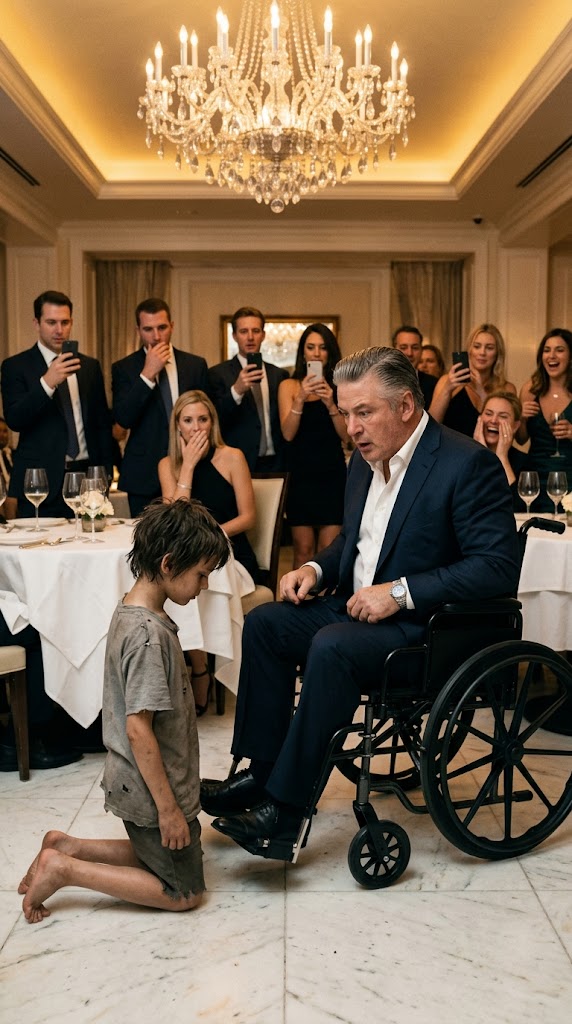
The champagne was already open.
That’s the detail I keep coming back to — the champagne was already open, already poured, already half-finished, and the laughter in that room was the kind that exists on a different frequency than ordinary laughter. It had weight. It had edges. It was the laughter of people who had stopped worrying about money so long ago that they’d forgotten there was ever a reason to worry.
I’d been inside The Meridian before — twice, maybe three times — always for work, always as the person whose name wasn’t on the reservation. That Friday night was no different. I was there with my boss, David Chen, and two clients he was working to close on a commercial property deal that would make the kind of commission that changes how a person carries themselves for the rest of their life.
My job was simple. Smile. Top off glasses. Stay invisible.
I was very, very bad at that job by the end of the night.
The Meridian sits on East 72nd Street in a brownstone that has been renovated so many times that nothing original remains except the address. The interior is pure theater — polished white Carrara marble floors, a coffered ceiling with three custom chandeliers that cast everything in warm amber gold, and tables spaced far enough apart that you can have a private conversation without lowering your voice. The kind of space that makes ordinary people feel extraordinary and extraordinary people feel inevitable.
That night, the room was packed. It was a Friday, late October, and the energy that comes with the end of a strong financial quarter was floating through the air alongside the jazz quartet playing near the back wall. Crystal clinked. Someone laughed too loudly at something that probably wasn’t funny. A server moved between tables with the practiced invisibility of someone who’s spent years perfecting the art of not existing in rooms like this.
I was watching David work — watching him lean in at just the right moment, watching him use silence as a tool — when the front door opened.
He was a child.
That’s the first thing. Just a child. Eight years old, maybe nine, the kind of age where the face is still soft but the eyes can sometimes hold something that doesn’t match. He was barefoot — I noticed that immediately, because the contrast between his bare brown feet and the cold, flawless marble was so jarring that my brain took a second to process what I was looking at. His clothes were dirty. A grey cotton t-shirt with a tear along the collar. Dark pants that were too short. His hair was matted, unwashed, the kind of hair that tells a story about a life without consistent shelter.
He walked in like he’d been there a thousand times.
The host — Marcus, a tall man with the professional warmth of someone who handles surprises for a living — scrambled from behind his podium with a polished smile that didn’t quite reach his eyes. “Excuse me, young man, I think there may be—”
The boy walked past him without a sideways glance.
The room noticed immediately. That’s the thing about spaces like The Meridian — they have a sensory immune system. Something foreign enters and every head turns, every conversation pauses, every phone reflexively lifts.
I counted at least fourteen phones come up within the first six seconds.
The whispers started fast. “Is this a joke?” from the table to my left. “Who let him in?” from somewhere near the bar. A woman in a white dress covered her smile with her fingertips, shoulders already shaking with laughter that she was trying — and failing — to contain.
I watched the boy’s face through all of it.
He didn’t react. Not even a flicker. He scanned the room once with those dark, calm eyes — the way a surgeon scans a room, not sightseeing, looking for something specific — and then he walked directly toward the center table.
Toward Preston Calloway.
Who Preston Calloway Was
If you moved in certain circles in New York — real estate, private equity, the architecture of old money being quietly transferred into new structures — you knew that name. Preston Calloway, sixty-one years old, founder of Calloway Capital Ventures, a man whose portfolio included office towers, three luxury hotel brands, a stake in a regional airline, and a reputation for being the most controlled person in any room he entered.
He was also, for the past four years, a wheelchair user.
The accident that put him there was semi-public knowledge — a car crash on Route 9 in Westchester County in November four years prior. His Range Rover had left the road during a rainstorm, hit a guardrail, and the resulting spinal injury had taken function from his legs. He’d done two surgeries. Three rounds of intensive rehabilitation. The best spinal specialists that unlimited money could buy had all told him the same thing in different polished ways: this is permanent.
Preston Calloway responded to that verdict the way he responded to every obstacle in his professional life — by outworking it. He redesigned his office. He redesigned his home. He redesigned his public image around strength, around the wheelchair being a detail and not a definition. He gave interviews. He showed up. He controlled the narrative with the same precision he applied to everything else.
He was seated at the center table — six people around him, the inner circle — in a dark navy suit that had been custom tailored to sit correctly in a wheelchair, his titanium Patek Philippe catching the chandelier light every time he moved his wrist. His salt-and-pepper hair was slicked back. His posture was the posture of a man who had learned to carry authority from a seated position so completely that you forgot to notice the chair.
He was mid-sentence, mid-laugh, completely in control of his table, when the boy stopped in front of him.
The table went quiet.
Preston looked at the boy the way you look at something unexpected — not with alarm, because alarm implies threat, and a thin barefoot child wasn’t a threat to a man like Preston Calloway. He looked at the boy the way you look at something curious. Something that has wandered into the wrong frame.
“Can I help you?” His voice was warm. Almost amused. The performance of a man so secure in his power that he could afford to be gracious.
“Sir.” The boy’s voice was clear. Completely steady. Not the voice of a frightened child. Not the voice of someone who had wandered in by accident. “I can fix your leg.”
One beat of absolute silence.
Then the table exploded.
Not just Preston’s table — the tables around it. The laughter spread outward like a wave from a stone dropped in still water. Genuine, unguarded laughter of the kind that comes when something strikes people as so absurd that the social filter drops entirely.
One of Preston’s associates — a man named Gerald Frost, late fifties, silver hair, the kind of laugh that fills rooms — had to put his hand on the table to steady himself.
A woman in a red dress pressed both hands over her mouth, eyes streaming.
Someone at the bar actually clapped.
“This kid—” someone started, and then couldn’t finish.
And Preston — Preston leaned back in his chair with that smile. The one that meant he was enjoying himself. The one that, if you knew him, also meant he was deciding exactly how to dismantle something.
“You,” he said, voice low and theatrical, scanning the boy slowly from head to bare feet and back again. “You can fix my leg.”
He let the silence stretch. The room leaned in.
“How long,” Preston asked, “will that take?”
“Just a few seconds,” the boy said.
The room went to a new level of noise I can only describe as controlled chaos. People were gasping between laughs. Someone knocked their fork off their plate. I watched a man in his forties literally stand up to get a better view, phone held above his head like he was at a concert.
But here’s the thing I noticed, sitting where I was sitting, at a table close enough to see the details:
The boy didn’t move.
He didn’t shift his weight. He didn’t look down. He didn’t react to a single person in that room except Preston. His attention was on Preston with a focus so complete and so still that it was the most unnerving thing I’d ever seen on a child’s face.
Preston opened his jacket with the slow, deliberate theatricality of a man who knows every eye in the room is on him. He reached into his inside pocket and placed his personal checkbook on the white linen tablecloth with a soft, definitive thud.
He uncapped a pen.
“Fix it,” he said quietly. The room was already half-silenced just watching him. “I’ll give you a million dollars.”
Total silence.
That specific kind of silence that means a room has collectively crossed from entertainment into something they can feel but can’t name yet.
I felt it in my chest before I understood it in my head.
What Happened at the Table
The boy stepped forward.
No hesitation. No pause to reconsider. Just forward — one step, two — until he was standing directly beside the wheelchair.
Then he dropped to his knees.
Not dramatically. Not performatively. He simply lowered himself to the marble floor with the practicality of someone who needed to get closer to something and this was the most direct way to do it.
He placed his right hand on Preston’s left leg.
Gently. The way you’d place a hand on something fragile.
The jazz quartet was still playing. A slow, warm arrangement of something that I later identified as “Misty.” It felt wrong now — too soft, too warm for whatever was accumulating in the air of that room.
“Count with me,” the boy said.
His voice was barely above a whisper now, but in the silence of that room it carried to every corner.
Preston let out a short laugh — the tail end of a performance, the laugh of a man who has indulged something long enough. “This is ridicu—”
He stopped.
In the middle of the word. His jaw stopped moving. His eyes, which had been performing amusement for the room, snapped downward to his leg — to the boy’s hand on his leg — with an expression that I had never seen on Preston Calloway’s face in any photograph or interview or piece of coverage I’d ever encountered.
That expression was: confusion.
Pure, unguarded, momentarily defenseless confusion.
“…what…” he said. The word came out wrong. Quiet. Small. The voice of someone who has felt something they didn’t expect to feel and doesn’t yet know what to do with that information.
“One,” the boy said.
The entire restaurant stopped breathing.
I’m not using that as a figure of speech. I mean that I noticed — consciously noticed — that the ambient sound of the room had dropped to near-zero. No clink of glasses. No scrape of silverware. The jazz quartet had tapered off, whether by instinct or instruction I don’t know.
“Two…”
Preston Calloway’s right hand came down onto the table.
Hard.
Not a slam — controlled, but heavy, like a man bracing himself against something he doesn’t understand. The crystal glasses jumped. His breathing changed — audibly, from where I was sitting — from the steady, measured rhythm of a man in control to something jagged and quick and desperate that he couldn’t seem to regulate.
And then his leg twitched.
I need to be careful about how I say this because I know how it sounds and I know what the skeptical response is and I’ve had that skeptical conversation with myself a hundred times in the three weeks since.
But his leg moved.
Not a tremor. Not a medical reflex. A movement. A voluntary, deliberate, unmistakable movement of a limb that four years of medicine and surgery and therapy and the best neurologists in the country had confirmed was permanently, irreversibly non-functional.
I heard a sharp intake of breath from directly behind me — a woman’s voice.
Then a glass hit the marble floor somewhere near the bar. The sound of it shattering ricocheted through the room like a gunshot.
Someone screamed. A short, sharp, involuntary scream — the sound a person makes when something they are witnessing doesn’t fit into any category their brain has available.
Preston’s hand slammed down on the table again — both hands now — and his breathing had broken entirely into those short, wet, desperate gasps that I’ve only heard before from people in moments of extreme physical or emotional crisis.
He was trying to stand.
I could see it happening in real time — the shift in his weight, the way his arms were pressing down, the way his upper body was rising — and the wheelchair was creaking under the redistribution of force as his legs, those legs that could not and had not and would not work, were bearing weight.
The boy did not move. His hand remained on Preston’s leg. His expression did not change.
“WHAT DID YOU DO?!” Preston’s voice came out at a volume I’d never heard from him — raw and torn and completely stripped of every layer of performance and control that he had spent decades constructing. He was screaming. Preston Calloway, the man who gave interviews in a wheelchair and smiled and talked about resilience and redefining success, was screaming in the middle of the most exclusive restaurant on the Upper East Side.
The boy looked up at him.
And smiled.
I’ve tried to describe that smile to every person I’ve talked to about this night and I keep failing because there isn’t a reference point for it. It wasn’t the smile of a child. It wasn’t the smile of someone who had accomplished a trick. It was the smile of someone who has known something for a very long time and has been waiting — patiently, without resentment — for exactly this moment.
“Three,” the boy said.
He Stood Up
Preston Calloway stood up.
I will write that sentence as plainly and directly as I’m capable of writing it because it is the plainest and most direct fact of that night and it deserves to be stated without decoration.
He stood up. Both legs. Full weight. The wheelchair sat empty behind him.
The room detonated.
There is no other word. Detonated. Sixty-plus people — wealthy, composed, socially calibrated people who had spent their adult lives learning to respond to everything with measured grace — completely lost any composure they had.
People were standing on chairs. People were grabbing the arms of strangers. Someone knocked an entire place setting off a table and didn’t seem to notice. The sound was overwhelming — shouts, gasps, crying, a kind of pure human noise that has no social equivalent and occurs only when something happens that genuinely cannot be explained.
Preston was standing. Shaking — his whole body in tremors — tears streaming freely down a face that I’d only ever seen behind careful control. His eyes were on the boy. Wild and flooding and absolutely terrified in a way that had nothing to do with the physical miracle happening in his own legs.
“WHO ARE YOU?!” he screamed.
His voice was gone. Just — gone. The controlled baritone that had sat across tables from senators and CEOs, the voice that had closed a billion dollars in deals, was nothing now. It was the voice of a man completely undone.
The boy rose from the floor.
He rose with the same unhurried calm with which he had entered the restaurant, walked past the host, and moved through a room full of mockery without a single flinch. He stood at his full height — this small, barefoot, dirty-clothed child — in front of a standing, shaking, weeping Preston Calloway, and he leaned forward.
And he whispered.
I was twelve feet away. I could see his lips moving. I could see Preston’s face in profile — the way it changed in real time, second by second, as those words entered his ear. The way the trembling shifted quality. The way it stopped being the trembling of a man overwhelmed by wonder and became something else entirely.
Became the trembling of recognition.
Of something remembered.
Of something that had been buried for four years, buried under legal settlements and insurance reports and the carefully managed story of a rainy night in Westchester County, suddenly being handed back to him by a child who should have had no way of knowing it existed.
Preston’s face collapsed.
I am using that word deliberately. It collapsed — the way a structure collapses when the load-bearing elements are removed simultaneously. Everything that had made his face a face associated with power and control and certainty just… fell. Into something unguarded and exposed and absolutely shattered.
He didn’t fall. He stood. But he stood the way ruins stand — technically still upright, but nothing of the original structure remaining.
The boy stepped back.
He looked at Preston for one more moment. That same expression — calm, knowing, ancient, and not unkind. Then he turned. And walked back through the restaurant the same way he had entered — unhurried, barefoot on the cold marble, through a room full of people who parted for him now in a way they absolutely had not done twelve minutes earlier.
Nobody stopped him.
Nobody spoke to him.
The host at the door — Marcus — stepped back and held the door open without a word.
The boy walked out into the October night.
And was gone.
What the Boy Whispered
It took me eleven days to find out.
I tried everything — I reached out to every person I could identify who had been at the table that night. Most didn’t return my messages. Two responded to say they didn’t know what I was talking about, which was such an obvious lie that it told me everything about how shaken they were. One person, a woman named Diane Sorensen who handled a portion of Preston’s charitable foundation work and had been seated two tables away, agreed to meet me for coffee in a midtown hotel lobby.
She told me everything. Or as much as she knew.
Four years ago — November 7th, four years ago — Preston Calloway was driving his Range Rover back from a dinner in Greenwich, Connecticut. It was past midnight. It was raining. He had been drinking — not enough to register on any test he would later take, but enough. The road was wet.
On a residential street in a small Westchester town, a boy named Marcus Webb — seven years old — was crossing the road on his way home from a neighbor’s house where he’d stayed too late watching movies. He crossed between parked cars. He was wearing a dark jacket.
Preston didn’t see him until it was too late.
The impact was not survivable.
Preston stopped. For eleven seconds — which Diane said she knew because the timeline was established later, by the only security camera in the area, mounted outside a hardware store three hundred yards away. He stopped for eleven seconds.
And then he drove away.
There was an investigation. A quiet one. Preston’s legal team — the kind of legal team that costs more per hour than most people earn in a month — handled it. The security camera footage was determined to be of insufficient quality to identify the vehicle definitively. A settlement was reached with the Webb family privately, under terms that required permanent non-disclosure.
Three weeks after that night, Preston’s Range Rover was involved in a second, legitimate, fully witnessed accident on Route 9. A genuine accident. He was genuinely injured. His spine was genuinely damaged. He was genuinely in that wheelchair.
And somewhere in the architecture of what Preston Calloway believed, his body’s loss of those legs became intertwined with what he had done on the night he used those same legs to press down on a gas pedal and drive away from a seven-year-old boy’s body in the rain.
He never told anyone that.
But he believed it.
Diane told me that she knew this — not because Preston had ever said it directly, but because of the conversations that happened in the weeks after the second accident. The way he talked about it. The way he never pushed back against his diagnosis the way someone of his resources and tenacity would logically push back. The way he accepted it.
Like a sentence.
The boy who walked into The Meridian that Friday night and placed his hand on Preston Calloway’s leg was named Daniel Webb.
He was nine years old.
He was the younger brother of Marcus Webb.
He had been two years old when his brother died.
What he whispered to Preston Calloway, standing in the middle of a restaurant full of phones and witnesses and spilled champagne, was this:
“My brother forgave you. He told me to tell you.”
After
Preston Calloway’s office confirmed on the following Monday that he would be “stepping back from all public-facing responsibilities for an indefinite period for personal reasons.” His PR firm released a statement so anodyne and so carefully emptied of information that it communicated everything by communicating nothing.
He has not appeared in public since.
On the Thursday following the incident at The Meridian, a statement was sent to the Westchester County District Attorney’s office. Signed by Preston Calloway. Voluntarily. Without attorney representation.
It contained a full account of what happened on the night of November 7th, four years ago.
The Webb family — Daniel’s mother, his father, and Daniel himself — confirmed through their own attorney that they had been aware of Preston’s identity for two years. That they had chosen not to pursue additional legal action beyond the original settlement. That they had spent those two years in family therapy, in grief counseling, in the slow and brutal work of rebuilding a life that had a seven-year-old boy-shaped hole in it.
That Daniel had asked, some months ago, if he could “go tell the man something.”
His parents had asked him what he wanted to tell the man.
Daniel had said: “That Marcus is okay. And that he can walk now too if he wants to.”
They had tried to understand what that meant. They had concluded that they didn’t need to understand it. They had driven their son to The Meridian on a Friday night and waited in their car on East 72nd Street.
They waited forty minutes.
Daniel walked out, climbed into the back seat, buckled his seatbelt, and said: “Okay. I told him.”
And that was all he said.
What I Keep Coming Back To
I am not a religious person. I want to be clear about that because I think it matters to the way I tell this. I am not a religious person, and I am not a person who believes in things I can’t explain, and I sat in a restaurant on the Upper East Side of Manhattan and watched a man stand up from a wheelchair that he had occupied for four years and I have no explanation for it.
I’ve consulted with two neurologists, both of whom asked me a series of clinical questions and ultimately declined to offer an opinion on what I described. I’ve read everything I could find about psychosomatic illness, about the placebo effect, about documented cases of hysterical paralysis and its reversal.
None of it adequately describes what I watched.
What I keep coming back to is not the standing.
What I keep coming back to is the face.
The moment the boy whispered. The moment Preston heard those four words — my brother forgave you — and his face did what it did. And standing there, legs working for the first time in four years, surrounded by sixty witnesses and sixty phone cameras, the most powerful man in the room became the most broken.
Because forgiveness, delivered that way, by that messenger, is not a mercy.
It is a reckoning.
It removes every wall a person has built between themselves and what they did. It takes away the option of believing that the damage is only yours, only private, only survivable because you have enough money to keep it from being public. It walks into your $500-a-plate restaurant on dirty bare feet and kneels down beside you and gives you back your legs and gives you back your crime in the same breath.
And then it leaves.
Daniel Webb is nine years old.
He went home that night, ate dinner with his parents, and went to bed.
Preston Calloway stood in a restaurant full of witnesses with tears running down his face and, for the first time in four years, held his own weight.
I still don’t know how.
I’m not sure it matters.
What I know is that I was at The Meridian on a Friday night in October, and a boy with no shoes walked into a room built specifically to exclude people like him, and he wasn’t afraid, and he wasn’t asking for anything, and when sixty people laughed at him he waited, patient as stone, for the moment he’d come to give.
And then he gave it.
And walked back out into the night.
I’ve been sleeping better since I wrote this down.
I don’t know what that means either.
But I think that’s the honest ending.

Evan Cole Editor-in-Chief | Breaking News & Public Policy
“From Washington to Wall Street, and Main Street to Hollywood—Evan Cole connects the dots.”
As the Editor-in-Chief at Newskilo, Evan leads a dynamic team of journalists dedicated to uncovering the truth behind the headlines. With over 15 years in digital media, Evan has a reputation for cutting through the noise.
While he is widely recognized for his deep analysis of U.S. fiscal policy (IRS & Stimulus), Evan’s expertise extends to global current events, corporate accountability, and cultural trends. Whether he is breaking down a complex government bill, exposing a tech giant’s failure, or analyzing the societal impact of a viral celebrity moment, Evan’s goal is simple: To tell the stories that shape our world with clarity, accuracy, and integrity.
Leave a Reply