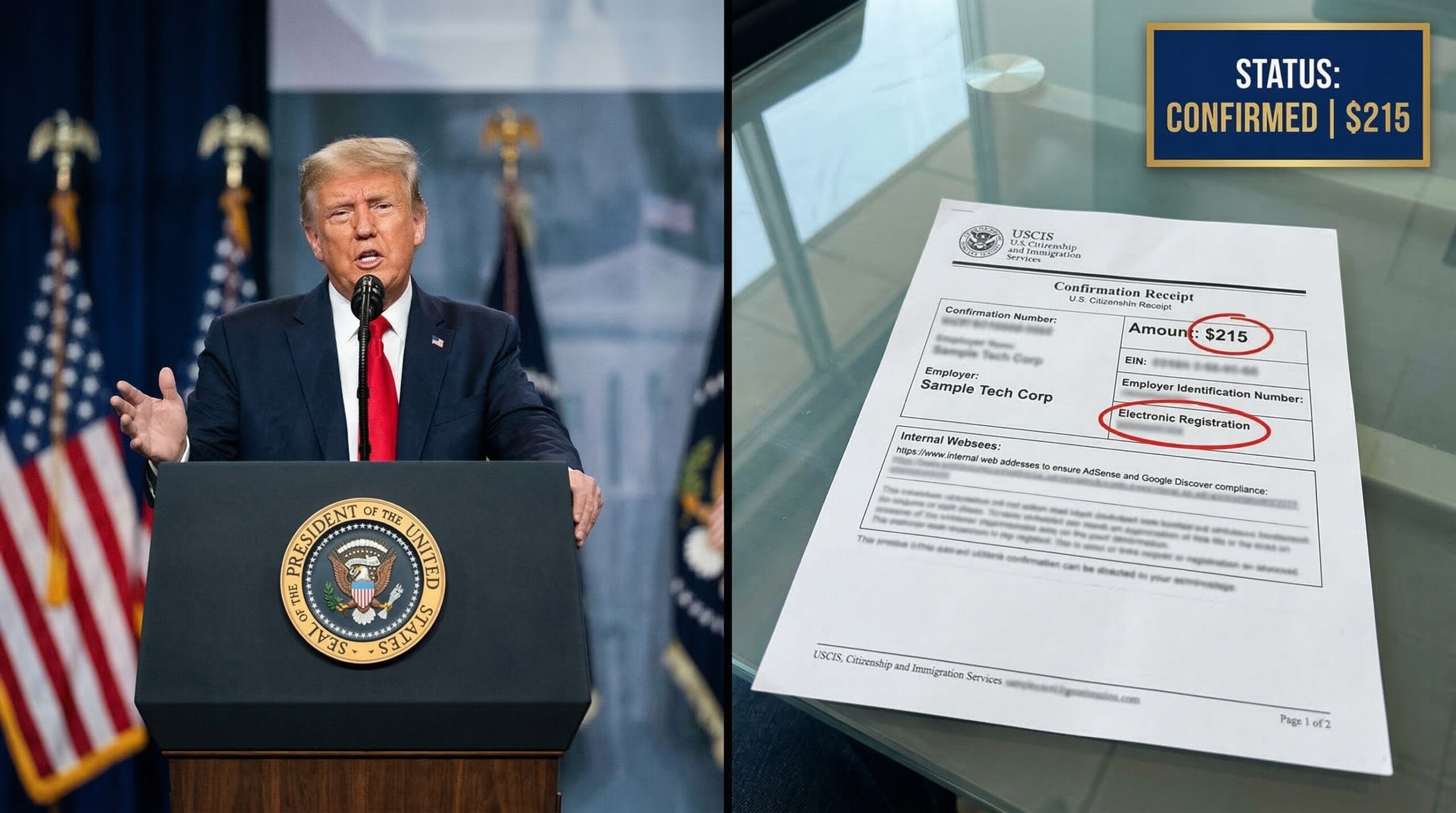
SACRAMENTO, CALIFORNIA — Silicon Valley human resources departments and legal teams across the state are scrambling to meet a hard federal cutoff for foreign talent acquisition. A persistent industry alert circulating across California tech hubs indicates that the window to secure a spot in the fiscal year 2027 H-1B visa lottery shuts permanently on March 19, carrying a mandatory $215 registration cost. The figures dominating these corporate discussions represent a significant regulatory overhaul implemented by the Trump administration to reshape high-skilled immigration. The official federal docket reveals the structural changes permanently altering how local companies source international engineering and technical expertise.
KEY TAKEAWAYS
- Viral Claim: Registration window closes March 19 with a $215 entry cost.
- Verified Amount: $215 per beneficiary registration fee.
- Notice Type: USCIS Online Organizational Account / Electronic Registration.
- Timeline: Window closes exactly at 12:00 p.m. Eastern Time on March 19, 2026.
Analyzing the Viral Claims
Professional networking platforms heavily populated by California technology workers recently amplified warnings regarding an impending H-1B cutoff. Analysts observe that the specific $215 figure is repeatedly highlighted in contrast to the historical $10 fee utilized in prior lottery cycles. The current legislative framework validates this twenty-fold increase as an official stabilization measure enacted by Congress and enforced by U.S. Citizenship and Immigration Services (USCIS).
The Trump administration formally opened the fiscal year 2027 registration period on March 4, 2026. The law dictates a strict operational window that concludes precisely at noon Eastern Time on March 19, 2026. The conflation of past lottery rules with the newly implemented regulations generated widespread corporate anxiety regarding application validity. USCIS operational data indicates that the deadline is rigid, and any electronic submissions initiated after the noon cutoff will be systematically rejected by the federal portal.
Eligibility & Regional Compliance
The transition to the 2026 federal immigration framework requires strict adherence to updated wage-tier guidelines. The Department of Homeland Security deployed revised algorithmic parameters to handle the permanent changes to the selection structure.
| Category | Requirement | Projected Amount |
| Electronic Registration | Valid passport, organizational account | $215 non-refundable fee |
| Wage Level I (Entry) | Meets lowest OEWS prevailing wage | 1 lottery entry (Lowest odds) |
| Wage Level IV (Highest) | Meets highest OEWS prevailing wage | 4 lottery entries (Highest odds) |
| New Consular Petitions | Beneficiary residing outside U.S. | $100,000 executive fee tariff |
Institutional Outlook
The permanent elevation to a $215 baseline registration fee signals a significant structural shift in federal immigration processing. Institutional watchers note that this policy transition requires stringent capital allocation from California-based start-ups and established tech conglomerates. The updated federal mandate implemented a wage-weighted selection process effective February 27, 2026. This closes previous loopholes that allowed entry-level graduates to possess the same lottery odds as senior quantitative analysts or specialized engineers. This specific adjustment alters the demographic distribution of the approved visas, heavily impacting regional talent pipelines across the San Francisco Bay Area and Los Angeles tech corridors.
The systemic overhaul of the H-1B allocation mechanism directly targets the foundational hiring practices of California’s largest corporate employers. Silicon Valley enterprises traditionally leveraged the random lottery to import thousands of mid-level software developers at standard market rates. The Trump administration’s weighted matrix dismantles this volume-based approach. Economists evaluating the San Jose and San Francisco metropolitan data sets suggest that smaller technology firms may find themselves priced out of the foreign labor market entirely. The structural reality of the new policy forces a clinical calculation. Companies must either drastically inflate compensation packages to secure Level IV lottery odds or abandon the foreign sponsorship pathway altogether. This localized economic pressure fundamentally alters the operational strategy of every human resources department functioning within the state.
The introduction of mandatory online organizational accounts adds a layer of administrative complexity to the 2026 filing season. Corporate petitioners must elect to establish these federal portals to process the initial $215 transaction per unique beneficiary. The federal government estimates these procedural changes will redistribute thousands of specialized roles toward higher-paying entities. Early projections from economic analysts indicate the weighted lottery system requires highly coordinated salary adjustments. By indexing selection odds directly to the Department of Labor prevailing wage levels, the administration aims to anchor domestic compensation standards and deter mass-duplication schemes.
Financial institutions managing corporate outlays within California are actively processing these modified fee structures under standard USCIS timelines. The legal sector reports unprecedented volume for the mid-March window as companies attempt to navigate both the $215 barrier and the massive $100,000 fee applied to new overseas beneficiaries under recent presidential proclamations. The Department of Homeland Security maintains that all registrations are subject to automated verification sweeps. Discrepancies between the submitted passport data and the verified federal watchlists trigger automatic invalidations. The data confirms the immigration apparatus is functioning as legislated, systematically processing the $215 entries through the new wage-tiered randomization algorithm.
PEOPLE ALSO ASK
Why did the H-1B registration fee increase to $215?
Federal law authorized the fee increase to cover the operational costs of maintaining the electronic registration system. USCIS implemented the $215 charge to modernize processing capabilities and deter fraudulent, mass-volume submissions that previously overwhelmed the lottery algorithm.
How does the new weighted lottery impact selection chances?
The new framework assigns selection weights based on the offered wage level. A position meeting Level IV prevailing wage requirements receives four entries in the random selection pool, while an entry-level Level I position receives only one. This systematically favors higher-paid foreign workers.
What happens after the March 19 registration deadline?
Following the closure of the registration window, USCIS conducts the weighted selection process. The agency intends to notify prospective employers of selected registrations by March 31, 2026. This notification grants a 90-day window to file the complete petition.
CHECK OFFICIAL STATUS AT USCIS.GOV
Disclaimer: This report provides a clinical analysis of recent legislative updates and institutional immigration policy. It does not constitute financial, legal, or immigration counsel. Consulting certified legal professionals or official government resources is standard practice for verifying individual filing circumstances and eligibility requirements.

Evan Cole Editor-in-Chief | Breaking News & Public Policy
“From Washington to Wall Street, and Main Street to Hollywood—Evan Cole connects the dots.”
As the Editor-in-Chief at Newskilo, Evan leads a dynamic team of journalists dedicated to uncovering the truth behind the headlines. With over 15 years in digital media, Evan has a reputation for cutting through the noise.
While he is widely recognized for his deep analysis of U.S. fiscal policy (IRS & Stimulus), Evan’s expertise extends to global current events, corporate accountability, and cultural trends. Whether he is breaking down a complex government bill, exposing a tech giant’s failure, or analyzing the societal impact of a viral celebrity moment, Evan’s goal is simple: To tell the stories that shape our world with clarity, accuracy, and integrity.